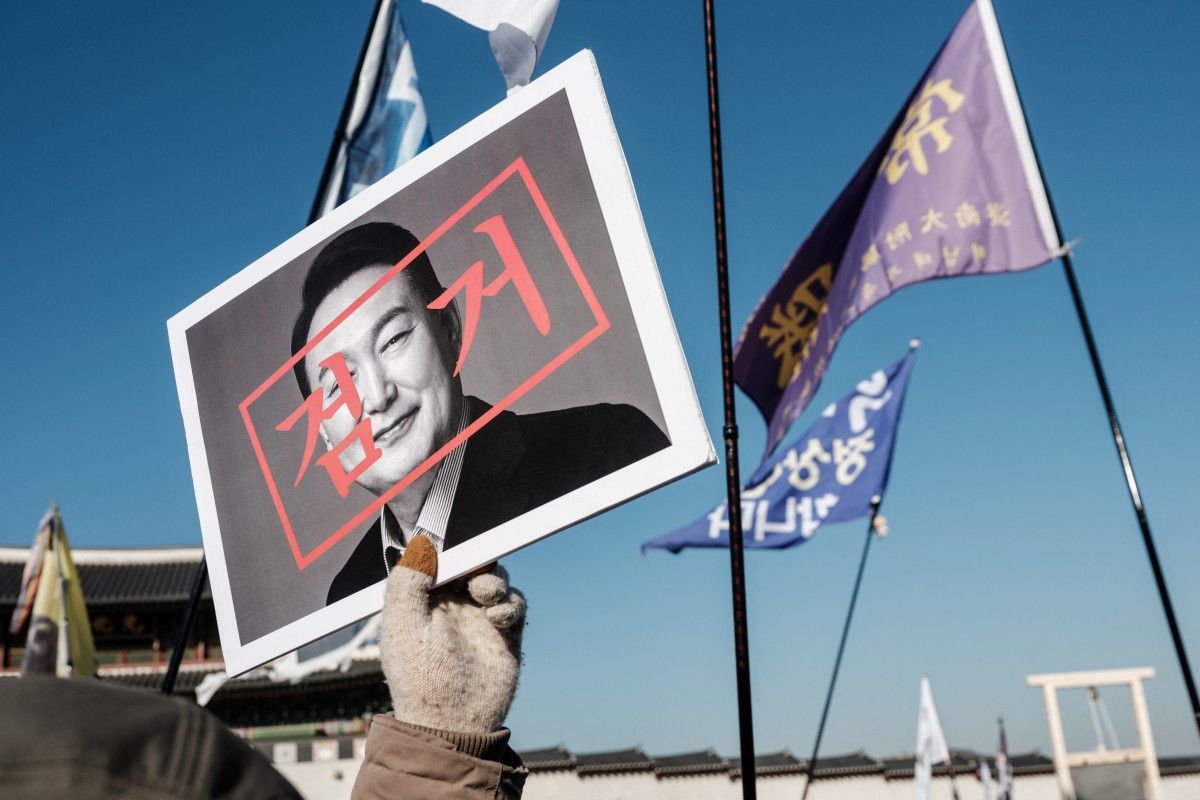
It was late on a cold Tuesday in December 2024 when everything changed. People were just getting ready for bed, scrolling through their phones, or finishing up work. Then, the screen went dark. A somber Yoon Suk Yeol appeared. He looked tired but resolute. In a move that felt like a relic from a 1970s military handbook, he declared "emergency martial law."
The justification? He claimed he was protecting the country from "anti-state forces" and North Korean sympathizers. Honestly, the country was stunned.
For about six hours, South Korea sat on a knife’s edge. Troops landed on the roof of the National Assembly. Soldiers with rifles walked the halls of democracy. But the people didn't stay home. They flooded the streets, and lawmakers literally climbed fences to get into the building to vote the decree down. That night didn't just end a decree; it effectively ended a presidency.
The Chaos That Led to the Yoon Suk Yeol Impeachment
You can't talk about the Yoon Suk Yeol impeachment without talking about that specific brand of political desperation. Yoon was a star prosecutor who became president in 2022. He was supposed to be the "law and order" guy. Instead, he ended up in the middle of a constitutional crisis that many experts, like Raphael Rashid and those at the Korea Economic Institute of America, now call a "self-coup."
What most people get wrong is thinking the impeachment happened overnight.
It was a process. After the martial law debacle, the National Assembly didn't wait. They filed an impeachment motion almost immediately. The first attempt actually failed because of a boycott by the People Power Party (PPP). But the public pressure was immense. Protests in Seoul didn't stop. By December 14, 2024, the second motion passed with 204 votes.
Why the Constitutional Court Was the Real Battleground
Once the Assembly votes, the president is suspended, but not gone. The case moves to the Constitutional Court. This is where things got really technical and, frankly, pretty messy.
The court had to decide if Yoon’s actions were a "serious violation" of the law. They looked at five specific acts:
- Using the military to block lawmakers.
- Ordering the arrest of political rivals like Lee Jae-myung.
- Attempting to muzzle the press.
- Declaring martial law without a genuine national emergency (like an actual war).
- Deploying drones over North Korea to try and provoke a response as a pretext.
On April 4, 2025, the court delivered a unanimous 8–0 verdict. They didn't just remove him; they scorched his legacy. The justices called his actions a "betrayal of public trust."
Life After the Presidency: Trials and the Death Penalty
Fast forward to right now, January 2026. If you thought the impeachment was the end of the story, you've missed the most dramatic part. Yoon isn't just a former president living in quiet retirement. He is a man on trial for his life.
Just a few days ago, on January 13, 2026, prosecutors did something that sent shockwaves through the region. They demanded the death penalty for Yoon Suk Yeol.
Think about that.
South Korea hasn't actually executed anyone since 1997. It is "abolitionist in practice." Yet, the special counsel, led by Cho Eun-suk, argued that the charge of insurrection—of trying to overturn the very foundation of the state—is so grave that only the maximum sentence fits.
The Scene in the Courtroom
The trial at the Seoul Central District Court has been intense. Yoon doesn't look like a defeated man. He still fights. During a 90-minute statement recently, he called the prosecutors "a pack of wolves." He laughed off the idea that he was a mastermind, famously saying, "How could someone like me, an idiot, even attempt a coup?"
It's a bizarre defense. One minute he’s a patriot protecting the country, the next he’s claiming he wasn't "politically savvy" enough to pull off a dictatorship.
Meanwhile, the country has moved on under President Lee Jae-myung, who won the snap election in June 2025. But the shadow of the Yoon Suk Yeol impeachment still looms over the economy and South Korea's relationship with the US.
What Most People Miss About the Legal Fallout
There are actually eight separate trials happening. It's a legal avalanche.
- The Insurrection Case (The big one).
- Abuse of power regarding a Marine's death investigation.
- Election law violations.
- Corruption and bribery allegations involving his inner circle.
People often ask: will he actually be executed? Most legal experts say no. Even if the court hands down a death sentence on February 19, 2026—the scheduled verdict date—it will likely be commuted to life in prison. That’s what happened to former military dictators Chun Doo-hwan and Roh Tae-woo back in the 90s.
History in Korea has a way of repeating itself, but with a modern, digital twist.
The Economic and Social Price Tag
This wasn't just a political drama. It hit people's pockets. When the Yoon Suk Yeol impeachment was in full swing, the won tanked. Investors got spooked.
For months, the country was essentially leaderless. Prime Minister Han Duck-soo was the acting president, but he was also facing impeachment threats and legal hurdles. It was a vacuum. While the world was dealing with trade wars and new tariffs from the US, South Korea was busy trying to figure out if its soldiers were going to arrest its parliament.
Actionable Insights for Following the Verdict
If you are tracking this case, keep your eyes on February 19. That is the "Judgment Day" for the insurrection charges. Here is how to stay informed without getting lost in the noise:
- Watch the Constitutional vs. Criminal distinction. The impeachment (which happened in April 2025) was about removing him from power. The current trials are about putting him in prison (or worse).
- Follow the Special Counsel reports. These are more reliable than the partisan bickering you see on social media.
- Check the precedents. Look up the 1996 trials of Chun and Roh. The legal framework being used against Yoon is almost identical.
The Yoon Suk Yeol impeachment serves as a massive stress test for democracy. It showed that even if a leader tries to use the military to stay in power, the systems—the courts, the parliament, and the people on the street—can hold firm. It's a messy, loud, and sometimes scary process, but it’s how the law works when the stakes are as high as they get.
To stay updated on the specific legal rulings, you should monitor the official releases from the Seoul Central District Court and the South Korean Ministry of Justice. The final verdict on the insurrection charges is expected to be a landmark moment in Asian political history, potentially redefining the limits of executive immunity for decades to come.