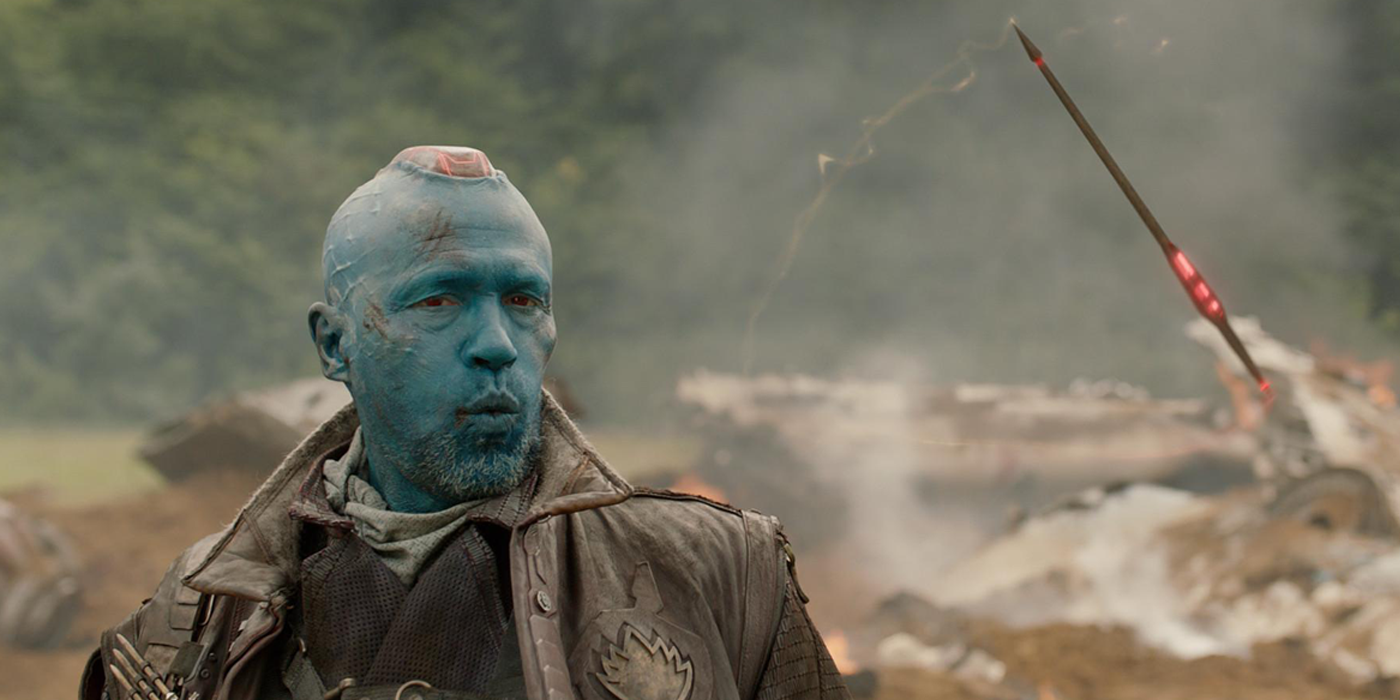
He wasn't supposed to be the hero. When we first met Yondu Udonta in the 2014 Guardians of the Galaxy, he was basically a space pirate with a bad attitude and a glowing arrow. He was the guy who kidnapped Peter Quill from Earth, threatened to eat him, and spent most of the movie chasing the protagonists for a payday. He was a secondary antagonist, a blue-skinned scumbag from the Ravagers who valued "units" over people.
Then Vol. 2 happened.
Suddenly, the guy with the metal fin became the emotional heartbeat of the entire Marvel Cinematic Universe. If you ask a fan today who the most complex character in the franchise is, Yondu is usually in the top three. It’s a wild arc. James Gunn took a character who, in the original 1969 comics, was a noble, bow-wielding mystic from the planet Centauri-IV and turned him into a gritty, redemptive father figure. Honestly, it’s one of the best character pivots in modern cinema history. Michael Rooker’s performance didn't just add depth; it redefined what we expect from a "supporting" role.
The Ravager Code and the Fall from Grace
To understand Yondu, you have to look at the Stakar Ogord situation. Sylvester Stallone’s cameo wasn't just fan service. It established the lore. Yondu wasn't always a freelance jerk; he was a high-ranking Ravager who broke the most sacred rule of the guild: he trafficked children.
Ego the Living Planet hired him to pick up his various offspring from across the galaxy. Yondu did it. He didn't ask questions. But when he realized Ego was murdering these kids, he stopped. He kept Peter. That one act of conscience cost him everything. He was exiled, stripped of his colors, and lost the respect of his peers.
- He lived in shame for decades.
- He hid his soft heart behind a facade of "I’m gonna eat you, boy."
- He let his crew think he was weak for keeping Quill because he couldn't admit he was trying to save a life.
That’s a heavy burden. It’s why he’s so prickly. Imagine living every day knowing you helped a celestial serial killer, and the only way to make it right is to raise one of his kids in the most dangerous environment imaginable. He chose to be a "bad" father to Peter to keep him from a "perfect" father who was actually a monster.
That Yaka Arrow: More Than Just a Weapon
Let’s talk about the arrow. The Yaka Arrow is technically controlled by a head-mounted cybernetic fin that picks up high-frequency whistles. But as Yondu tells Kraglin, you don't fly it with your head; you fly it with your heart.
That’s not just some cheesy line. It’s the central metaphor for his character.
When Yondu is acting out of greed or spite, the arrow is a tool of destruction. But in the final act of Vol. 2, when he’s fully embraced his role as a protector, the arrow becomes an extension of his soul. It’s graceful. It’s fluid. It wipes out an entire deck of mutineers in a display of power that makes the rest of the Guardians of the Galaxy look like amateurs.
There’s a technical nuance here that many people miss. The fin we see in the first movie is small and low-profile. It gets destroyed. The one he gets later—the big, red, comic-accurate prototype—is more sensitive. It’s a visual representation of him returning to his roots. He’s no longer hiding who he is. He’s a Ravager. A real one.
Why "He Might’ve Been Your Father, Boy, But He Wasn’t Your Daddy" Hits So Hard
This line is arguably the most famous quote in the entire Guardians trilogy. It works because it exposes the lie Peter Quill had been living. Peter spent his life mourning a mother and searching for a father figure, thinking he’d found "perfection" in Ego.
But Ego was a narcissist. Ego wanted an extension of himself.
Yondu was the guy who taught Peter how to shoot, how to fly, and how to survive. He was the guy who stayed. It’s a masterclass in the "Found Family" trope. James Gunn uses Yondu to deconstruct the idea that biology equals destiny. Yondu’s sacrifice at the end of the second film isn't just about saving the universe; it’s a personal correction of his greatest mistake. He gave his life to ensure that at least one of Ego’s children survived.
The Complicated Reality of Michael Rooker’s Performance
You can’t talk about Yondu Udonta without Michael Rooker. Rooker has this unique ability to look like a guy who’s been through a blender but still has a twinkle in his eye. He plays Yondu with a specific kind of "space-redneck" charisma.
Think about the scene where he’s being teased by Taserface’s crew. He’s vulnerable. He’s losing his grip on his men. You see the fear in his eyes, not because he’s afraid of dying, but because he’s afraid of being forgotten. He’s a man who has lost his legacy. Rooker brings a physical weight to the role. Every time he whistles, there’s a sense of effort. It’s not magic; it’s a skill he’s honed over centuries of being a survivor.
What Most People Miss About the Funeral
The Ravager funeral at the end of Vol. 2 is a top-tier MCU moment. The Colors of Ogord. The fireworks. It’s a massive emotional payoff.
But look closer at the faces. You see the original Ravager captains—Aleta Ogord, Charlie-27, Martinex, Krugarr, and Mainframe. These aren't just random aliens; they are the 1969 Guardians of the Galaxy. By giving Yondu this send-off, the movie is bridge-building between the old-school comic history and the modern cinematic world.
It also proves that Yondu was redeemed in the eyes of his gods. He died a hero. He died "right."
Common Misconceptions About Yondu
A lot of people think Yondu was just a mean guy who changed his mind at the last minute. That’s a surface-level take. If you re-watch the first movie, the signs of his affection for Peter are everywhere.
- He smiles when he sees the "troll doll" Peter swapped for the Power Stone.
- He keeps the little trinkets Peter gave him on his dashboard.
- He never actually lets his men eat Peter.
He was always "the good guy" pretending to be a villain because, in the world of space piracy, being soft gets you killed. He was playing a part for twenty years to protect a kid who wasn't even his. That’s commitment.
The Legacy of the Blue Man
Even after his death, Yondu’s presence looms large. In Guardians of the Galaxy Vol. 3 and the Holiday Special, we see the impact he left.
Kraglin inheriting the arrow is a huge plot point. It’s about the struggle of living up to a legend. Kraglin can’t whistle like Yondu because he doesn't have Yondu’s confidence—or his heartbreak. You need the pain to make the arrow fly. It’s also interesting to see how Peter deals with the loss. He goes from a guy searching for his dad to a guy who realizes he already had one, and he lost him.
Actionable Insights for Fans and Creators
If you’re a writer or a fan looking to dive deeper into this kind of character development, there are a few things to take away from how Yondu was handled:
- Embrace the Flaws: Don't make a character "good" immediately. Let them be messy. Let them be wrong. The redemption only works if there’s something to redeem.
- Subtext is Everything: Watch Yondu’s eyes during the scenes where he’s yelling at Peter. He’s often saying one thing but feeling another. That’s what makes a character feel human.
- Visual Storytelling: Notice how his costume changes. He starts in rags and ends in his Ravager finery. Use external changes to signal internal growth.
- The "Daddy" vs. "Father" Distinction: This is a powerful psychological tool in storytelling. One is a biological fact; the other is an earned title. In your own life or your own writing, focus on the earned titles.
Yondu Udonta is the soul of the Guardians franchise. He’s a reminder that no matter how much you’ve messed up, you can still do the right thing when it counts. He might’ve been a thief, a smuggler, and a terrible influence, but in the end, he was the only one who stayed.
To really appreciate the depth of the character, go back and watch the first two films back-to-back. Pay attention to the way he looks at Peter when Peter isn't looking at him. It changes everything. You’ll see a man who was always a father, even when he didn't know how to be one.
Next time you hear that specific whistle, remember it’s not just a weapon. It’s the sound of a man who finally found his heart.
Key Takeaways to Remember:
- Yondu's redemption was planned from the start, signaled by his collection of "Earth junk."
- The Yaka Arrow is a psychological weapon, not just a physical one.
- His exile from the Ravagers was a self-inflicted wound caused by a moral choice.
- He represents the ultimate "Found Family" archetype in the Marvel Cinematic Universe.
Check out the Guardians of the Galaxy Vol. 2 behind-the-scenes features if you want to see Michael Rooker's transformation process. It’s pretty intense. Also, keep an eye on Kraglin’s development in the later films to see how Yondu’s legacy continues to evolve through his surrogate son and his crew.



