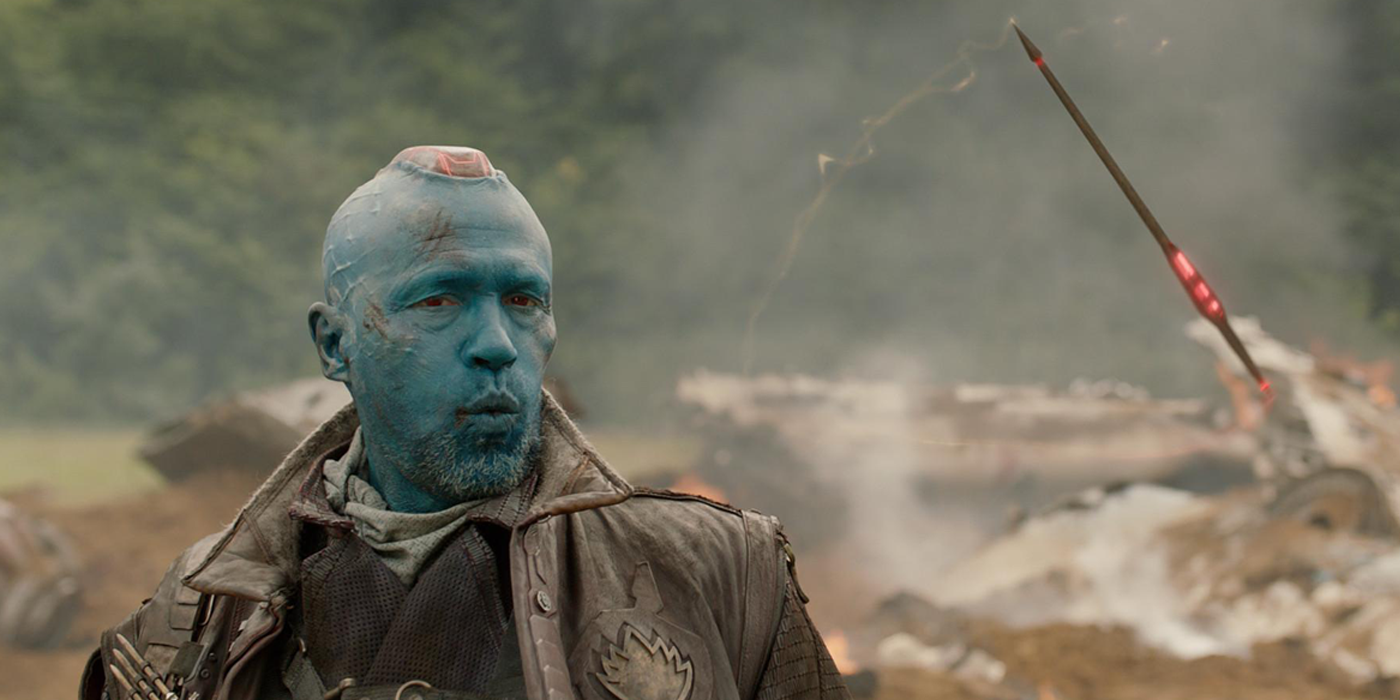
He wasn't supposed to be the emotional core of a multi-billion dollar franchise. When audiences first saw Michael Rooker’s blue-skinned, whistling mercenary in the 2014 debut of Guardians of the Galaxy, he felt like a secondary antagonist. A foil. The guy chasing Peter Quill for a payday. But by the time the credits rolled on the sequel, Yondu Udonta had effectively hijacked the entire emotional arc of the series.
Honestly, it’s a weird legacy.
Yondu is a character defined by contradictions. He’s a child trafficker who became a father. He’s a ruthless Ravager who turned out to be a softie. Most importantly, he’s the guy who proved that "family" in the Marvel Cinematic Universe isn't about blood—it’s about who shows up when the vacuum of space is trying to kill you.
The Ravager Reality: He Was Never Just a Villain
Most people forget that Yondu’s history in the comics is radically different from the movies. In the original 1969 Guardians lineup, he was a noble primitive from Centauri-IV. James Gunn threw all of that out. He kept the fin and the arrow but turned Yondu into a gritty, space-faring biker with a thick Southern drawl.
It worked.
The MCU version of Yondu is a high-ranking member of the Ravagers, specifically the leader of his own clan. But there’s a massive stain on his record. He was exiled by Stakar Ogord (played by Sylvester Stallone) because he broke the Ravager code. He trafficked children. Specifically, he delivered the offspring of Ego the Living Planet back to their father, knowing full well those kids weren't coming back.
That’s dark. Like, actually dark for a Disney-owned property.
When he got to Peter Quill, something shifted. He claims he kept Peter because he was "skinny" and could fit into tight spaces for thieving, but we all know that’s a lie he told to keep his tough-guy reputation intact among his crew. He saw a kid who was about to be murdered by a celestial ego-maniac and decided, for the first time in his life, to say no.
The Yaka Arrow: More Than Just a Cool Trick
Let's talk about the whistle.
The Yaka Arrow is arguably one of the most overpowered weapons in the entire MCU. It’s controlled via a high-frequency whistle, reacting to the user's emotional state rather than just physical commands. This is why Kraglin struggles with it at first; it’s not about the tune, it’s about the intent.
There is a specific scene in Guardians of the Galaxy Vol. 2—the escape from the Ravager ship—that serves as a masterclass in action choreography. Set to "Come a Little Bit Closer," Yondu wipes out an entire small army with a single piece of flying metal. It’s effortless. It’s beautiful. It’s terrifying.
But notice the nuance Michael Rooker brings to it. He isn't laughing. He’s focused. There’s a weariness to his violence. By this point in the timeline, Yondu is a man who has lost his crew, his status, and his "father," Stakar. The arrow is his only remaining connection to his culture, and he uses it with a surgical, almost mournful precision.
Why "He Might've Been Your Father, Boy, But He Wasn't Your Daddy" Hit So Hard
This is the line. The one that launched a thousand memes and made grown men cry in IMAX theaters.
To understand why this works, you have to look at the contrast between Ego and Yondu. Ego is a literal god. He’s handsome, powerful, and offers Peter the universe. But Ego is a narcissist who saw Peter as an extension of himself—a tool.
Yondu was a mess. He yelled. He threatened to eat Peter. He was a terrible role model in almost every traditional sense. But when it mattered, he was the one who actually raised him. He taught him how to survive. He taught him how to fly.
The sacrifice at the end of the second film isn't just a plot point. It’s the completion of a redemption arc that started decades prior when he decided not to hand Peter over to Ego. When Yondu gives Peter the only remaining aero-rig and oxygen mask, he’s making a choice to end his own story so Peter’s can continue. It’s the ultimate "dad" move.
The Mary Poppins Moment and the Power of Genuine Acting
"I'm Mary Poppins, y'all!"
It’s a funny line, sure. But look at the context. Peter tells him he looks like Mary Poppins—a character Yondu has never heard of—and tells him he's "cool." Yondu’s reaction is pure, unadulterated joy. For a second, the hardened criminal disappears.
This is where the casting of Michael Rooker was a stroke of genius. Rooker has spent a career playing creeps and tough guys (Henry: Portrait of a Serial Killer, The Walking Dead). Seeing that specific actor lean into vulnerability creates a layer of "human" quality that CGI-heavy movies often miss. You believe his pain because you’ve seen him be a monster.
What the Fans Get Wrong About His Return
Ever since his death, there have been rumors about Yondu returning. Fans want him back. They want a prequel. They want a multiversal variant.
James Gunn has been very vocal about this: bringing Yondu back to life in the main timeline would cheapen his sacrifice. Death has to matter. In a cinematic universe where characters frequently "die" only to return two movies later (looking at you, Loki and Gamora), Yondu’s permanent absence is what gives the Guardians trilogy its weight.
Even in Volume 3, his "appearance" is a brief, spectral hallucination or memory for Kraglin. It serves a purpose—to remind Kraglin to trust his heart—but it doesn't undo the tragedy of the second film. That is how you handle a legacy character.
Actionable Takeaways for Fans and Collectors
If you’re looking to dive deeper into the lore of the Ravagers or want to celebrate the character, there are a few things you should actually do rather than just re-watching the movies for the tenth time.
- Read the 2016 Star-Lord comic run: It provides a much more grounded look at the early days of Peter and Yondu’s relationship, showing the rough-around-the-edges "parenting" that the movies only hint at.
- Check out the 1969 Guardians of the Galaxy: If you want to see the "Original Yondu," look for Marvel Super-Heroes #18. It’s a trip to see how much the character has evolved from a bow-and-arrow mystic to a space pirate.
- Analyze the soundtrack lyrics: James Gunn didn't pick the songs at random. "Father and Son" by Cat Stevens playing during Yondu's funeral is perhaps the most literal and devastating use of a licensed track in MCU history. Listen to the lyrics while thinking about Yondu’s perspective, not Peter’s.
- Look for the Ravager badges: If you're a prop collector or cosplayer, realize that there are different designs for different clans. Yondu’s specific flame-like sigil represents a history he was desperate to reclaim, which he finally did posthumously when the other Ravagers showed up for his funeral.
Yondu Udonta wasn't a perfect man. He wasn't even a particularly good man for most of his life. But he was a real one. In a galaxy filled with talking raccoons and sentient trees, he was the most human character on the screen. He proved that your past doesn't have to define your end, and that sometimes, the best fathers are the ones who didn't know they wanted the job in the first place.
To really appreciate the depth of the character, pay attention to his eyes in the scenes where he isn't speaking. The regret is always there, right beneath the blue paint. That's not just "superhero movie" acting; that's a character study. And that is why, years later, we're still talking about him.
Next Steps for Deep Diving into the Lore
To truly grasp the impact of the character's journey, go back and watch the first film specifically looking for the "lies" Yondu tells. Every time he threatens Peter, look at his crew's reaction versus his own. You’ll see a man performing a role to keep his people safe while protecting the "son" he isn't allowed to admit he loves. It changes the entire tone of the franchise from a comedy to a tragedy with a very hopeful ending.
Once you've done that, track down the behind-the-scenes footage of the "Colors of the Ravagers" funeral scene. Understanding the technical work that went into that sequence—the practical lighting and the number of extras involved—makes the emotional payoff of the "loyal Ravager" send-off even more satisfying. It wasn't just a send-off for a character; it was a tribute to Michael Rooker's contribution to the heart of the Marvel Cinematic Universe.
Check out the official Marvel databases for the Centaurian race if you want the "hard sci-fi" explanation for his biology, but remember that the MCU version prioritizes the emotional truth over the alien physiology. That’s what makes him stick. He’s a blue alien with a magic arrow, but his heart is something anyone who has ever had a complicated relationship with a parent can understand.



