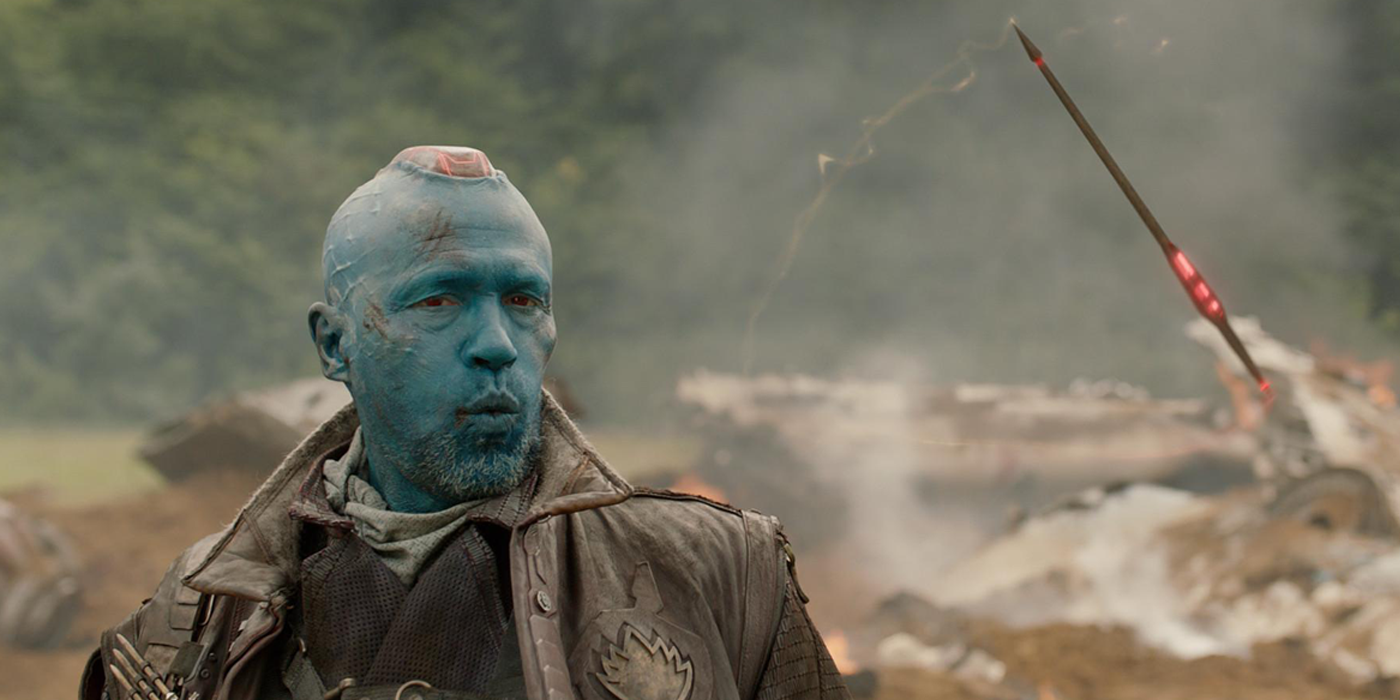
He isn't the guy you’re supposed to like at first. Seriously. When we first meet Yondu in Guardians of the Galaxy, he’s basically a space pirate with bad teeth and a glowing red fin who’s threatening to eat the protagonist. Not exactly "Father of the Year" material. But if you look at the trajectory of the Marvel Cinematic Universe, specifically James Gunn’s corner of it, Yondu Udonta isn't just a sidekick or a secondary villain. He’s the emotional glue. Without him, Peter Quill is just another guy with daddy issues and a walkman.
Blue skin. Red arrow.
That Yaka Arrow is one of the coolest weapons in cinema history, honestly. It’s controlled by high-octave whistling and can tear through a whole squad of Sakaarans or Ravagers in seconds. But the arrow is just a tool. The real story of Yondu in Guardians of the Galaxy is about a guy who spent his whole life being a "jackass"—his words—only to realize he had a soul right before it was too late. It’s heartbreaking. It’s messy. It’s human, even if he’s a Centaurian.
The Ravager Code and Why He Kept Peter
Most people forget that Yondu was actually exiled from the greater Ravager community. Stakar Ogord, played by Sylvester Stallone, kicked him out because Yondu broke the code. What was the crime? He was trafficking children for Ego the Living Planet. It’s a dark backstory. It makes Yondu a complicated figure because he wasn’t always the hero. He was a guy doing dirty work for money until he realized what happened to those kids.
He saw what Ego was doing. He knew if he delivered Peter Quill to his father, the kid was dead.
So he kept him. He told Peter he kept him because he was "skinny and could fit into tight places" for thieving, but that was a lie. It was a protective cover. Yondu raised Peter in a world of violence and theft because it was the only world he knew, but he also kept him away from a celestial god who would have consumed him.
That Infamous Whistle: The Yaka Arrow Explained
Technically, the arrow is made of Yaka metal, which is native to the planet Centauri-IV. It’s sound-sensitive. In the first film, we see it as a symbol of terror. By Guardians of the Galaxy Vol. 2, it becomes a symbol of liberation. Remember the "Come a Little Bit Closer" sequence? It’s one of the most stylishly directed scenes in the MCU.
Yondu, Rocket, and Baby Groot are escaping a Ravager ship, and the arrow just dances through the air. It’s effortless.
But there’s a nuance here that gets missed: the fin. In the first movie, the fin is small, almost flush with his head. After the mutiny led by Taserface (god, what a terrible name), Yondu’s fin is destroyed. He has Groot retrieve a prototype fin—the big, tall, red one that looks more like his comic book counterpart. This isn't just a costume change. It’s Yondu embracing his true self. He’s no longer hiding his power or his leadership. He’s the captain again.
"He Might Have Been Your Father, Boy, But He Wasn't Your Daddy"
This is the line. The one that wrecked everybody in the theater.
In the climax of the second film, Yondu makes the ultimate sacrifice. He gives Peter the last remaining aero-rig and stays behind as Ego’s planet explodes. He chooses to die so his "son" can live.
It recontextualizes every interaction they had in the first movie. All those threats about the crew wanting to eat Peter? That was Yondu protecting Peter from the crew. He had to act tough to keep the other Ravagers from turning on the human kid. It’s a classic "tough love" trope pushed to the cosmic extreme. Michael Rooker plays this with so much grit; you can see the regret in his eyes even when he’s yelling.
Why the Fans (and Google) Still Obsess Over Him
Even though he died in 2017, the impact of Yondu in Guardians of the Galaxy hasn't faded. Why?
- Redemption: He’s a character who actually pays for his sins. He doesn't just get a "get out of jail free" card; he gives his life.
- Aesthetics: The blue skin against the neon colors of the Ravager ships is visual candy.
- The Mary Poppins Bit: It’s a meme, sure, but it showed a moment of pure, unadulterated joy in a character who was usually cynical. "I'm Mary Poppins, y'all!" is arguably the most famous line in the franchise.
James Gunn has been very vocal about not bringing Yondu back to life in the main timeline. He feels that death should mean something. While we saw a version of him in the Holiday Special (animated) and a brief Kraglin-induced vision in Vol. 3, the character’s arc is complete. It’s a rare bit of narrative discipline in a genre that loves resurrections.
The Cultural Impact of the Ravager Funeral
The end of the second movie features the "Colors of Ogord." It’s one of the most emotional moments in the MCU. Seeing all the Ravager factions show up to honor the man they previously shunned proved that Yondu had finally earned back his honor. He died a Ravager. He died a Guardian.
Honestly, the way the fireworks light up the sky while Cat Stevens’ "Father and Son" plays is a masterclass in manipulation. It works every time.
What You Can Learn from Yondu’s Arc
If you're a writer or a fan of storytelling, Yondu is a case study in "Show, Don't Tell." We aren't told Yondu loves Peter until the very end. We see it in how he avoids capturing him. We see it in how he smiles when he finds the troll doll Peter left for him in the first movie.
- Look for the subtext in the first film. Watch the scenes where Yondu interacts with Peter again. Notice how he never actually lets the Ravagers hurt him.
- Analyze the "Finn" evolution. The transition from the low-profile fin to the prototype is a visual metaphor for his return to glory.
- Appreciate the practical effects. Michael Rooker spent hours in the makeup chair. That blue isn't CGI. It adds a layer of reality to the performance that fully digital characters often lack.
The legacy of Yondu in Guardians of the Galaxy is one of complicated fatherhood. He wasn't perfect. He was a thief, a smuggler, and a kidnapper. But in the moments that mattered, he was a hero. He taught Kraglin how to lead. He taught Peter how to love. And he showed the audience that your past doesn't have to define your end.
To really understand the weight of his character, go back and watch the scene in the first movie where he first uses the arrow on the Xandar soldiers. Then watch his funeral. The distance between those two versions of the character is what makes great cinema. He went from a terrifying force of nature to a beloved, flawed father figure. That’s why we’re still talking about him years later.
To dive deeper into the lore, check out the Guardians of the Galaxy comic runs by Dan Abnett and Andy Lanning, though be warned: the comic version of Yondu is quite different from the Michael Rooker version. The MCU version is a unique creation that blends the original 1969 character with something entirely new and much more grounded in the theme of found family.
Next Steps for Fans:
- Re-watch Guardians of the Galaxy Vol. 2 specifically focusing on the background Ravager characters like Kraglin to see how they react to Yondu’s leadership.
- Listen to the "Awesome Mix Vol. 2" and pay attention to how "Father and Son" and "Brandy (You're a Fine Girl)" mirror the relationship between Peter, Ego, and Yondu.
- Look for the Yondu Easter eggs in the Avengers Campus at Disney Parks, where his legacy is still celebrated through "The Collector’s" artifacts.



