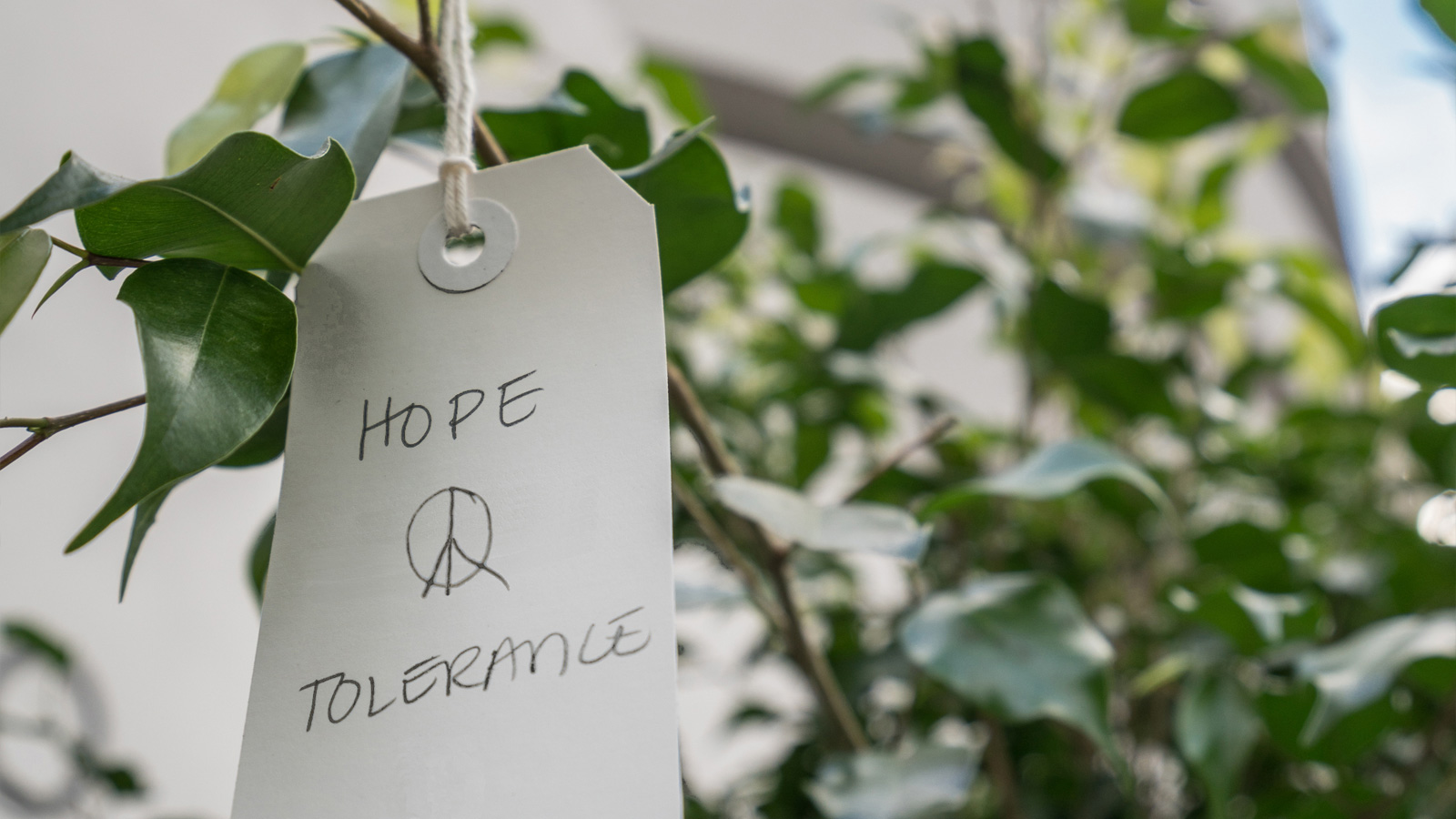
You’re walking through a museum or a public park and you see it. A tree—maybe a dogwood in DC or an olive tree in London—covered in hundreds of fluttering white tags. From a distance, it looks like it’s blooming out of season. Up close, it’s a chaotic, beautiful mess of handwriting. These are the Yoko Ono Wish Trees.
Honestly, most people think it’s just a cute photo op. They scribble a wish, tie it to a branch, and walk away. But there is a massive, global machinery behind these trees that most visitors never see. It isn’t just about the moment you tie that string. It is a decades-long project involving millions of people and a literal tower of light in the middle of the North Atlantic.
Where the wishes actually go
Ever wonder what happens when the museum exhibit ends? The curators don't just toss those tags in the trash. That would be a PR nightmare, sure, but it would also violate the "instruction" of the art.
Yoko Ono is a conceptual artist. For her, the "art" isn't the tree itself. It’s the action. Since 1996, every single wish—over two million of them now—is harvested. They get packed up and shipped to Iceland. Specifically, they go to the Imagine Peace Tower on Viðey Island, just off the coast of Reykjavík.
She doesn’t read them. She’s been very clear about that to protect people’s privacy. Instead, they are stored in capsules and buried at the base of this tower, which is essentially a giant wishing well that beams a pillar of light into the sky. It’s wild to think about. Your secret wish for a new job or world peace or for your ex to stop calling is literally powering a monument in the Arctic Circle.
The childhood memory behind the branches
To understand why she does this, you have to go back to her childhood in Japan. Yoko used to go to local temples and shrines. She’d write a wish on a thin slip of paper and tie it to the branch of a bush or tree.
"Trees in temple courtyards were always filled with people’s wish knots, which looked like white flowers blossoming from afar."
She’s basically been trying to recreate that visual of "white flowers" for the last thirty years. The project officially kicked off in 1996, but the seeds were planted way back in her early Fluxus days in the 60s. She loves "instructional art"—pieces where the viewer has to do something to make the art exist. Without your wish, the tree is just a tree.
It’s more than just one type of tree
People often ask, "What kind of tree is it?" The answer is basically whatever works locally. Yoko usually specifies native trees.
- In Washington, D.C., at the Hirshhorn, it’s a Japanese Flowering Dogwood.
- In Venice, she used olive trees.
- In Sydney, they used eucalyptus.
- For her 92nd birthday in New York (early 2025), she filled the Park Avenue Armory with a grove of 92 Magnolia and Cedar trees.
It’s a logistical mountain. You have to find trees that can handle the weight of thousands of paper tags. In the winter, the installations often stop because the trees are too vulnerable. It’s a living sculpture, which means it’s temperamental.
The "Mini-Forest" incident
There’s a great story from her 1999 installation in Finland. Originally, it was supposed to be a single tree. But the response was so overwhelming that the "wish" became larger than the branches could hold. People kept coming. They had to keep adding trees until it turned into a mini-forest.
That’s when Yoko realized this wasn't just a gallery piece. It was a "social need." People are desperate for a place to put their hopes where they won't be judged.
How to do it "right" (even from home)
You don't actually have to find a museum to participate in the Yoko Ono Wish Trees project. While the physical installations are the most famous version, the "instructions" are open-source.
- Find a tree. It can be in your yard or even a sturdy houseplant.
- Write it down. Use a small piece of paper or cardstock.
- Tie it. Use string or ribbon.
- The most important part: Ask a friend to do the same. The project is built on the idea of "collective power."
If you want your wish to actually make it to Iceland but can't find a tree, you can literally mail it. People send envelopes full of tags to P.O. Box 1009, 121 Reykjavik, Iceland. You can even email them to the Imagine Peace website, and they’ll "store" them digitally or print them for the tower.
Why it still matters in 2026
We live in a pretty cynical time. A paper tag on a tree feels... flimsy. But there is something deeply human about the physical act of writing. In a world of digital noise, taking thirty seconds to focus on one specific hope and tying it to a living thing is a grounding exercise.
It’s not just "hippy stuff." It’s an archive of human desire. When those wishes are buried in Iceland, they become a time capsule of what we wanted in the early 21st century. Most of us just want to be okay. Most of us want the people we love to be safe.
If you happen to pass one of these trees this year, don't just take a selfie. Take a tag. Write the thing you're afraid to say out loud. Tie it tight. Your words might end up under a beam of light in the North Atlantic, and honestly, that's a lot better than just leaving them in your head.
Actionable next steps
- Check local listings: Major museums like MoMA in New York or the Tate in London frequently host temporary Wish Tree installations.
- The Mail-In Option: If you have a wish that feels heavy, write it down and mail it to the Reykjavik P.O. box mentioned above. It’s a surprisingly cathartic ritual.
- Visit the Tower: If you’re ever in Iceland, the Imagine Peace Tower is lit from October 9 (John Lennon’s birthday) through December 8. It is one of the few places where you can feel the physical scale of two million people's collective hopes.



