If you’re hunting for a yogi berra signed photo, you’ve probably noticed something weird. You can find one for 75 bucks on eBay, but then you see another one—looking almost identical—listed for $600 at a high-end auction house. It’s enough to make your head spin. Honestly, the market for Yogi’s ink is one of the most misunderstood corners of the hobby.
People think because he was a "good signer" who never turned down a fan, his stuff isn't worth much. That's a mistake. While he was incredibly generous with his time, the "Yogi Berra" we see on a glossy 8x10 today isn't the same as the "Lawrence Berra" who signed scraps of paper in the 1940s.
Basically, you’re not just buying a signature. You're buying a specific era of Yankees history.
The Larry vs. Yogi Problem
Most folks don't realize that before he was the king of "Yogisms," he was just Larry. If you find a vintage 1940s shot where he signed "Larry Berra," you’ve basically hit the jackpot. Around 1950, he made the switch. He started signing "Yogi" almost exclusively because that's what the world called him.
A yogi berra signed photo from his active playing days is a different animal than the stuff he signed at card shows in the 90s.
Collectors crave the "on-site" feel. A black-and-white photo of Yogi jumping into Don Larsen’s arms after the 1956 perfect game? That’s the gold standard. If that signature is bold, blue, and hasn't faded into a ghostly gray, you’re looking at a piece that holds its value even when the rest of the market dips.
Spotting the Fake (It’s Harder Than You Think)
Yogi signed a lot. Like, a lot. Because he was so approachable, there are thousands of genuine examples out there, but that also gave forgers a massive "data set" to practice on.
Here’s the thing: Yogi’s signature was remarkably consistent for sixty years. It wasn't the most elegant—definitely not like the flowing script of Ted Williams—but it was legible.
- The "Y" Factor: Look at the way the "Y" in Yogi starts. It usually has a specific, slightly shaky loop that feels natural, not forced.
- Ink Flow: In the 2000s, his signature got a bit more "heavy." He was older. If you see a photo from 1950 with a signature that looks like it was signed by a 20-year-old with a modern Sharpie, run away.
- The Secretarials: Sometimes, the Yankees' front office or even his family members would sign for him during his playing days. These "secretarial" signatures are the bane of a collector's existence. They look too perfect.
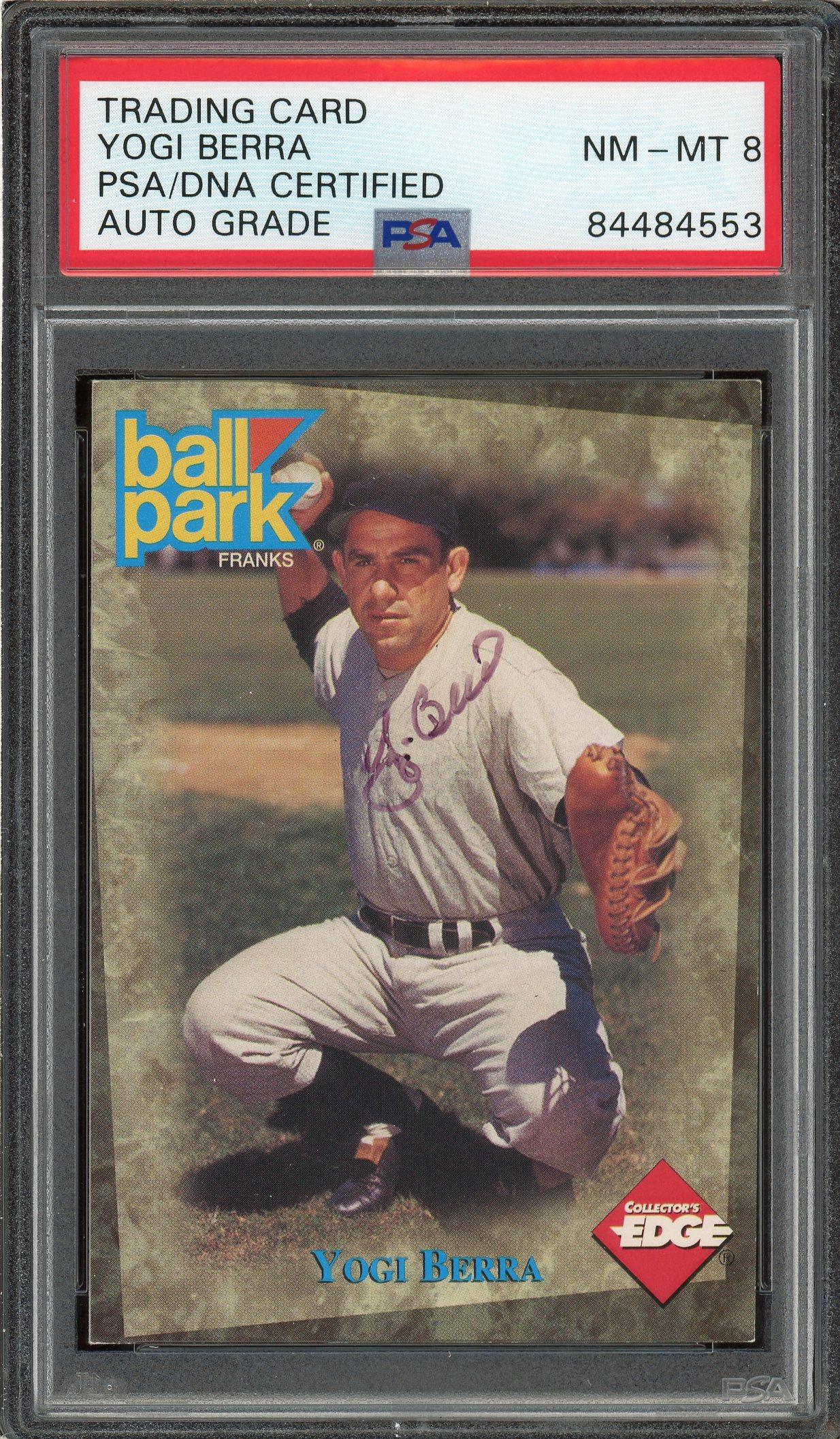
I’ve seen guys get burned because they bought a photo that had a "COA" from a company nobody’s ever heard of. If it doesn’t have a sticker from PSA/DNA, JSA (James Spence), or Beckett (BAS), it’s just a piece of paper. Period.
What’s It Actually Worth in 2026?
Let’s talk brass tacks. Prices have shifted lately. In 2026, a standard, authenticated yogi berra signed photo (8x10) usually moves for between $120 and $250.
But wait.
If it’s a 16x20 "Farewell to Yankee Stadium" shot or one with a rare inscription like "It ain't over till it's over," the price leaps. I recently saw a dual-signed photo of Yogi and Don Larsen sell for well over $1,100. Why? Because you’ve got two legends on one piece of history.
Condition is everything. A photo with "minor dings" or a signature that's starting to bleed into the background might only fetch $70. Don't be the person who buys a damaged photo thinking it's a "steal." It’s just a hard-to-resell item.
The Inscription Trap
Sometimes you’ll see "HOF 72" or "3x MVP" added. These are great. They add character. But be careful with "Yogisms." Yogi didn't always write those out himself; sometimes fans would ask, and if he was tired, he'd just sign the name. If the handwriting of the quote doesn't match the signature, you’ve got a "Frankenstein" item.
Where to Buy Without Getting Scammed
Honestly, stay off the deep corners of Facebook Marketplace unless you really know your stuff.
Steiner Sports used to be the go-to for Yogi because they had an exclusive deal with him for years. You can still find "Steiner Authenticated" pieces all over the secondary market. They are generally considered "ironclad" in the hobby.
Pristine Auction and Heritage are also solid bets. You’ll pay a buyer’s premium (usually around 20%), but you won’t wake up in three years realizing your prized possession was signed by a guy named Steve in a basement.
Your Next Steps for a Smart Purchase
If you're ready to pull the trigger on a yogi berra signed photo, don't just click "Buy It Now" on the first thing you see.
First, decide on your "display goal." Are you looking for a centerpiece for a home office, or just a small memento? A framed 8x10 is the classic choice.
Second, verify the cert number. If the seller provides a PSA or JSA number, go to their website and plug it in. If the description on the site says "Signed Baseball" but the seller is holding a photo, you're looking at a swap scam.
Finally, check the ink. Avoid "bubblegum" signatures where the ink has beaded up on a glossy photo. You want a signature that looks like it’s part of the image, usually signed with a blue felt-tip pen that has deep, consistent color.
Once you have those three things squared away, you’re not just buying memorabilia. You’re holding a piece of the winningest career in baseball history.
Stay focused on the "Big Three" authenticators (PSA, JSA, Beckett) and always prioritize the "action shots" over the static portraits if you want the value to hold up over the next decade.
For the most secure investment, look for Steiner-hologrammed pieces from the early 2000s, as these represent the most documented period of his signing career.
Check the photo’s corners for silvering or "crazing," which can happen to older prints, and ensure the signature hasn't been placed over a dark area of the photo where it's hard to read.
Stick to these rules and you'll end up with a Hall of Fame piece that actually belongs in a Hall of Fame.