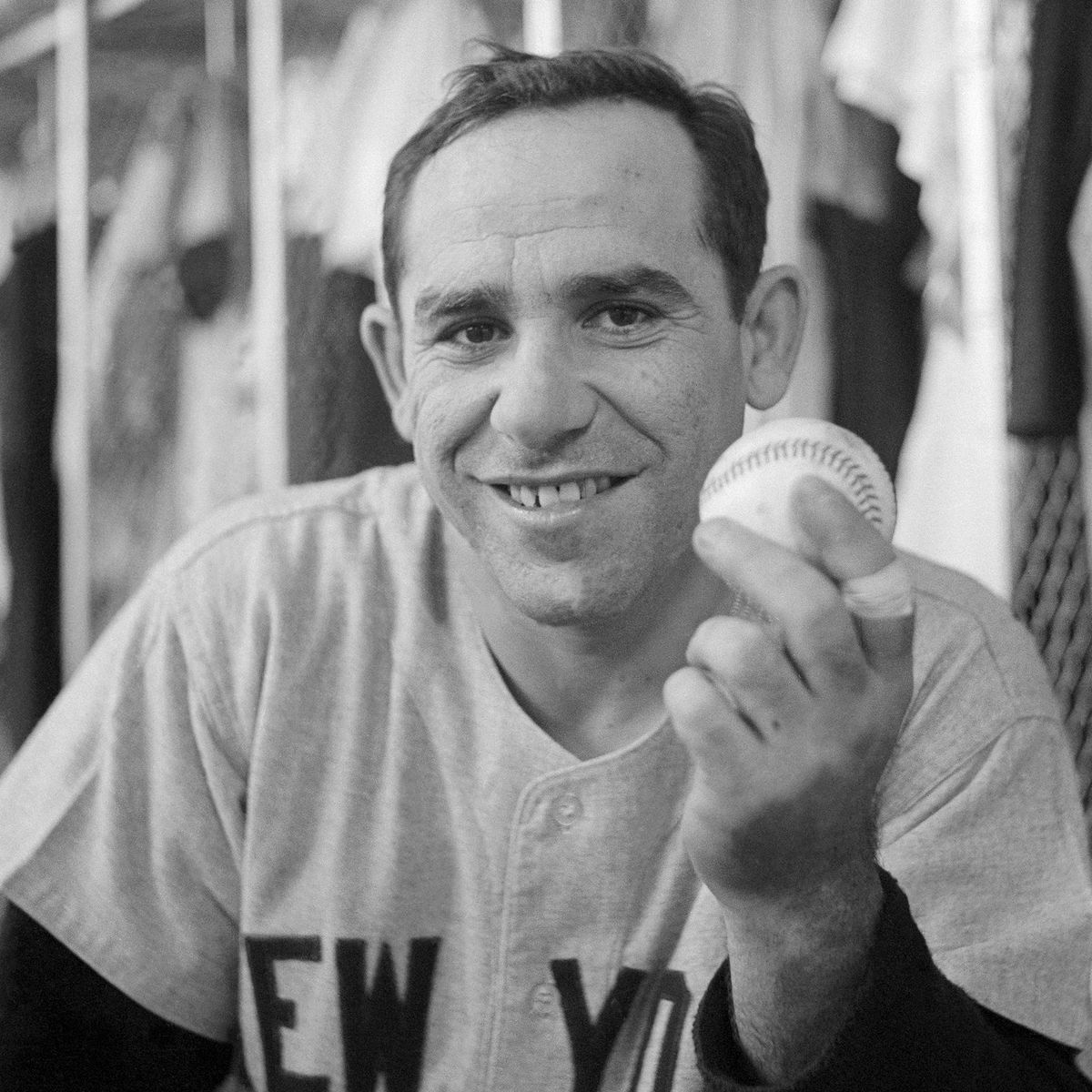
Honestly, if you ask a casual baseball fan about Yogi Berra, they start quoting him. You know the drill. "It ain't over till it's over." "It’s like déjà vu all over again." The guy was a philosopher in a chest protector. But for those of us who spend our weekends digging through dusty cardboard at card shows or scrolling through eBay until our eyes bleed, Yogi is more than just a quote machine. He is a 10-time World Series champion as a player. He’s a three-time MVP.
Yet, there is this weird, specific niche in the hobby that feels like a secret handshake: the Yogi Berra manager card.
Most people want the 1948 Bowman rookie. Sure, it’s iconic. It’s expensive. But the manager cards? They tell the story of a man who simply refused to leave the dugout. They capture the transition from the "Bad Ball Hitter" to the guy leading the 1964 Yankees and the 1973 "Ya Gotta Believe" Mets. These cards are quirky, sometimes strangely designed, and—in my humble opinion—wildly undervalued compared to his playing-day classics.
The 1964 Topps #21: The "Mistake" That Started It All
The 1964 Topps Yogi Berra manager card is, for lack of a better word, jarring.
You have to remember the context here. Yogi had basically been the face of the Yankees for nearly two decades. Then, suddenly, in '64, he’s on a card and he isn't wearing a mask. He isn't squatting behind the plate. He’s standing there in a suit—or sometimes that classic pinstriped home jersey—but the card clearly says "MANAGER" at the bottom.
It feels wrong. Like seeing your teacher at the grocery store.
This card is technically his "managerial rookie" card. The Yankees had fired Ralph Houk (well, promoted him to GM) and handed the keys to Yogi. Topps responded by giving him card #21. It’s a clean design, part of that beautiful 1964 set with the giant block letters.
What people get wrong about the '64 Manager Card: Some folks think it’s just a "sunset" card—a final tribute. Nope. This was a legit career pivot. Yogi took that '64 team all the way to Game 7 of the World Series against the Cardinals. He lost, and then—in a move that still baffles historians—the Yankees fired him anyway.
Because of that quick exit, this card represents a tiny, one-year window of Yogi’s first stint managing the Bronx Bombers. If you find one in a PSA 7 or 8, you've got a serious piece of pinstripe history. It’s not just a card; it’s a record of a front-office blunder.
The Mets Years: 1973 and 1974 Topps
If the 1964 card is the "Yankee shocker," the mid-70s cards are the "Mets miracles."
Yogi ended up across town. After a brief stint as a player/coach (check out the 1965 Topps #470 if you want to see a rare Mets player card of his), he eventually took over managing the Mets after Gil Hodges passed away.
The 1973 Topps #257 and 1974 Topps #179 are where things get interesting for budget collectors.
- 1973 Topps #257: This one is a "Manager/Coaches" card. It’s not just Yogi. He’s sharing the spotlight with his staff: Eddie Yost, Joe Pignatano, Roy McMillan, and Rube Walker. It’s a group shot. It feels like a family photo from a BBQ you weren't invited to.
- 1974 Topps #179: Same deal, another group shot.
Why do these matter? Because Yogi took the 1973 Mets—a team that was under .500 for a huge chunk of the season—to the World Series. These cards represent the "Ya Gotta Believe" era. They are usually dirt cheap. You can snag a decent 1974 Topps manager card for five bucks. Honestly, for a Hall of Famer, that’s criminal.
The 1984 Topps Traded and 1985 Topps: The Return to the Bronx
Fast forward a decade. Yogi is back in the Bronx. George Steinbrenner brought him home, and the card companies had to scramble to catch up.
The 1984 Topps Traded #13T is a personal favorite.
It’s got that classic 84 design—the vertical name bar on the side, the crisp photography. Yogi looks older, wiser, and maybe a little tired of George's nonsense. This was a "Traded" set, so it wasn't in the standard wax packs you bought at the pharmacy. You had to buy the whole boxed set.
Then came the 1985 Topps #155.
This is arguably the most famous Yogi Berra manager card for kids who grew up in the 80s. It features the bold "Yankees" script across the bottom and a portrait of Yogi looking legendary.
But there’s a sad story attached to this piece of cardboard. Just 16 games into the 1985 season, Steinbrenner fired him. Again. But this time it was worse—George didn't even do it himself; he sent a scout to do the dirty work. Yogi was so hurt he didn't step foot in Yankee Stadium for 14 years.
When you hold that 1985 card, you’re holding the end of an era. It’s the last time Yogi was "officially" a Yankee on a contemporary card during his active career.
How to Value a Yogi Berra Manager Card (The Real Talk)
Look, you aren't going to retire on a 1985 Topps manager card. Let's be real. If you’re looking for "investment" pieces, you stay in the 1950s. But if you’re building a "Master Set"—meaning every card ever made of a player—these manager cards are the connective tissue.
Pricing is all over the place depending on the grade.
For the 1964 Topps #21: A PSA 8 might run you $250 or more. A "Good" or "Very Good" raw copy? Maybe $30 to $50. It’s the most expensive of his manager cards because it’s vintage and it’s a solo shot.
For the 80s stuff: We're talking lunch money. A PSA 10 of the 1984 Traded #13T might hit $35. An ungraded 1985 Topps is a dollar bin hero.
But value isn't always about the dollar sign.
Collectors love the 1964 card because it marks the precise moment the Yankees' dynasty started to crumble. They love the 1973 Mets cards because they represent a miracle. They love the 1985 card because it’s the catalyst for the most famous feud in New York sports history.
Why You Should Care About the "Father-Son" Connection
There is one more card you have to know about if you're hunting Yogi manager-era stuff. It’s the 1985 Topps #132.
It’s a "Father & Son" card. It features Yogi and his son, Dale Berra.
At the time, Dale was playing for the Yankees while his dad was managing. It’s a sweet card. It’s also a bit of a tragedy, as they only got to be together on the team for those 16 games before the axe fell. In the world of the Yogi Berra manager card, this is the emotional peak. It’s a dad and his boy, wearing the most famous uniform in sports, before things went south.
Actionable Insights for Collectors
If you’re ready to add a Yogi manager card to your shoebox, here is how you do it without getting ripped off or buying a reprint:
- Check the 1964 Backs: The 1964 Topps cards are heavily faked. Look at the "rub-off" section on the back. On originals, the orange ink should look a bit grainy, not like a modern laser print. If the white cardstock looks too white, be suspicious.
- The "Traded" Texture: The 1984 Topps Traded card is on different stock than the regular 1984 set. It’s whiter and smoother. If it feels like a standard grainy 80s card, it might be a weird counterfeit or a reprint from a later "Archives" set.
- Don't Overpay for 1973/74: These are "coach" cards. Many sellers try to list them as "Yogi Berra HOF Card" to jack up the price. Remember, he’s sharing that card with four other guys. Don't pay "solo star" prices for a group photo.
- Focus on Centering: Topps in the 60s and 70s had terrible quality control. A 1964 Yogi manager card that is perfectly centered is worth triple what a wonky, off-center one is worth.
Basically, the Yogi Berra manager card is for the collector who loves the narrative. It’s for the person who realizes that a career doesn't end when the playing spikes are hung up. Whether it’s the suit-and-tie look of '64 or the weary veteran look of '85, these cards are the footnotes that make the book of baseball worth reading.
Go out and find a 1964 #21. It’s the perfect bridge between the Golden Age and the modern era, and honestly, it just looks cool in a top-loader.
Next time you're at a card show, don't just look for the Mantles. Look for the Yogi in the dugout. You'll find a better story there anyway.