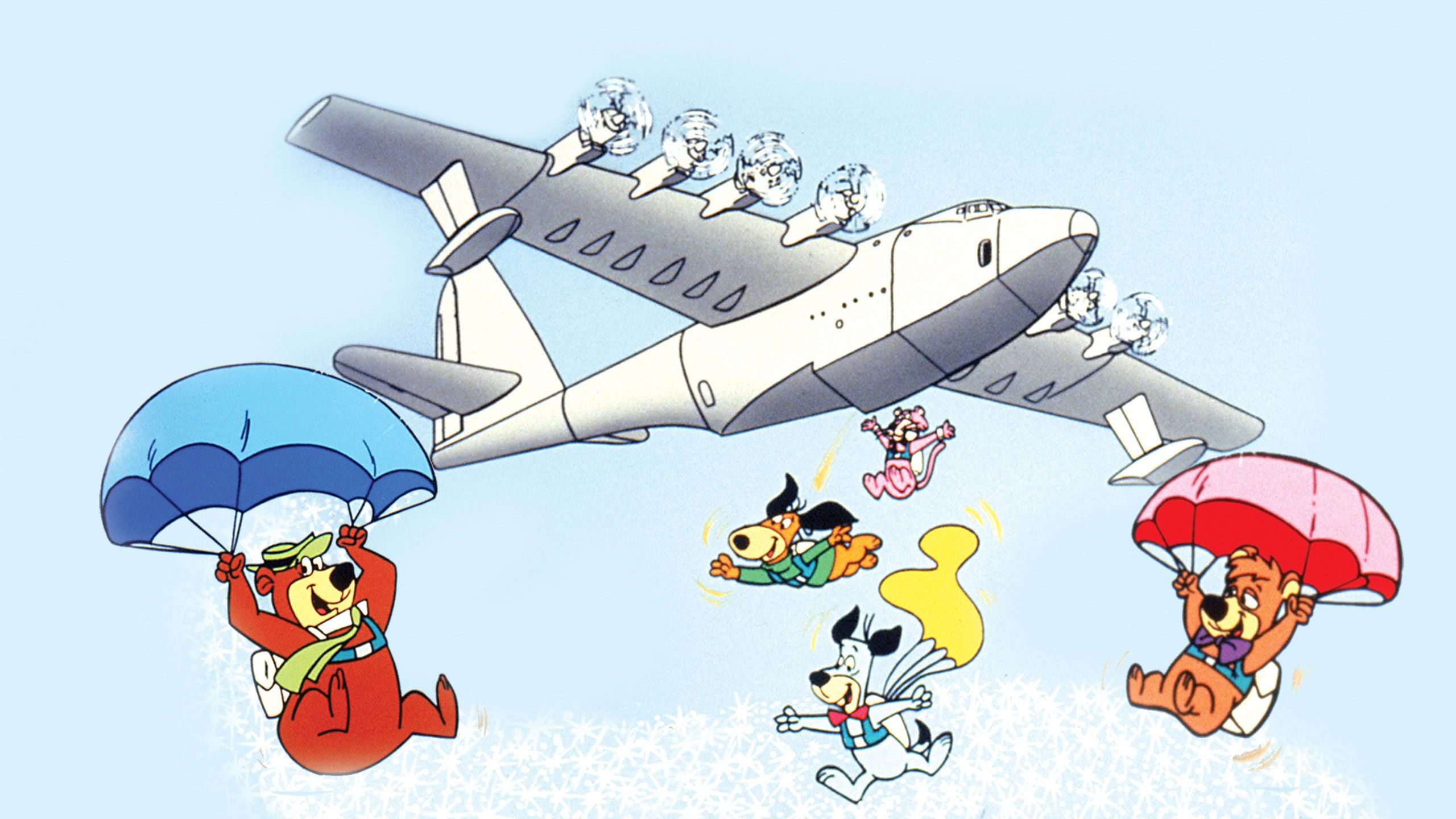
You probably remember Yogi Bear for stealing pic-a-nic baskets in Jellystone Park. Maybe you remember the Spruce Goose as that massive, slightly ridiculous wooden airplane built by Howard Hughes that only flew once. But if you grew up in the late eighties, there’s a good chance your brain has fused these two things together into a fever dream of Saturday morning syndication.
It actually happened.
In 1987, Hanna-Barbera released a television movie titled Yogi Bear and the Magical Flight of the Spruce Goose. It wasn't just a random title. It was a feature-length marketing exercise, a bizarre piece of history, and a surprisingly ambitious—if totally nonsensical—adventure that took a bunch of classic cartoon characters and shoved them inside the world’s largest flying boat.
Honestly, the whole thing feels like a hallucination now. But for a specific generation of kids, this was the definitive introduction to Howard Hughes' H-4 Hercules.
Why Yogi Bear and the Spruce Goose became a thing
Animation in the 1980s was a wild west of licensing. Hanna-Barbera was trying to revitalize their aging "Funny Animals" roster—Yogi, Boo-Boo, Snagglepuss, Quick Draw McGraw, and Augie Doggie—by putting them in "Hanna-Barbera Superstars 10" movies.
At the same time, the real Spruce Goose was a massive tourist attraction in Long Beach, California. It sat right next to the Queen Mary. The Wrather Corporation, which owned the rights to the plane at the time, clearly saw a cross-promotion opportunity.
The plot is basically a travelogue gone wrong. Yogi and the gang tour the Spruce Goose, but then a group of aliens (yes, really) and a ghostly presence get involved, eventually causing the massive wooden plane to actually take flight. It’s absurd. The H-4 Hercules was never meant to fly more than seventy feet off the water, and it certainly wasn't meant to go on a global rescue mission to save animals and fight off extraterrestrials.
But that’s the magic of eighties animation. Logic didn't matter.
The actual history behind the H-4 Hercules
To understand why this crossover was so weird, you have to look at the real plane. Howard Hughes built it during World War II because the government needed a way to transport troops and materials across the Atlantic without getting sunk by German U-boats.
Steel was in short supply.
So, Hughes built it out of wood. Specifically, laminated birch, though everyone called it the "Spruce Goose," a name Hughes reportedly hated. It had a wingspan of 320 feet. To this day, that is almost unrivaled. It only flew once, on November 2, 1947, with Hughes at the controls. It stayed in the air for about thirty seconds.
Then it sat in a climate-controlled hangar for decades.
When the Yogi Bear Spruce Goose movie came out, the plane was still in Long Beach. It was a massive dome-shaped building. Kids could walk through it. By linking Yogi Bear to the plane, Hanna-Barbera was basically creating a giant, hour-and-a-half-long commercial for a tourist trap.
Analyzing the "Magical Flight"
The movie itself is a weird mix of high-stakes environmentalism and slapstick. You’ve got the Dread Baron and Mumbly (who were basically the villains from Laff-A-Lympics) trying to use the plane for evil.
One thing that stands out is the scale. The animators actually tried to convey how big the Spruce Goose was compared to a bear. They drew the interior with multiple decks, massive cargo bays, and a cockpit that looked like a cathedral.
It’s surprisingly educational in a "fact-adjacent" way.
The movie focuses on the "magical" aspect, but it peppers in details about the plane's construction and its history. For a lot of kids, this was their first exposure to the idea of Howard Hughes, even if he was portrayed more like a generic eccentric billionaire or a ghost in the machine.
Why do people still talk about this?
Nostalgia is a powerful drug. But there's also the "Mandela Effect" vibe of it all. People remember the movie, but they can't quite believe it was real.
- The animation was typical of late-80s Hanna-Barbera: colorful but a bit stiff.
- The voice acting featured legends like Daws Butler as Yogi and Don Messick as Boo-Boo.
- It was part of a series that included The Jetsons Meet the Flintstones, so crossovers were the norm.
The film eventually fell out of regular rotation. You don't see it on Max or Netflix very often. It exists mostly on old VHS tapes and the darker corners of YouTube. But the Yogi Bear Spruce Goose connection remains a fascinating footnote in animation history.
The Spruce Goose today
The plane isn't in California anymore. If you want to see it, you have to go to the Evergreen Aviation & Space Museum in McMinnville, Oregon. They took the whole thing apart, shipped it up the coast, and reassembled it.
It’s still breathtaking.
When you stand under the wing, you realize why Hanna-Barbera thought it could be a character in itself. It’s an impossible machine. It represents a brand of mid-century ambition that feels totally alien today.
Looking back, the movie was a product of a specific moment where corporate synergy met Saturday morning cartoons. It wasn't "good" in a traditional cinematic sense. It was a mess. But it was a memorable mess. It gave a wooden airplane a personality. It gave Yogi Bear a reason to leave the woods.
How to watch it and what to look for
If you manage to track down a copy of Yogi Bear and the Magical Flight of the Spruce Goose, keep an eye out for the background art. While the character animation is standard, the renderings of the plane itself are often quite detailed.
The writers clearly had the blueprints.
You should also look for the environmental subtext. The 1980s were obsessed with "saving the animals," and this movie uses the Spruce Goose as a literal vehicle for that message. It's a time capsule of 1987 values.
Actionable Insights for Fans and Collectors
If you're looking to dive deeper into this weird intersection of aviation and animation, start with these steps:
- Visit the Evergreen Aviation & Space Museum: Seeing the H-4 Hercules in person is the only way to appreciate the scale that the movie tried (and failed) to capture. You can even walk inside the cargo hold, just like Yogi.
- Track down the original VHS: The DVD releases are rare, and streaming is spotty. The original Worldvision Home Video VHS has the best "period-accurate" feel, including the old trailers that set the mood.
- Research the Hanna-Barbera Superstars 10: This movie was part of a specific block of ten telefilms. Watching others, like Scooby-Doo and the Ghoul School, provides context for the production quality and weird creative choices of that era.
- Read up on the Wrather Corporation: Understanding the business side of why this movie was made—specifically their ownership of the Queen Mary and the Spruce Goose—reveals how 80s media was often driven by physical real estate interests.
The Yogi Bear Spruce Goose crossover remains one of the most oddly specific moments in pop culture history. It’s a reminder that back in the day, if you had a big enough plane and a popular enough bear, you could pretty much write whatever story you wanted, no matter how many aliens or ghosts you had to include to fill the runtime.



