He’s smarter than the average bear. We all know the catchphrase, but if you really sit down and watch those old Hanna-Barbera shorts, you start to realize that the dynamic between Yogi Bear and Ranger Smith isn't just a simple "cat and mouse" game. It’s a workplace drama. It’s a clash of philosophies. Honestly, it’s basically a 1960s version of The Office set in a national park.
While Yogi is the charismatic, tie-wearing grifter looking for a free lunch, Ranger John Smith is the quintessential middle manager just trying to keep his pension intact. They need each other. Without Yogi, the Ranger has no job; without the Ranger, Yogi actually has to hunt for food like a regular, non-anthropomorphic animal. That sounds exhausting.
The Secret History of Jellystone’s Favorite Feud
Most people think Yogi and the Ranger were together from the start. They weren't. Yogi Bear actually debuted in 1958 as a supporting segment on The Huckleberry Hound Show. It took a bit for the writers at Hanna-Barbera—specifically the legendary Daws Butler, who voiced Yogi with that unmistakable Art Carney-inspired lilt—to find the perfect foil.
Enter Ranger Smith.
He didn't always have a name. Early on, he was just "the Ranger." But as the show blew up and Yogi got his own series in 1961, Smith evolved into a specific archetype. He’s a former U.S. Army soldier. That’s why he’s so obsessed with rules, regulations, and that crisp olive-drab uniform. He views Jellystone Park (a thinly veiled parody of Yellowstone) as his command. Yogi, meanwhile, is the quintessential beatnik rebel.
Why the "Don't Feed the Bears" Rule Actually Matters
It’s easy to see the Ranger as a buzzkill. I mean, the guy spends half his life hiding behind trees with binoculars just to make sure a bear doesn't eat a ham sandwich. But if you look at the history of the National Park Service in the 1950s and 60s, Ranger Smith was actually a PR tool.
Back then, real tourists at Yellowstone were doing incredibly dangerous stuff. They were literally lining up to feed black bears and grizzlies from their car windows. It was a disaster waiting to happen. By making the conflict between Yogi Bear and Ranger Smith revolve around the "Don't Feed the Bears" sign, Hanna-Barbera was tapping into a very real cultural moment. Smith wasn't just being mean; he was trying to prevent a lawsuit.
The Weird Respect Between the Two
There’s an episode called "A Day to Remember" where the Ranger actually gets sentimental about Yogi. It’s weirdly touching. Even though they spend most of their time trying to outsmart one another, there is a deep-seated mutual respect.
Think about it.
Yogi refers to him as "Sir" or "Mr. Ranger." He respects the office, if not the rules. On the flip side, the Ranger often shows a strange pride in Yogi’s intelligence. When Yogi builds a complex flying machine or a sophisticated pulley system to steal a pic-a-nic basket, Smith is almost impressed before he remembers he has to write a report about it.
They are two sides of the same coin. Both are trapped in Jellystone. Both are defined by their roles. Smith is the law; Yogi is the subversion of that law.
Breaking Down the Power Dynamics
Let's get into the weeds of their relationship. You've got Boo-Boo Bear acting as the middleman. Boo-Boo is the "conscience" who constantly reminds Yogi that the Ranger wouldn't like whatever scheme is currently in motion.
- The Ranger's Strategy: Primarily psychological. He tries to guilt-trip Yogi or use the threat of being sent to the St. Louis Zoo.
- Yogi’s Strategy: Pure innovation. He uses physics, disguises, and psychological warfare to get what he wants.
It’s a constant stalemate. If the Ranger ever actually sent Yogi to the zoo permanently, the show would end. He needs the conflict. It defines him. Without a bear to wrangle, John Smith is just a guy in a lonely cabin counting pinecones.
The Legacy of the 1990s Reboot and Beyond
In the late 90s, John Kricfalusi (the creator of Ren & Stimpy) did a couple of specials for Cartoon Network called Boo Boo Runs Wild and A Day in the Life of Ranger Smith. These were... intense. They leaned into the repressed rage of the Ranger. They showed him as a man on the brink of a total mental breakdown because of Yogi’s antics.
While those specials were polarizing, they highlighted something the original series only hinted at: the sheer frustration of being a rule-follower in a world where the rule-breaker is the hero.
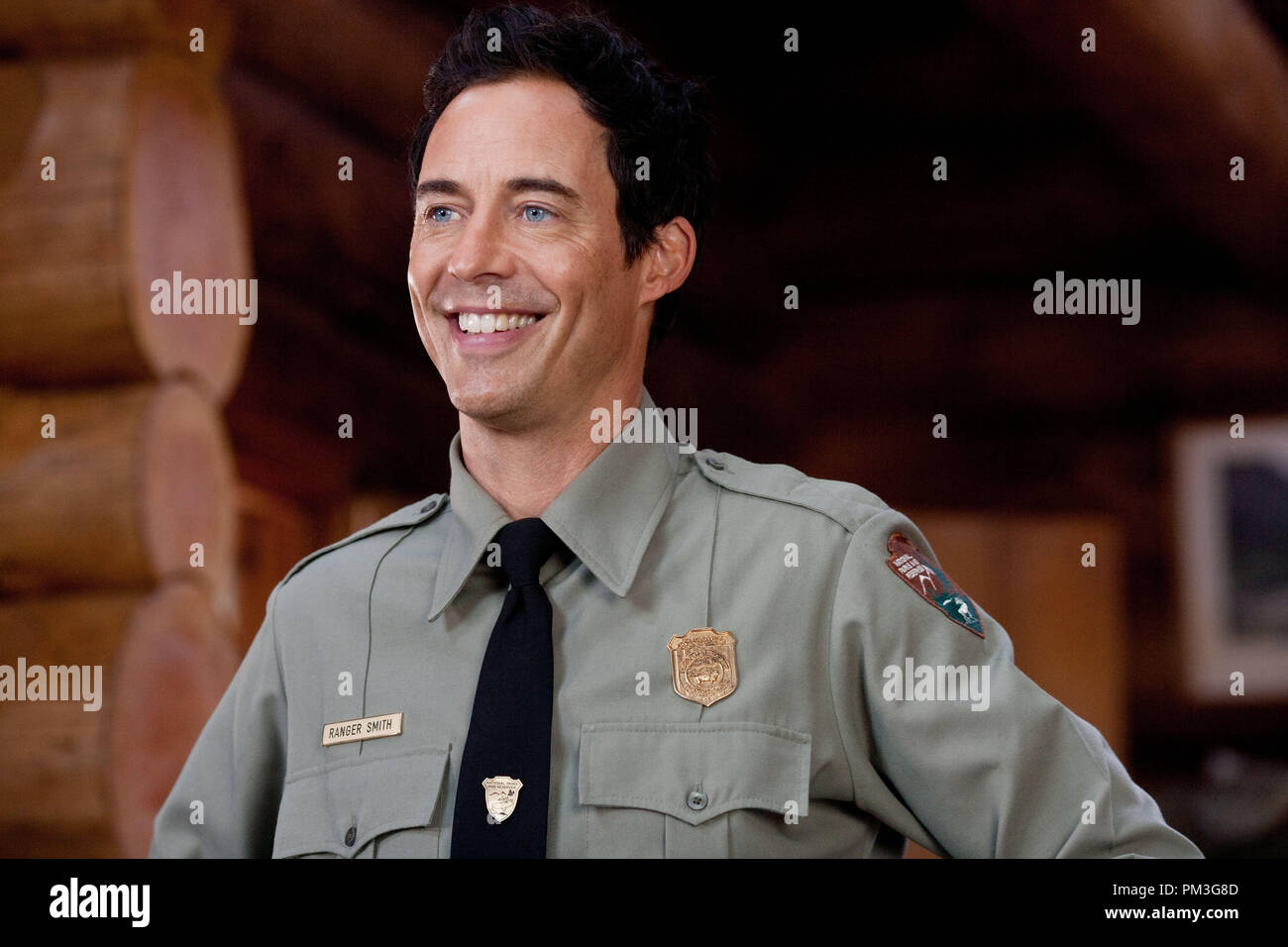
In the 2010 live-action/CGI movie, they tried to modernize the duo. Tom Cavanagh played the Ranger, and Justin Timberlake voiced Boo-Boo. It was okay, but it lost some of that grainy, 1960s industrial-era charm. Then came Jellystone! in 2021, which reimagined the characters in a much more surreal, town-based setting. Even there, the core remains. The Ranger is stressed. Yogi is hungry. The universe is in balance.
Is Yogi Actually the Villain?
If you talk to professional park rangers today, they’ll tell you—mostly jokingly—that Yogi Bear is the villain of the story. From an ecological perspective, he’s a nightmare. He’s a habituated bear. In the real world, a bear that steals food from humans usually ends up being euthanized.
"A fed bear is a dead bear."
That’s the grim reality behind the cartoon. When we watch Yogi Bear and Ranger Smith, we’re watching a sanitized, comedic version of a very real struggle for wildlife management. Smith is the hero we need; Yogi is the chaos we want.
How to Apply the "Ranger Smith" Logic to Real Life
There is actually a lot to learn from this rivalry about conflict resolution and boundaries. Smith doesn't hate Yogi; he hates the disruption. In any workplace or family dynamic, you’re going to have a Yogi—someone who finds shortcuts, ignores the handbook, and charms their way out of trouble.
The "Ranger" response isn't to get angry. It’s to stay consistent.
- Consistency is Key: Smith never stops putting up the signs. He knows Yogi will tear them down, but the standard must be maintained.
- Understand the Motivation: Yogi isn't malicious. He’s just hungry. When you understand what drives the "rule-breaker" in your life, you can manage them better.
- The Zoo Option: Always have a "St. Louis Zoo." Not a literal one, but a clear boundary. There has to be a point where the behavior leads to a real consequence, or the rules mean nothing.
Final Thoughts on Jellystone's Finest
We still talk about these characters because they represent a fundamental human tension. We all want to be Yogi—carefree, smart, and eating someone else's pie. But deep down, we suspect we're actually Ranger Smith—overworked, underappreciated, and just trying to keep the park from burning down.
The rivalry works because it’s never resolved. It’s a loop. The sun rises over Jellystone, Yogi gets an idea, and the Ranger grabs his hat.
To dive deeper into this history, check out the archives at the Hanna-Barbera Studios or look into the early character sketches by Ed Benedict. He’s the guy who gave Yogi his collar and tie—ironically, a move made to save money on animation by allowing the body to remain still while only the head moved. Even the bear's design was a "shortcut," which is perfectly on-brand for Yogi.
To get the most out of your nostalgia trip, watch the original 1961 episodes and pay attention to the background music. The "stock" jazz tracks by Hoyt Curtin define that era of animation just as much as the voices do. If you're looking to visit a real-life version of the park, Yellowstone remains the gold standard, though you should probably leave the picnic baskets in the trunk. Seriously. The real rangers don't have the patience of John Smith.
For a deeper look at how animation changed during this period, you can research the transition from full animation to "limited animation," a technique Hanna-Barbera pioneered to dominate the television market. This shift is exactly why characters like Yogi and the Ranger have such distinct, recognizable silhouettes and repetitive, iconic dialogue patterns. It wasn't just art; it was a revolution in how stories were told on a budget.



