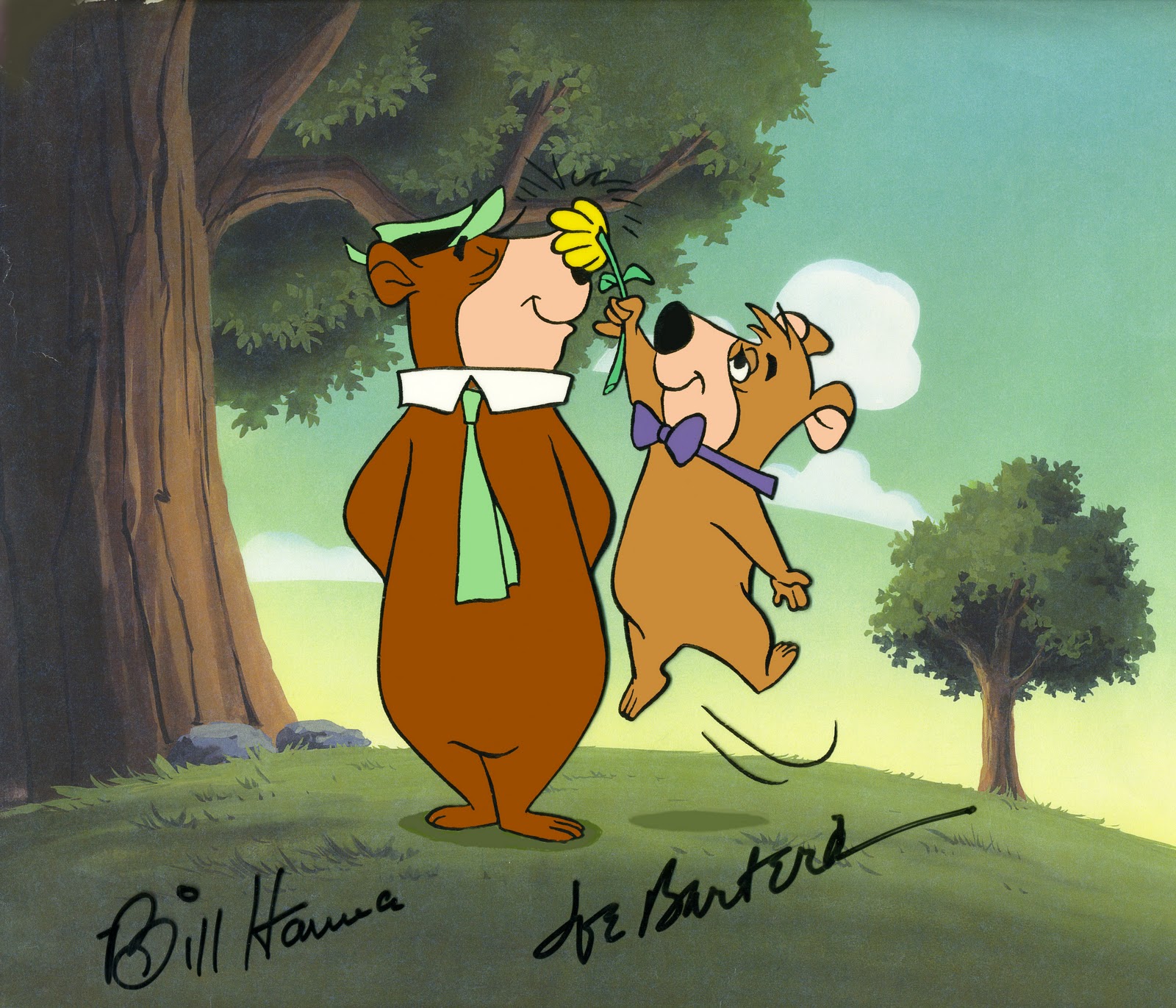
You know the hat. You know the green tie. If you’ve ever seen a "No Fed Bears" sign at a national park and immediately thought about a wicker basket filled with ham sandwiches, you’re part of a multi-generational club. Yogi Bear and Boo Boo Bear aren't just remnants of Saturday morning television; they represent one of the most successful character dynamics in animation history. While most 1950s cartoons feel like dusty relics, Yogi and his diminutive "conscience" still feel weirdly relevant. Maybe it’s the relatable desire to avoid work. Maybe it’s just the charm of a bear who thinks he’s smarter than the average human.
Honestly, the brilliance of Bill Hanna and Joe Barbera wasn't just in the animation—it was in the voice acting. Daws Butler didn't just voice Yogi; he channeled Art Carney’s Ed Norton from The Honeymooners. That specific blend of overconfidence and bumbling charm created a character that was fundamentally subversive. He was a rebel in a park ranger’s world.
The Genesis of Jellystone’s Dynamic Duo
It started in 1958. Yogi wasn't even the star of his own show at first; he was a supporting character on The Huckleberry Hound Show. But audiences didn't care about the blue dog as much as they cared about the bear in the collar. Why the collar? It was a technical trick. By giving Yogi a collar and tie, the animators only had to redraw his head for dialogue scenes, keeping the body static and saving thousands of dollars. It was a "cheat" that became an iconic fashion choice.
Boo Boo Bear was the necessary anchor. Without Boo Boo, Yogi is just a jerk who steals lunches. With Boo Boo, he’s a misguided mentor. Boo Boo, voiced by the legendary Don Messick, provided the "moral" center, though he usually ended up helping Yogi eat the stolen pie anyway. This wasn't some high-brow philosophical pairing. It was classic vaudeville.
The setting of Jellystone National Park—a thin parody of Yellowstone—tapped into the post-WWII American obsession with the Great Outdoors. Families were buying station wagons and hitting the road. The idea of a bear waiting for you at the end of the trail to swipe your cooler was a shared cultural anxiety turned into a joke.
Behind the Voices
Daws Butler and Don Messick were the secret sauce. Butler’s rhythmic, almost musical delivery gave us catchphrases that have survived decades. "Hey, Hey, Hey!" and "Smarter than the average bear!" aren't just lines; they are linguistic staples.
Messick, meanwhile, gave Boo Boo a nasal, cautious tone that perfectly countered Yogi's booming bravado. It’s a blueprint that every buddy-comedy has used since. Think about it. You have the wild optimist and the worried realist. It’s Tommy Boy. It’s The Odd Couple. It’s every duo that shouldn’t work but does.
Why We Still Care About the Picnic Basket
Let’s talk about the "Pic-A-Nic" basket. It’s more than a prop. In the world of Yogi Bear and Boo Boo Bear, the basket represents the ultimate prize of a consumerist society. Yogi doesn't want to hunt. He doesn't want to fish. He wants processed meat and pre-sliced bread. He’s essentially the first "quiet quitter." He lives in nature but refuses to participate in the "bear economy" of catching salmon or hibernating on schedule.
- Subversion of Authority: Ranger Smith isn't a villain. He’s a middle manager. He has a boss (the Chief Ranger), he has rules to follow, and he’s just trying to keep the park running. Yogi is the chaotic employee who makes his life miserable.
- The Adult Appeal: Kids like the slapstick. Adults like the fact that Yogi is constantly trying to "beat the system."
- The Design: Ed Benedict’s character designs were minimalist but expressive. The heavy jaw, the tiny hat—it’s a silhouette you can recognize from a mile away.
The show was also a pioneer in "limited animation." This is often used as a derogatory term, but in the late 50s, it was a necessity. By focusing on dialogue and character beats rather than fluid, Disney-style movement, Hanna-Barbera created a style that felt snappy and fast-paced. It paved the way for everything from The Flintstones to The Simpsons.
The Evolution and the 2010 "CGI" Era
Not everything stayed gold. The 2010 live-action/CGI hybrid film starring Dan Aykroyd and Justin Timberlake is... polarizing. Some fans felt the soul was lost in the transition to photorealistic fur. However, it did something important: it introduced Yogi Bear and Boo Boo Bear to a generation of kids who had never seen a grainy 4:3 television set.
The film leaned heavily into the "environmentalist" angle, which was always lurking in the background of the original series. Jellystone being threatened by logging or developers gave Yogi a reason to be a hero rather than just a nuisance. It’s a recurring theme in the later iterations, like Yo Yogi! (the weird 90s version where they hung out at a mall) and the more recent Jellystone! series on Max.
The Jellystone! reboot by C.H. Greenblatt is actually a fascinating case study. It strips away the "nature" aspect and puts all the Hanna-Barbera characters in a small town. Yogi is a surgeon (a terrifying thought), and Boo Boo is his overworked nurse. It’s frantic and surreal, but it keeps the core of their relationship intact: Yogi’s unearned confidence and Boo Boo’s weary loyalty.
Real-World Impact on National Parks
Believe it or not, Yogi Bear actually impacted how the National Park Service (NPS) dealt with real bears. In the mid-20th century, tourists were actually encouraged to feed bears. There are old photos of people handing sandwiches to black bears in Yellowstone.
Once Yogi became a superstar, the "beggar bear" archetype was solidified in the public consciousness. The NPS had to work overtime to explain that real bears aren't charming, don't wear ties, and will absolutely destroy your car for a granola bar. The "Yogi effect" made bears seem like forest-dwelling neighbors rather than apex predators. This led to stricter "Bear Aware" campaigns that persist today.
Technical Milestones of the Original Series
If you look at the 1961 The Yogi Bear Show, you’ll see the debut of Snagglepuss and Yakky Doodle. This was the moment the "Hanna-Barbera Universe" really solidified. It was a shared world long before Marvel made it cool.
- The Emmy Win: In 1960, The Huckleberry Hound Show (featuring Yogi) was the first animated program to win an Emmy. That’s huge. It validated animation as a medium for more than just theatrical shorts.
- Merchandising: Yogi was one of the first characters to be slapped on everything from cereal boxes to vitamins. He wasn't just a character; he was a brand.
- The Feature Film: Hey There, It's Yogi Bear! (1964) was the first theatrical feature based on a television cartoon. It proved that audiences would pay to see their small-screen favorites on the big screen.
Common Misconceptions
People often think Yogi and Boo Boo are father and son. They aren't. They’re just friends, or perhaps "companions" in the vaguest sense of the word. Boo Boo is often referred to as a "cub," but his maturity level often exceeds Yogi's.
Another big one? The name "Yogi" was long thought to be a direct swipe at baseball legend Yogi Berra. Berra actually sued Hanna-Barbera for defamation, though he eventually dropped the suit. The creators claimed it was a coincidence, but let’s be real—the name was definitely "inspired" by the catcher’s popularity at the time.
How to Revisit the Classics
If you want to understand why these characters lasted, don't start with the movies. Go back to the original 1958-1961 shorts. Watch the way Yogi manipulates Ranger Smith with faux-politeness. It’s a masterclass in comedic writing.
- Look for the "Ranger" episodes: The ones where the conflict is purely about the rules of the park.
- Pay attention to the background art: The stylized, watercolor-looking trees and rocks of Jellystone are beautiful in their simplicity.
- Listen to the score: Hoyt Curtin’s jazzy, brass-heavy music defines the era.
Practical Steps for Fans and Collectors
If you're looking to dive into the world of Yogi Bear and Boo Boo Bear, or even if you're a parent wanting to introduce them to your kids, here is the best way to do it without getting overwhelmed by the 60+ years of content.
First off, hunt down the "Hanna-Barbera Classics Collection" DVDs or find the curated "best of" selections on streaming platforms like Max. Don't feel like you have to watch every single episode in order. The show was episodic; there’s no deep lore you’re going to miss if you skip around. Focus on the early 60s era for the "purest" experience.
If you’re a collector, be careful with "vintage" toys. The 1960s Knickerbocker plushies are highly sought after but often suffer from "foam rot" where the internal stuffing turns to dust. Look for the vinyl figures from the 70s or the more recent Funko Pops if you want something that will actually last on a shelf.
For a real-world experience, visit a "Yogi Bear’s Jellystone Park Camp-Resort." There are over 75 of them across North America. They are essentially high-end campgrounds themed around the characters. It’s a weird, meta experience to see a giant fiberglass Yogi Bear while you're actually roasting marshmallows, but it shows just how deeply these characters are embedded in the American vacation experience.
Lastly, check out the original 1964 film Hey There, It's Yogi Bear! for the musical numbers alone. It’s surprisingly well-produced and gives Boo Boo a chance to shine as a character rather than just a sidekick. Understanding the history of these two isn't just a trip down memory lane—it’s a look at how American humor shifted from the stage to the screen.
Next time you see a bear—from a safe distance, hopefully—remember the guy in the green tie. He’s probably just looking for a ham on rye.



