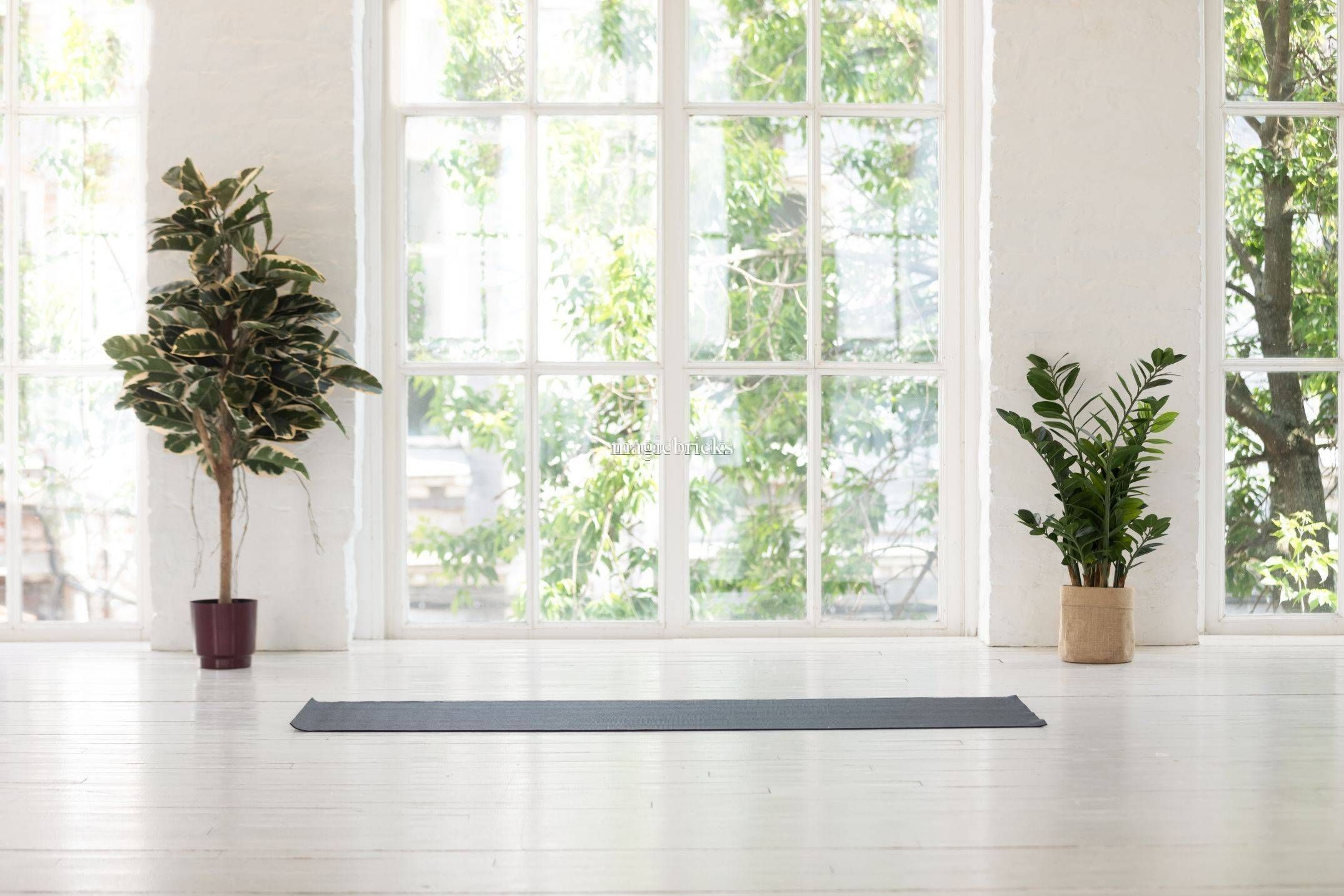
You’ve probably seen those Instagram photos of "perfect" yoga spaces. They usually involve a massive floor-to-ceiling window overlooking a pristine forest, a $500 hand-woven rug, and exactly zero clutter. It’s intimidating. Honestly, it’s also mostly fake. If you’re trying to figure out yoga room decorating ideas that actually work in a normal spare bedroom or a corner of your basement, you have to stop thinking about aesthetics first and start thinking about nervous system regulation.
Your brain is constantly scanning your environment for threats or distractions. That pile of laundry in the corner? Your brain sees it as a "to-do" list, not a relaxation trigger. If your yoga space feels like a storage closet with a rubber mat thrown on the floor, you aren't going to use it. It's just science.
The lighting mistake almost everyone makes
Most people just flip on the overhead "boob light" and call it a day. Big mistake. Overhead lighting, especially cool-toned LEDs, mimics the midday sun. It keeps your cortisol high. That’s the opposite of what you want when you’re trying to sink into a child’s pose after a brutal 9-to-5.
Think layers. You want light that hits the room from the side, not from above. A salt lamp is a cliché for a reason—it emits a warm, amber glow that doesn't mess with your circadian rhythm. But you can do better. Try a smart bulb in a floor lamp and set it to a dim sunset orange. Or, even better, grab some battery-operated flickering candles. They give you that "temple" vibe without the fire hazard of a real flame near your flowing yoga pants.
If you have a window, don't just leave it bare. Use sheer linen curtains. They diffuse the light so it feels soft and hazy rather than sharp and distracting.
Let’s talk about the "clutter-core" problem
You can’t meditate in a mess. You just can’t. But you also don't need a minimalist monastic cell. The key to yoga room decorating ideas that stick is clever concealment.
Get a dedicated basket for your props. Don't let your blocks, straps, and bolsters just migrate across the floor like stray socks. A wicker trunk or a low wooden shelf works wonders. I’m a big fan of the "out of sight, out of mind" rule for electronics too. If you use a tablet for classes, get a dedicated stand for it so it doesn’t look like you’re just working from your mat.
Wall space is where people usually go overboard. You don't need twelve posters of the chakra system. Maybe just one piece of art that actually means something to you. A framed landscape of a place where you felt peaceful. Or even just a blank wall. Seriously. A blank wall is a gift for your focus during balance poses like Tree or Warrior III.
Mirrors: The double-edged sword
There is a huge debate in the yoga community about mirrors. On one hand, B.K.S. Iyengar, the founder of Iyengar Yoga, often used mirrors to ensure precise alignment. It helps you see if your hips are squared or if your spine is rounding. On the other hand, mirrors can make you hyper-critical. You start judging your body instead of feeling the movement.
If you decide to include one, don't get a gym-style wall mirror. Choose a leaning floor mirror with a wooden frame. It feels like furniture, not equipment. If you find yourself getting too caught up in your reflection, you can always drape a beautiful tapestry over it during your more meditative sessions.
The sensory layer: Beyond the visual
Decorating isn't just about what you see. It’s about how the room "holds" you.
Sound matters. If your "studio" is next to a noisy street or the kitchen where the dishwasher is running, the best decor in the world won't save your Zen. Acoustic panels are an option, but they look like a recording studio. Instead, try heavy velvet curtains or a thick wool rug. These materials naturally soak up sound.
Smell is the fastest way to bypass the thinking brain and hit the emotional center. Don't just buy "ocean breeze" candles. Look for grounding scents. Sandalwood, cedar, or frankincense. If you hate smoke, an ultrasonic diffuser is better than incense. It adds a bit of humidity to the air, which feels great for your lungs during pranayama (breathwork).
Choosing a color palette that doesn't suck
Please, I am begging you, stay away from "hospital white" or "depressing beige."
Color psychology is real. Terracotta or muted clay tones feel grounding—like you’re literally connected to the earth. Sage green is incredibly soothing for the eyes. If you want something more spiritual, a very pale, dusty lavender can work, but keep it desaturated.
You want colors that look like they were pulled from a forest at dusk. Nothing neon. Nothing high-contrast. If you’re renting and can’t paint, use large-scale textiles. A massive, earthy-toned rug can cover up ugly rental carpet and instantly define the boundaries of your "sacred space."
Texture is your best friend
A yoga room should feel "soft." Think about the transition from your daily life to your practice. You're taking off shoes, probably peeling off socks. The first thing your feet touch shouldn't be cold linoleum.
- Natural fibers: Jute rugs are popular but can be scratchy. A low-pile wool rug is better for joint support.
- Wood elements: Bring in a small wooden stool or a bamboo plant stand. Wood adds a "living" energy that plastic and metal lack.
- Plants: You need them. Not just for oxygen, but for the "biophilia effect." Snake plants or Pothos are basically impossible to kill and thrive in the lower-light conditions often found in yoga corners.
Why your floor choice actually dictates your decor
If you have hardwood floors, you’re lucky. They’re stable and easy to clean. But they are hard. If you’re doing a lot of Yin yoga or restorative poses, you might want to layer your yoga mat on top of a larger, thin rug.
If you have carpet, you have the opposite problem: stability. Doing a headstand on plush carpet is a recipe for a neck injury. In this case, your "decor" needs to include a piece of plywood or a specialized "yoga floor" insert that sits under your mat to provide a firm base.
Creating an "Altar" (Even if you aren't religious)
The word "altar" sounds heavy, but in a yoga room, it’s just a focal point. It’s where you put your intentions.
This could be a small floating shelf with a few crystals, a photo of a loved one, or even just a bowl of smooth river stones. It gives your eyes a place to land during your practice. When you see this specific spot, your brain should automatically switch into "yoga mode." It’s a psychological anchor.
Many practitioners like to include the five elements:
- Earth: A stone or a plant.
- Water: A small fountain or even just a beautiful glass of water.
- Fire: A candle or lamp.
- Air: Incense or the literal air from an open window.
- Space: This is the room itself—the emptiness you create.
Real-world constraints and small spaces
Most of us aren't working with a dedicated 20x20 room. You’re likely carving out a corner of your bedroom.
The biggest tip for small-space yoga room decorating ideas is the "Room Divider." A folding screen or even a tall plant can physically block your view of your bed or your desk. If you can see your unmade bed while you're in Savasana, you're going to think about sleep, not presence. If you can see your computer, you're going to think about emails. Block the view.
Actionable steps to transform your space today
Don't go out and buy a bunch of stuff yet. That just adds more "things" to manage. Do this instead:
- The Purge: Take everything out of the corner or room. Every single thing.
- The Deep Clean: Wipe down the baseboards. Vacuum the cracks. Yoga involves being very close to the floor; you don't want to be staring at a dust bunny while you're in a plank.
- Lighting First: Turn off the overhead light. Find a lamp from another room and put it on the floor. See how the vibe changes instantly.
- The "Feet Test": Stand where your mat will go. Is it cold? Is it slippery? Address the flooring before you worry about the wall art.
- The One Focal Point: Choose one item—just one—that makes you feel calm. Place it at eye level where you’ll see it most often during your flow.
Yoga is about the internal experience, but your external environment either supports that or fights it. By focusing on lighting, sound, and the physical "feel" of the room rather than just buying trendy decor, you create a space that actually pulls you toward your mat every morning. Stop trying to make it look like a magazine and start making it feel like a sanctuary.



