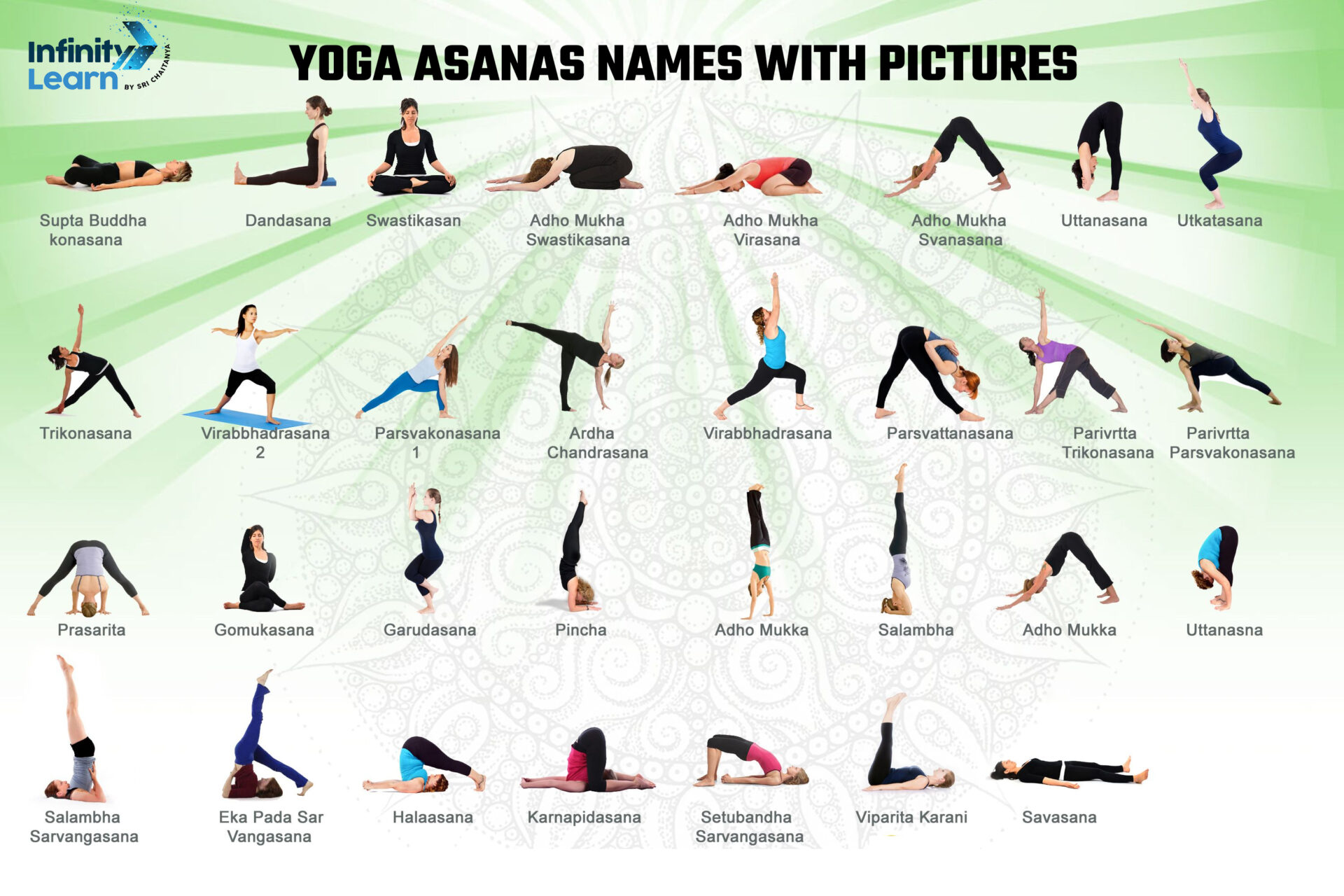
Yoga isn't just about stretching. It’s a language. Honestly, walk into any studio from New York to Rishikesh and you’ll hear a chaotic mix of Sanskrit, English, and weirdly specific metaphors about animals. If you’ve ever been stuck in a class wondering why the teacher is yelling about a "downward dog" while you're just trying to breathe, you’re not alone. Most people looking for yoga position names with pictures are really just looking for a way to stop feeling lost.
Learning the names is basically like learning the "code" for your body. But there’s a catch. One person’s "Crescent Lunge" is another person’s "High Lunge," and if you go deep into the lineage of B.K.S. Iyengar versus Pattabhi Jois, the names actually start to shift. It's confusing.
The Sanskrit vs. English Tug-of-War
Why do we even use Sanskrit? Some people find it pretentious. Others find it sacred. The reality is that Sanskrit provides a universal blueprint. Asana translates to "seat," but today it refers to any physical posture.
Take Adho Mukha Svanasana. That’s a mouthful. In English, we call it Downward-Facing Dog.
If you look at historical texts like the Hatha Yoga Pradipika, you won't actually find a lot of the modern "flow" poses we do today. A lot of the yoga position names with pictures you see on Instagram are actually relatively modern inventions, blending gymnastics with traditional Indian breathing techniques.
The Big One: Downward-Facing Dog (Adho Mukha Svanasana)
This is the bread and butter. If you don't know this one, you're going to have a rough time in 99% of classes.
What most people get wrong: They think their heels have to touch the floor. They don't. Seriously. If you have tight hamstrings, keeping your heels up and your knees slightly bent actually protects your lower back. The "picture perfect" version of this pose is less about the legs and more about the long line from your wrists to your hips. Think about pushing the floor away.
Why Warrior Poses Have Three Different Names
Ever wonder why there’s a Warrior I, II, and III? It's based on a myth. The story goes that the god Shiva created a super-warrior named Virabhadra to avenge the death of his wife, Sati.
Each pose represents a different moment in that battle.
- Warrior I (Virabhadrasana I): The warrior rising up from the earth.
- Warrior II (Virabhadrasana II): The warrior sighting his enemy.
- Warrior III (Virabhadrasana III): The warrior moving in for the kill.
It’s kinda dark for a "peaceful" yoga practice, right? But that’s the point. Yoga is about the internal struggle.
Warrior II (Virabhadrasana II)
This is the "power" pose. When you see yoga position names with pictures in a magazine, this is usually the one they pick because it looks heroic.
Pro tip: Watch your front knee. It loves to cave inward. You want to track that knee toward your pinky toe. Also, relax your shoulders. You aren't actually fighting a war; you're just standing in a room with some incense.
The Balancing Act: Tree Pose and Beyond
Balance is weird. Some days you’re a rock; other days you’re a wet noodle. Tree Pose (Vrksasana) is the ultimate test of focus.
Tree Pose (Vrksasana)
The cardinal sin of Tree Pose: Putting your foot directly on your knee joint. Don't do it. Your knee isn't designed to take lateral pressure. Put the foot on your calf or way up on your thigh. If you're wobbly, just touch your toe to the ground like a kickstand. There is no shame in the kickstand game.
Common Misconceptions About Advanced Names
You might see a photo of someone twisted into a pretzel and think, "I need to know the name of that so I can avoid it." Usually, those are variations of Bakasaana (Crow Pose) or Pincha Mayurasana (Forearm Stand).
But here’s a secret: the "advanced" poses aren't actually the goal of yoga. Patanjali, who wrote the Yoga Sutras, only mentions physical postures briefly. He was way more interested in how you handle your mind.
Child’s Pose (Balasana)
This is the most important pose in the entire lexicon of yoga position names with pictures. Why? Because it’s the "escape hatch." If a class gets too intense, you drop into Child’s Pose.
It’s restorative. It calms the nervous system. If a teacher ever makes you feel bad for taking Child’s Pose, find a new teacher. Honestly.
The Practical Side of Learning the Names
Why bother memorizing these?
If you know the names, you can close your eyes. Yoga becomes a moving meditation rather than a "watch the instructor" session. When you hear "Tadasana," you don't have to look up; you just know to stand tall like a mountain.
Tadasana (Mountain Pose)
It sounds simple. You’re just standing there. But in Tadasana, you’re active. You're engaging your quads, tucking your pelvis slightly, and reaching the crown of your head toward the ceiling. It's the blueprint for every other standing pose.
Actionable Steps for Mastering Yoga Poses
Don't try to learn 50 names at once. It's a waste of time. Your brain will just scramble them.
- Focus on the "Big 5": Master Downward Dog, Warrior II, Plank, Tree Pose, and Child’s Pose. If you know these, you can survive 80% of any Vinyasa class.
- Listen for suffixes: Any word ending in -asana is a pose. Tri means three (Triangle), Chatur means four (Four-limbed staff pose). It's a pattern.
- Use visual cues: When looking at yoga position names with pictures, pay attention to the angles. Is the spine straight? Where are the eyes looking (Drishti)?
- Don't obsess over perfection: Yoga is a "practice," not a "perfect." Your body changes every day. What felt easy on Tuesday might feel impossible on Friday. That’s totally normal.
The real benefit of knowing these names isn't to sound smart at the juice bar. It's to build a deeper connection between your brain and your muscles. When the Sanskrit name becomes second nature, the movement becomes fluid.
Grab a mat. Find a spot. Start with one pose. Even if it's just lying on the floor in Savasana (Corpse Pose)—which, let’s be real, is everyone’s favorite anyway.
To take this further, start by picking three poses today and holding them for five breaths each while mentally repeating their names. This simple Pavlovian trick links the physical sensation to the terminology, making it stick way faster than just reading a list. Once you’ve got the "Big 5" down, you can start exploring more complex transitions like moving from Plank to Chaturanga Dandasana without collapsing your shoulders. Consistency beats intensity every single time.