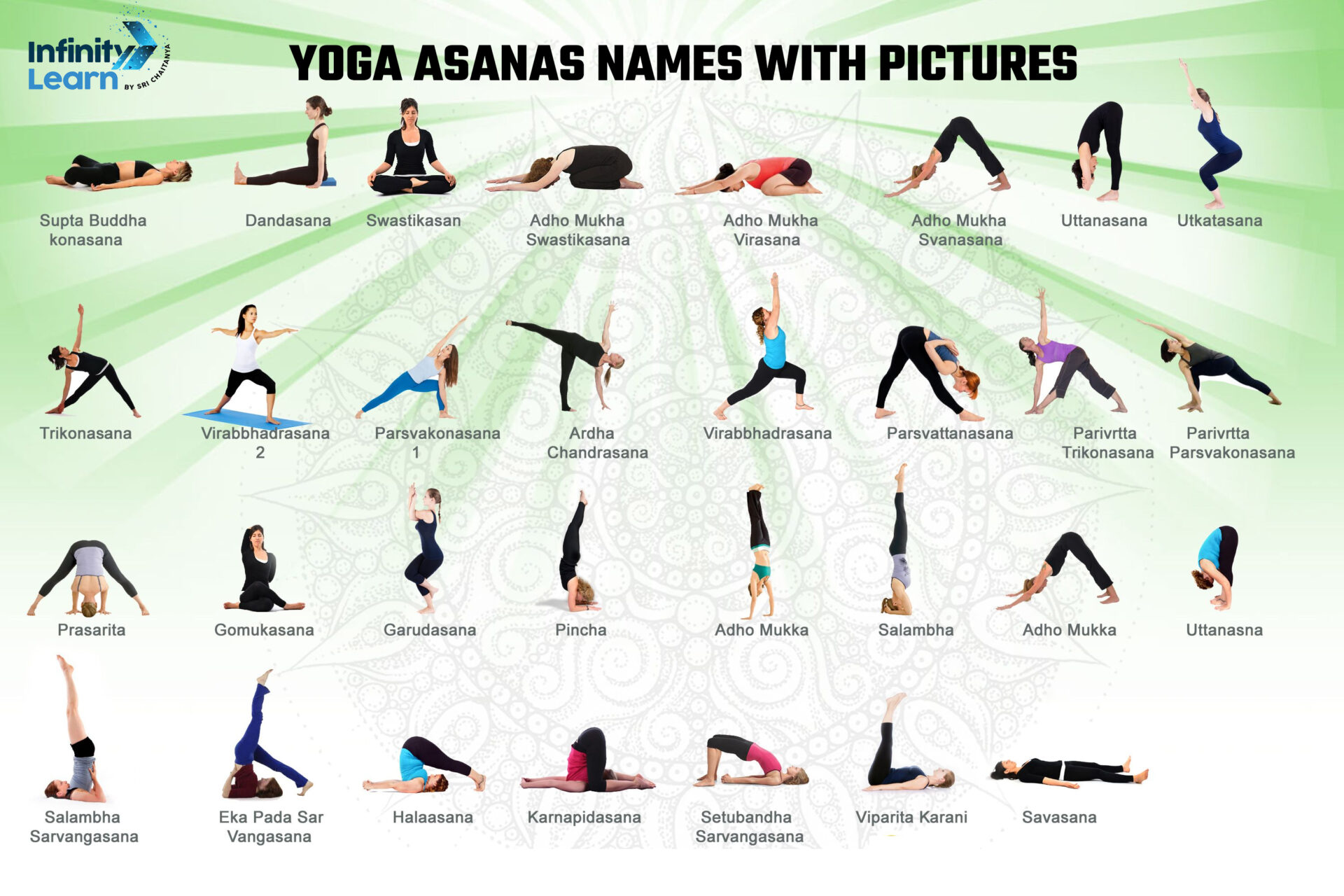
You’re standing in the back of a dimly lit room, smelling of eucalyptus and sweat, and the instructor suddenly shouts "Adho Mukha Svanasana!" You freeze. Everyone around you hinges forward, planting their palms and sending their hips to the sky. You’ve just encountered the first hurdle of modern practice: the language barrier. Finding a reliable list of yoga poses names and pictures isn't just about looking at pretty stock photos on Instagram; it’s about understanding the mechanics of a 5,000-year-old tradition that has been chopped, screwed, and rebranded for the TikTok era.
Let’s be real.
Yoga terminology is a confusing mix of ancient Sanskrit and sometimes-clunky English translations. If you're looking for a "Down Dog," that's easy enough. But then someone mentions "Wild Thing" or "Falling Star," and suddenly you’re wondering if you’re in a fitness class or an indie rock concert.
Why the Sanskrit Names Actually Matter
Sanskrit isn't just there to make the teacher sound fancy. It’s a vibrational language. B.K.S. Iyengar, arguably the most influential figure in modern yoga and author of Light on Yoga, insisted that the names describe the internal "shape" of the energy, not just the physical geometry. When you hear Tadasana, it's not just "Mountain Pose." It’s a call to be as unshakeable as a tectonic plate.
Most people get this wrong. They think the English name is the "real" one and the Sanskrit is the "extra" one. Honestly, it’s the other way around. English translations are often a bit reductive. Take Savasana. We call it "Corpse Pose." Sounds morbid, right? But in the original context, it refers to the total shedding of the ego—a "death" of the day’s stresses. If you only look at yoga poses names and pictures without the context, you're basically just doing calisthenics in expensive leggings.
The Big Three: Foundations You’ll See Everywhere
If you’re scrolling through a gallery of yoga poses names and pictures, you’ll notice a few shapes that repeat constantly. These are the "bread and butter" of Vinyasa and Hatha styles.
Mountain Pose (Tadasana) It looks like you're just standing there. You aren't. Your big toes touch. Your heels are slightly apart. You’re engaging your quads so hard your kneecaps lift. It’s the blueprint for every other pose. If you can’t stand straight in Tadasana, your handstand is going to be a disaster.
Downward-Facing Dog (Adho Mukha Svanasana) The icon. The legend. It’s technically an inversion because your heart is above your head. Most beginners struggle here because their hamstrings are tighter than a piano wire. Pro tip: bend your knees. There is no yoga law saying your heels must touch the floor. Actually, forcing your heels down often rounds your back, which is exactly what we’re trying to avoid. We want a long spine. Think of your body as an inverted "V."
Warrior II (Virabhadrasana II) Named after Virabhadra, a fierce warrior born from a lock of Shiva’s hair. This isn't a "stretching" pose; it's a "strength" pose. Your front thigh should be parallel to the mat. Your gaze (drishti) is over the middle finger. It’s about focus. If you feel like your arms are getting heavy after thirty seconds, you’re doing it right.
The Misconception of "Perfect" Alignment
We see these perfectly curated yoga poses names and pictures and think, "My body doesn't do that."
Guess what? Nobody’s does, at least not at first.
The images you see in magazines often feature hyper-mobile practitioners. Someone like Kino MacGregor or the late Sri K. Pattabhi Jois spent decades—literally decades—opening their hips. For the average person sitting at a desk for eight hours, "Pigeon Pose" (Eka Pada Rajakapotasana) isn't going to look like a graceful bird. It’s going to look like a person struggling with a very angry glute muscle. And that's fine.
A Closer Look at the Sanskrit Roots
Understanding the prefixes helps you decode the names without needing a dictionary.
- Adho: Downward
- Urdhva: Upward
- Kona: Angle
- Asana: Seat or Pose (every pose ends with this)
- Utthita: Extended
So, when you hear Utthita Trikonasana, you know it’s "Extended Triangle Pose." It’s like a LEGO set of words. Once you know the pieces, you can build the name.
Balancing Poses: Where the Ego Goes to Die
Balancing is where yoga gets psychological. You can be the strongest person in the gym, but the second you try Vrikshasana (Tree Pose), you’re wobbling.
Why? Because your mind is busy.
In Tree Pose, you place your foot on your inner thigh—never the knee, please protect your joints—and find a still point on the wall to stare at. This is your drishti. The moment your mind wanders to what you’re having for dinner, you fall. This is the "yoga" part of yoga. It’s the union of the physical body and the mental focus.
The Problem with "Advanced" Poses
Social media has created a weird obsession with "peak" poses like Crow (Bakasana) or King Pigeon. People see these yoga poses names and pictures and skip the foundations.
Don't do that.
Doing an arm balance before you have core stability is a great way to face-plant. In Bakasana, you’re not "lifting" your legs with your muscles as much as you are shifting your center of gravity forward until your feet simply have no choice but to leave the ground. It's physics, not just brute force.
Restorative Poses: The Ones We Actually Need
We live in a culture of "more." More work, more caffeine, more HIIT workouts.
Sometimes the most "advanced" thing you can do is lie down.
Child’s Pose (Balasana) is the universal "I need a break" button. If a teacher is pushing you too hard, you drop into Balasana. No questions asked. Your knees are wide, your forehead is on the mat, and you just breathe.
Then there's Viparita Karani (Legs-Up-The-Wall). It’s exactly what it sounds like. It’s incredible for lymphatic drainage and calming the nervous system. If you have insomnia, do this for ten minutes before bed. Seriously.
How to Use Pictures Safely
When you are looking at yoga poses names and pictures online, use them as a map, not a mirror. Your skeleton is unique. The shape of your femoral neck (the top of your thigh bone) determines how far your hips can rotate. No amount of "breathing into it" will change the shape of your bones.
If a picture shows a yogi with their head touching their shins in a forward fold (Uttanasana), but your back starts to hurt when you try it, stop. Bend your knees. Use blocks. Blocks are not "cheating." They are tools that bring the floor to you. Even elite practitioners use props to find better alignment.
Moving Toward a Consistent Practice
You don't need sixty minutes. You need ten minutes consistently.
Start by memorizing the Sun Salutation (Surya Namaskar A). It’s a sequence of about nine poses that flow together with the breath. It contains the most fundamental yoga poses names and pictures: Mountain, Forward Fold, Halfway Lift, Plank, Chaturanga, Upward Dog, and Downward Dog.
Once you have that sequence down, you have the "skeleton" of a home practice. You can do it in your pajamas. You can do it in a hotel room.
Actionable Steps for Your Practice
- Audit your "Why": Are you doing this for a "yoga body" or a "yoga mind"? The latter lasts longer.
- Learn five Sanskrit terms a week: Start with the basics like Tadasana and Savasana. It builds a deeper connection to the lineage.
- Invest in two cork blocks: They provide more stability than foam ones and help you maintain integrity in poses like Triangle or Half Moon.
- Focus on the breath (Pranayama): If you aren't breathing, you're just stretching. The breath is the bridge between the body and the mind.
- Find a teacher who explains anatomy: Look for instructors who mention "external rotation" or "pelvic tilt" rather than just telling you to "flow." Understanding the why prevents the ouch.
Yoga is a practice of subtraction, not addition. It's about stripping away the layers of tension and the "shoulds" we carry around. Whether you call it Adho Mukha Svanasana or Downward Dog, the goal is the same: to feel a little more centered in a world that is constantly trying to pull you off balance. Stop worrying about looking like the pictures and start focusing on how the pose feels in your own skin. That is where the real yoga happens.