Gravity is a relentless jerk. From the moment you roll out of bed, it’s squishing your intervertebral discs and pulling your shoulders toward your phone screen. Most people think "real" yoga happens standing up, sweating through a fast-paced flow or balancing on one leg like a caffeinated flamingo. But honestly? The most profound shifts usually happen when you’re horizontal. Yoga poses lying on back—or supine asanas, if you want to get technical—are the unsung heroes of longevity. They take the weight of the world off your skeletal system.
It's about decompression.
When you lie down, your heart doesn't have to fight gravity to pump blood to your brain. Your nervous system finally gets the memo that it's okay to chill. I’ve seen runners with hamstrings like steel cables find more relief in a five-minute supine stretch than a month of standing lunges. This isn't just about "stretching." It's about recalibrating how your pelvis sits against the floor.
The Anatomy of Why We Default to the Floor
The floor is the best yoga teacher you’ll ever have. It’s perfectly flat, it doesn't lie, and it provides immediate feedback on your alignment. If one shoulder is hovering higher than the other, the floor tells you. If your lower back is arching aggressively because your hip flexors are tight, the floor is right there to remind you.
Dr. Stuart McGill, a legendary spine biomechanics expert at the University of Waterloo, has spent decades researching how we protect our backs. While he’s big on core stability, the principle of "unloading" the spine is a massive part of recovery. When you're performing yoga poses lying on back, you’re effectively creating a safe container where the spine can elongate without the compressive load of your own body weight.
The Pelvic Tilt Reality Check
Start here. Lie down. Bend your knees and put your feet flat. Now, try to flatten the small of your back against the mat. Then, arch it. This tiny movement, often called Pelvic Tilts, is the foundation for everything else. It wakes up the transverse abdominis. That's the deep muscle that acts like a natural corset. Most of us walk around with a "swayback" (anterior pelvic tilt) from sitting at desks. Doing this on the floor lets you feel exactly where "neutral" actually is.
Reclined Big Toe Pose (Supta Padangusthasana)
This is the gold standard for hamstring health. If you try to stretch your hamstrings while standing—think touching your toes—you’re often just rounding your spine and straining your lower back. Your brain thinks it’s stretching the legs, but your lumbar vertebrae are doing all the work.
When you do this lying down, your back is protected.
- Use a strap. Seriously. Even if you’re flexible.
- Loop it around the ball of your right foot.
- Keep your left leg active on the floor, pushing the heel away.
- Breathe.
The beauty of this pose is the "fixed" nature of the spine. Since your back can’t round into the floor, the stretch stays where it belongs: in the belly of the hamstring muscle. According to a study published in the Journal of Physical Therapy Science, consistent hamstring stretching can significantly reduce non-specific chronic low back pain. It's not magic; it's just physics. You’re loosening the ropes that pull on your pelvis.
The Variation Nobody Does
Try taking that leg out to the side while keeping your opposite hip glued to the ground. It’s way harder than it looks. Most people let their left hip lift up, which defeats the whole purpose. Keep your left hand on your left hip bone like a paperweight. This targets the adductors (inner thighs) and helps stabilize the SI joint.
Why Happy Baby Pose is Kinda Revolutionary
Ananda Balasana looks ridiculous. There is no way around that. You’re on your back, grabbing your feet, knees tucked toward your armpits, rocking like a toddler. But for your hips? It’s a game-changer.
Most hip openers are "closed chain" or involve significant weight-bearing, like Pigeon Pose. Pigeon can be brutal on the knees if your hips are tight. Happy Baby gives you the same external rotation and hip flexion without any torque on the knee joint. You control the intensity by how much you pull down.
Pro tip: If you can’t reach your feet without your tailbone lifting off the floor, grab your ankles or shins. If your tailbone is curling up toward the ceiling, you’re losing the stretch in the hips and putting it into the low back. Keep the spine long. Heavy sacrum. That’s the secret sauce.
The Reclined Spinal Twist (Supta Matsyendrasana)
Twisting is like wringing out a wet sponge. It’s often said to "detoxify" the organs, which is a bit of a yoga myth—your liver and kidneys handle detox just fine on their own. However, twists do help with spinal mobility and stimulate blood flow to the perispinal muscles.
When you’re lying on your back, a twist is passive.
- Drop your knees to the left.
- Look to the right.
- Feel the stretch across your chest and obliques.
The danger here is forcing it. People often try to get their knees to the floor at the expense of their shoulder. Don't do that. Your priority is keeping both shoulder blades pinned to the mat. If your knees are hovering in the air, put a pillow or a block under them. This creates a "proprioceptive" sense of safety, allowing the nervous system to let go of the muscle guarding that usually keeps you stiff.
The Most Underrated Pose: Supta Baddha Konasana
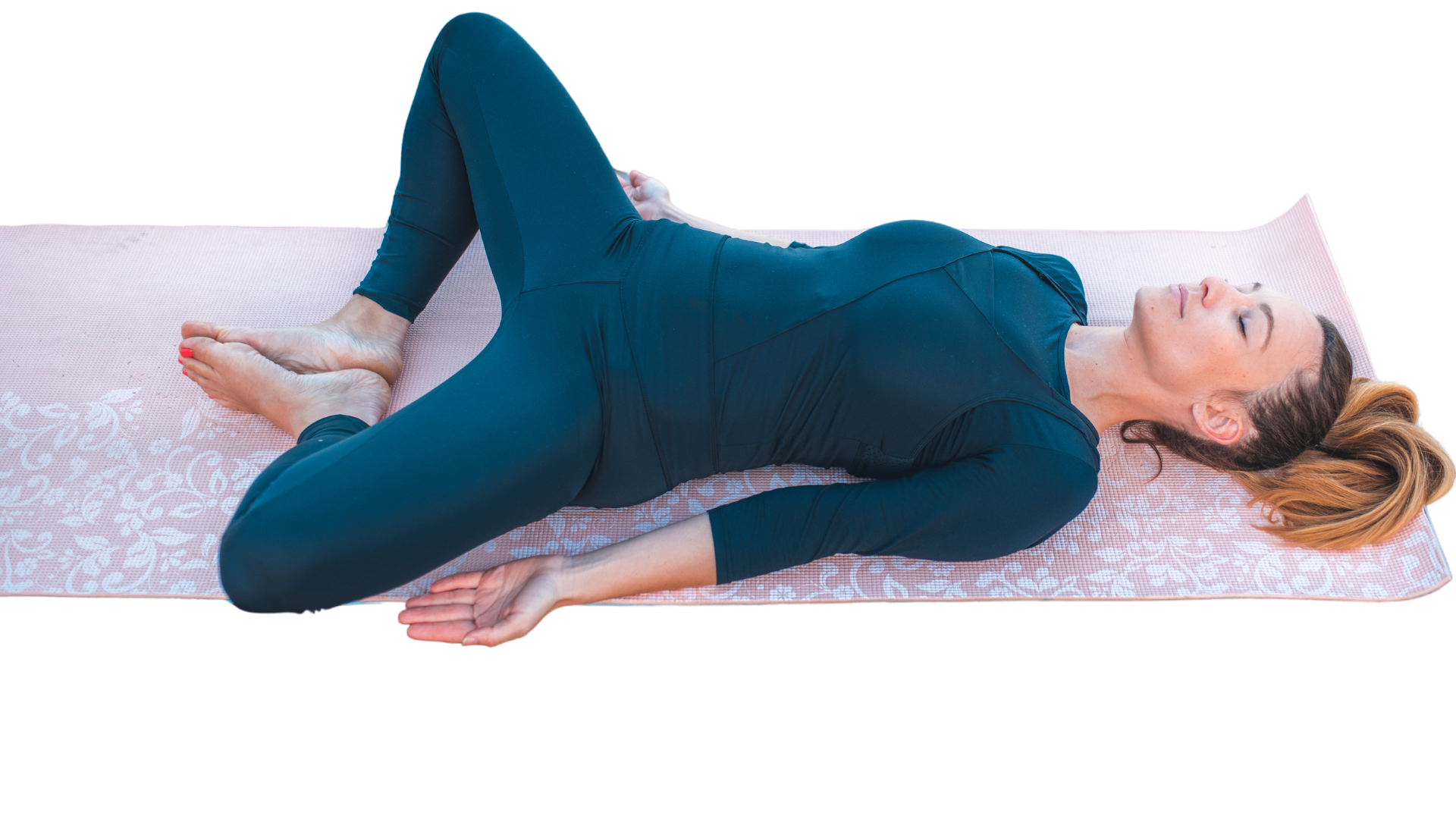
Reclined Bound Angle Pose. This is basically a nap with benefits. You bring the soles of your feet together and let your knees fall open like a book.
This pose is a direct antidote to the "closed" posture we adopt when we're stressed or cold. It opens the groin and the chest simultaneously. Many restorative yoga practitioners, following the lineage of B.K.S. Iyengar, suggest staying here for 10 to 20 minutes with a bolster under the spine.
Why so long? Because it takes about two minutes for the "stretch reflex" to calm down and the fascia to actually start responding. It’s deeply parasympathetic. It moves you out of "fight or flight" and into "rest and digest." Honestly, if you only have time for one of these yoga poses lying on back, make it this one. It’s the closest thing to a factory reset for your body.
Legs Up The Wall (Viparita Karani)
Technically, this is an inversion. You don't need a wall, but it helps. You’re essentially reversing the blood flow.
If you stand all day, your veins have to work incredibly hard to push blood from your feet back up to your heart. It's a long trip. By putting your legs up, you’re using gravity to assist venous return and lymphatic drainage. It reduces swelling in the ankles and can even help lower heart rate.
I’ve met athletes who swear by this after a marathon. I’ve met teachers who do it after eight hours on their feet. It’s restorative in the truest sense of the word. You don't have to do anything. Just exist.
Common Mistakes That Ruin the Benefits
- Tucking the chin: People often let their heads tilt back, compressing the back of the neck. If your chin is higher than your forehead, put a thin blanket under your head.
- Holding your breath: If you’re grimacing, your brain thinks you’re in danger. It will tighten the muscles to "protect" you, which is the exact opposite of what you want.
- The "Tailbone Curl": As mentioned, keep your sacrum heavy.
- Ignoring Pain: Sharp, shooting, or electric sensations are a "no." Dull aches are okay. Know the difference.
Actionable Steps for Your Routine
You don't need a 90-minute class to see results. Start with a five-minute "floor session" before bed.
- Minutes 1-2: Pelvic tilts to find your neutral spine.
- Minute 3: Reclined Big Toe Pose (each side) using a towel or belt.
- Minute 4: Reclined Twist to neutralize the spine.
- Minute 5: Savasana (Corpse Pose).
Savasana isn't just "lying there." It’s the final integration. It’s where your brain maps the changes you just made. Don't skip it. The floor is waiting.
Check your alignment daily. Use a mirror if you have to, but eventually, you'll start to "feel" when your hips are uneven or your shoulders are hiked up. This kinesthetic awareness travels with you when you stand up and walk back out into the world. It changes how you sit in your car and how you stand in line at the grocery store. That is where the real yoga begins.
Focus on the breath moving into the back of the ribs. Most of us are chest breathers. When you’re on your back, you can feel the ribcage expand into the floor. This 360-degree breathing is what actually stabilizes the core and calms the mind. Use the floor as your feedback loop. It's the most honest friend you've got.