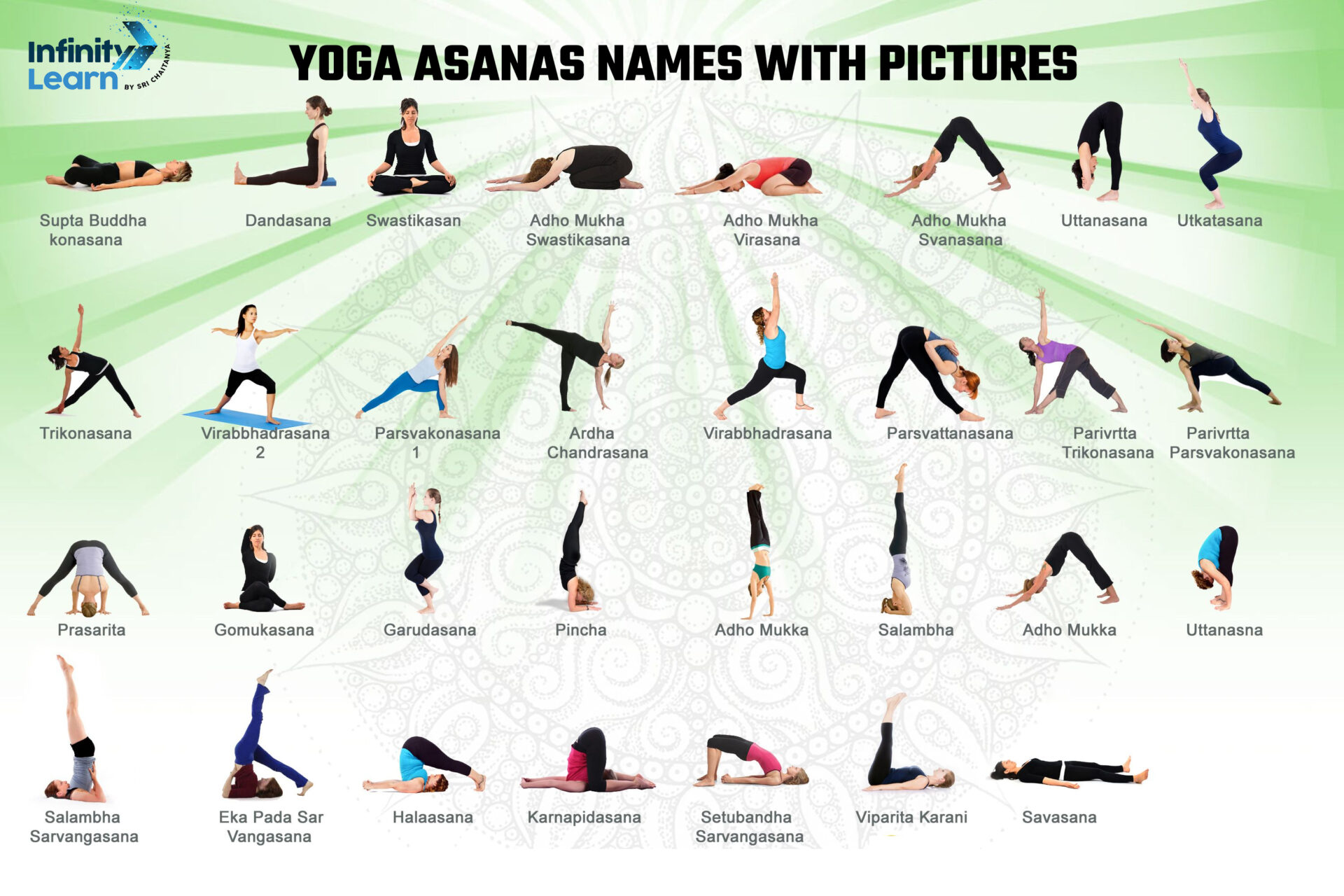
You’ve seen the photos. Usually, it’s a lithe person on a beach, silhouetted against a sunset, legs twisted into something resembling a human pretzel. It looks effortless. It looks like "yoga." But honestly, if you’re just scrolling through yoga poses images and names to find the "perfect" version of a posture, you might be setting yourself up for a massive headache—or a torn hamstring.
Most people treat these images like a blueprint. They think, "If my body doesn't look like that 22-year-old gymnast's body, I'm not doing the pose." That's total nonsense. Yoga isn't about the shape you make; it's about the space you create in your own body.
We need to talk about what these poses actually do and why the names matter more than you think.
The Disconnect Between the Image and the Anatomy
The internet is flooded with pictures of Adho Mukha Svanasana. You probably know it as Downward-Facing Dog. In almost every stock photo, the model has their heels flat on the floor and their back as straight as a ruler.
Here is the truth: most people have tight calves. If you force your heels down because the picture says so, your lower back will likely round like a dome. That's bad. It puts massive pressure on your lumbar spine. In a real clinical setting, a physical therapist would tell you to bend your knees. But a bend in the knees doesn't look "cool" in a thumbnail, does it?
Yoga poses images and names often prioritize aesthetics over biomechanics. Take Chaturanga Dandasana (Four-Limbed Staff Pose). It’s the yoga version of a push-up. If you look at high-end yoga photography, the practitioner is hovering inches off the mat, shoulders perfectly aligned with elbows. For a beginner, this is a recipe for rotator cuff surgery. Without significant serratus anterior strength, your shoulders will dip forward.
We have to stop chasing the "image" and start understanding the "asana." The word asana literally translates to "seat" or "steady, comfortable posture." If you’re gritting your teeth and shaking like a leaf to match a photo, you’ve missed the point of the Sanskrit name entirely.
Why Sanskrit Names Actually Help Your Practice
It's tempting to just use the English names. "Warrior I" is easier to say than Virabhadrasana I. But the Sanskrit names carry the DNA of the movement.
Take Trikonasana. Tri means three, kona means angle. Triangle Pose. Simple enough. But when you look at the name Tadasana (Mountain Pose), it implies a sense of rootedness and height that "Standing Pose" just doesn't capture. The name tells you how to feel, not just how to look.
When you study yoga poses images and names together, you start to see patterns.
- Ardha means half.
- Ut implies intensity or power.
- Baddha means bound.
If you see Baddha Konasana, you know your feet or hands are "bound" in some way. It’s a linguistic roadmap. If you're looking at a photo of someone doing a seated fold and the caption says Paschimottanasana, the name tells you it's an "intense stretch of the west." In yogic tradition, the back of the body is the "west" side. It’s a full-body posterior chain stretch, not just a way to touch your toes.
Breaking Down the "Big Five" Poses
Let's get into the weeds on the poses everyone searches for.
1. Vrikshasana (Tree Pose)
This is the classic balance pose. You see images of people with their foot pressed high against their inner thigh. The Reality Check: Do not put your foot on your knee. Ever. Your knee joint is not designed to take lateral pressure. If your foot doesn't reach your thigh, put it on your calf. Or even keep your toes on the ground like a kickstand. The "name" of the pose is Tree, but trees have different heights. You're still a tree if your foot is at your ankle.
2. Bhujangasana (Cobra Pose)
Images often show people with their arms bone-straight, looking up at the ceiling. The Nuance: This is often confused with Upward-Facing Dog (Urdhva Mukha Svanasana). In Cobra, your thighs stay on the ground. If you straighten your arms completely and your hips lift, you've changed the pose. If you have a stiff lower back, "Baby Cobra" with your elbows bent is actually more effective for strengthening your erector spinae muscles than forcing a "full" expression.
3. Balasana (Child's Pose)
The "rest" pose. The Struggle: Many people find this pose incredibly uncomfortable because their hips don't touch their heels. That’s fine. Use a blanket. Put a block under your head. The image of the "perfect" child's pose—forehead to mat, butt to heels—is a goal, not a requirement for entry.
4. Utkatasana (Chair Pose)
The name literally means "Fierce Pose." The Misconception: People often try to keep their back perfectly vertical. Physics says no. Unless you have the ankle mobility of a professional ballet dancer, your torso will lean forward. Focus on weight in the heels. If your toes are lifting, you’re doing it right. If you’re looking at yoga poses images and names for this one, notice the alignment of the knees—they should stay parallel, not knocking together.
5. Savasana (Corpse Pose)
It looks like just lying down. It is arguably the hardest pose in the entire system. The Depth: You aren't just napping. You’re practicing conscious relaxation. If you’re fidgeting with your leggings or thinking about grocery shopping, you’re just lying on the floor. The "image" is still, but the internal work is massive.
The Problem With "Advanced" Yoga Photography
Instagram and Pinterest have ruined our perception of what a healthy yoga practice looks like. We see King Pigeon (Eka Pada Rajakapotasana) and think that’s the gold standard.
In reality, extreme backbends can lead to spondylolisthesis—a condition where one vertebra slides over another—if done without proper core engagement. I’ve seen practitioners who can put their heads on their butts but can't hold a basic plank for thirty seconds. That’s not yoga; that’s hypermobility without stability.
When you're browsing yoga poses images and names, look for "active" poses. Look for images where the muscles look engaged, not just hanging out in the joints. A "good" image of a pose should show a line of energy. In Warrior II, for example, the arms shouldn't just be dangling; they should be reaching as if being pulled from both ends.
How to Actually Use This Information
If you want to start a home practice using yoga poses images and names as a guide, stop looking at the "final" version. Look for "modifications" or "props."
Yoga blocks are not "cheating." Straps are not for "weak" people. They are tools to bring the floor to you. If you’re doing Trikonasana and you can’t reach the floor without collapsing your chest toward the ground, use a block. Now you have the "angle" the name promises without the structural collapse.
Dr. Ray Long, a board-certified orthopedic surgeon and long-time yoga practitioner, has written extensively on this. He uses 3D medical illustrations to show what’s happening under the skin. When you see the muscular engagement required for a "simple" pose like Tadasana, you realize that standing still is actually a complex physiological event.
Actionable Steps for Your Practice
Don't just look at pictures. Do this instead:
- Focus on the Foundation: In any pose, look at what is touching the floor. If it's your feet, spread your toes. If it's your hands, press through the knuckles. This is called Pada Bandha and Hasta Bandha. It's the "secret sauce" that makes poses feel stable.
- Film Yourself: This is the best way to bridge the gap between "what I feel" and "what I look like." Compare your video to a reputable source—not a random influencer, but someone like Yoga Journal or B.K.S. Iyengar’s Light on Yoga.
- Learn Five Sanskrit Terms a Week: Start with the basics like Adho (down), Urdhva (up), Utthita (extended), Paschim (back/west), and Purva (front/east). It changes how you hear a teacher's cues.
- Prioritize Spine Over Limbs: If a pose asks you to touch your toes but your back rounds painfully, forget your toes. Keep your spine long. A long spine is always the priority in Hatha yoga.
- Change Your Search: Instead of "yoga poses images," search for "yoga pose alignment cues" or "yoga pose anatomy." You'll get much more useful information that won't lead to an injury.
Basically, stop trying to win yoga. You can't win. It’s just you on a mat, breathing through some uncomfortable positions until your brain calms down. The images are just suggestions. Your body is the reality. Focus on the reality.



