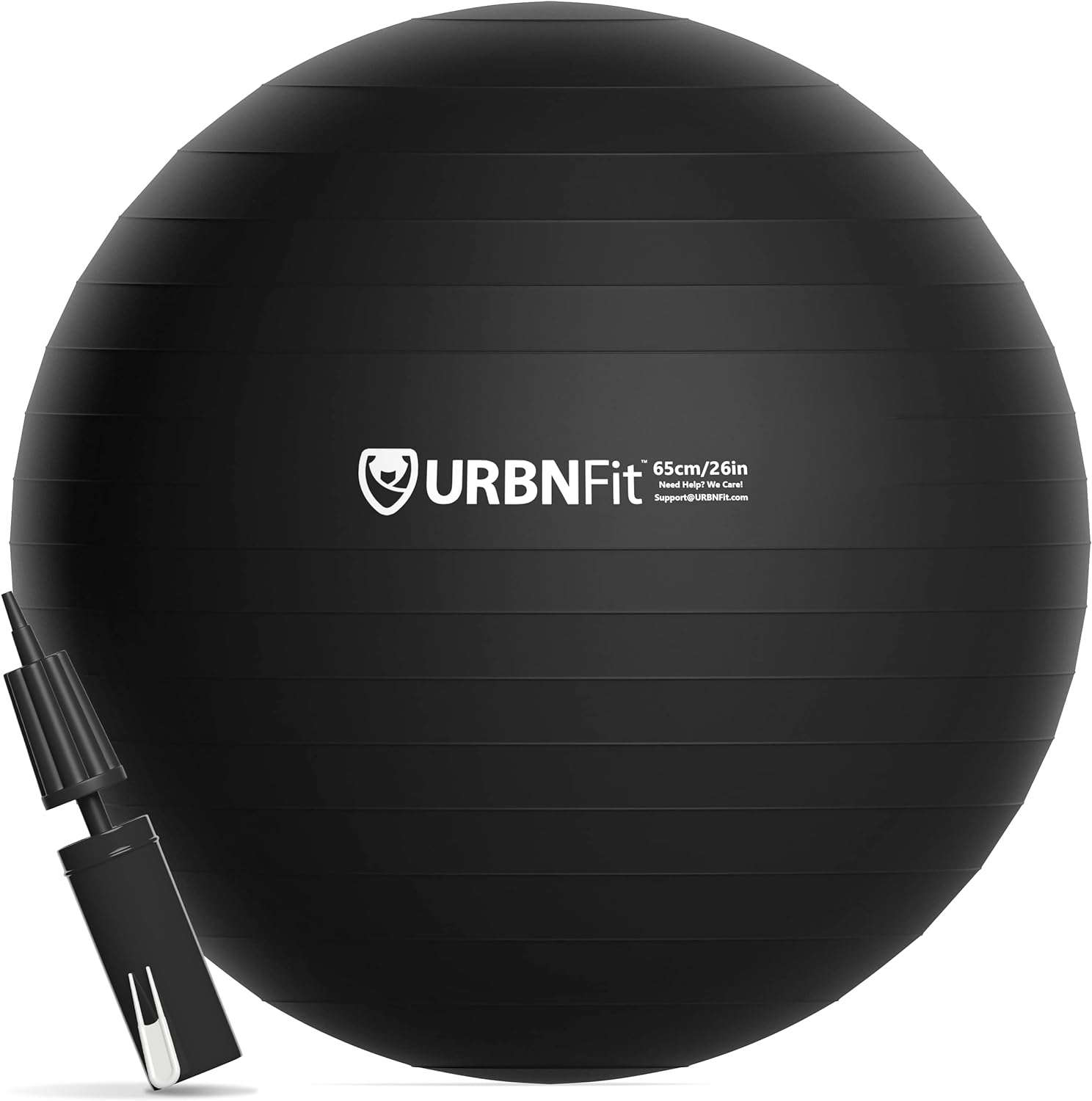
You think you have a strong core because you can hold a plank for two minutes. Honestly? You’re probably just good at bracing against a floor that doesn't move. The second you introduce a 65cm sphere of unstable PVC, everything changes. Your stabilizer muscles—the ones you didn't even know existed—start screaming. That is the magic (and the frustration) of a yoga on the ball workout. It’s not just yoga with a prop. It is a total recalibration of how your body perceives balance.
Most people see the Swiss ball, or Physioball, in the corner of the gym and think of it as a chair for people with lower back pain. That’s a mistake. When you combine the mindful, isometric holds of Hatha or Vinyasa with an unstable surface, you're essentially forcing your nervous system to work overtime. It’s hard. It's humbling. If you liked this article, you might want to look at: this related article.
The science of why wobbling is actually good for you
Stability is a lie. Well, at least "static" stability is. In the real world, your body has to react to uneven pavement, sudden shifts in weight, or a dog pulling on a leash. Traditional yoga on a mat is fantastic for flexibility and strength, but it provides a predictable base of support. A yoga on the ball workout removes that safety net.
When you’re doing a standard Warrior II, your feet are glued to the earth. Now, imagine trying to find that same pelvic alignment while one shin is resting on a ball that wants to roll toward the door. Research published in the Journal of Strength and Conditioning Research has shown that performing exercises on an unstable surface increases electromyographic (EMG) activity in the trunk muscles significantly compared to stable ground. You aren't just doing a pose; you’re surviving it. For another look on this development, check out the recent update from Everyday Health.
This isn't just about getting "six-pack abs." It’s about the multifidus and the transversus abdominis. These are the deep-layer muscles that wrap around your spine like a corset. A stability ball forces these muscles to fire in micro-adjustments. You won't feel it like a "burn" from a crunch. It feels more like a deep, internal heat. It's subtle until it isn't.
Size matters (and so does air pressure)
If the ball is too big, you can’t reach the floor properly. Too small? Your knees will be higher than your hips, which is a disaster for your lower back. Generally, if you’re between 5'4" and 5'11", a 65cm ball is your best friend.
Don't inflate it until it's rock hard. That’s a rookie move. If the ball is slightly—just slightly—squishy, it has a larger contact patch with the floor. This makes it a bit more stable, which is what you want when you’re first starting out. As you get better, pump it up. The harder the ball, the more it wants to escape from under you.
Reimagining the classics: Poses that change everything
Let’s talk about the Downward Facing Dog. On a mat, it’s a resting pose for many. On the ball? It’s a shoulder-stability nightmare. You place your hands on the ball and push back. Because the ball can roll forward or sideways, your rotator cuff muscles have to engage intensely to keep your chest from collapsing.
Then there’s the Tree Pose. Balancing on one leg is one thing. Placing your lifted foot against a ball instead of your inner thigh? That’s a different game. Or, for the truly brave, try a Plank with your shins on the ball and your hands on the mat. Now, pull your knees toward your chest. This is the "Ball Tuck." It’s basically a high-intensity version of a yoga crunch that targets the psoas and lower abdominals with surgical precision.
The Pelvic Tilt: Small move, huge impact
Sit on the ball. Just sit there. Feet flat, spine tall. Now, tilt your pelvis forward and back without moving your head. It looks like you're doing nothing. In reality, you're hydrating your spinal discs. Dr. Stuart McGill, a world-renowned expert in spine biomechanics, often discusses the importance of "spine hygiene." Moving the pelvis on a ball allows for gentle mobilization of the lumbar spine without the heavy loading of traditional weights. It’s restorative, but because you’re on a ball, your core is still "on" to prevent you from sliding off.
Why most people get the "Ball Workout" wrong
The biggest mistake is trying to be a circus performer on day one. I've seen people try to stand on the ball while doing a prayer pose. Don't do that. It's a great way to end up in the ER. The goal of a yoga on the ball workout is controlled instability, not chaos.
- Focus on breath, not just balance. If you hold your breath, your muscles tense up, and you actually become less stable.
- Keep your gaze fixed. In yoga, we call this Drishti. If your eyes are darting around the room, the ball will follow your lead.
- Use a wall. There is no shame in placing the ball against a corner. It limits the range of motion and lets you focus on the yoga form rather than just "not falling."
Yoga purists sometimes argue that props take away from the spiritual essence of the practice. I disagree. Anything that forces you to be 100% present in your body is "yoga." You cannot think about your grocery list or that annoying email from your boss while you're trying to hold a Bridge Pose with your heels on a ball. The moment your mind wanders, the ball leaves. It is the ultimate mindfulness coach.
Advanced sequences: The "Float" factor
Once you’ve mastered the basics, you can start incorporating "floats." This is where you move from one pose to another while keeping the ball in constant motion or, conversely, perfectly still.
Imagine a Cobra Pose where your belly is draped over the ball. As you inhale, you lift your chest, using the ball to provide feedback against your diaphragm. As you exhale, you roll forward into a modified plank. The transition is seamless. It’s fluid. It feels more like dancing than exercise. This is where the "yoga" part really shines—finding the flow in the midst of a physical challenge.
Specific benefits for athletes
If you’re a runner or a cyclist, your hip flexors are probably tighter than a guitar string. A yoga on the ball workout allows for passive stretching that is hard to achieve otherwise. Laying your back over the ball (the "Heart Opener") creates a supported backbend that opens the chest and stretches the intercostal muscles between the ribs. It's the perfect antidote to the "hunched over" posture we all adopt at our desks.
Actionable steps for your first session
Don't just jump on and hope for the best. Follow this logic to avoid a bruised ego or a bruised tailbone.
- Check the air. Press your thumb into the ball. It should indent about two inches. If it’s like a bowling ball, let some air out.
- Establish three points of contact. When starting, try to have two feet and the ball on the ground, or one foot, one hand, and the ball. Moving to two points of contact (like one foot on the ball) is the "level up."
- Start with "Seated Marches." Sit on the ball and lift one foot off the ground at a time. If you can’t do this without the ball swaying wildly, you aren't ready for standing poses.
- The 5-Minute Rule. Don't try to do a 60-minute session. Your stabilizer muscles fatigue much faster than your big muscles. Start with five minutes of ball work at the end of your regular yoga routine.
- Use a non-slip surface. Do not do this on a hardwood floor with socks on. Use a high-quality yoga mat under the ball to provide traction.
A yoga on the ball workout is a tool for longevity. It builds the kind of functional strength that keeps you moving well into your 70s and 80s. It’s about the "little" muscles. It’s about the nerves. And honestly, it’s just fun to bounce around a bit while you’re getting fit.
Forget the "perfect" mat practice for a second. Get a ball. Get wobbly. Get stronger from the inside out. Your spine will thank you, even if your abs are swearing at you the next morning.
The real work starts when the floor stops being a constant. Focus on the micro-movements. Pay attention to the shake in your legs—that’s your nervous system "downloading" new balance protocols. Stay consistent, keep the breath moving, and let the ball be the teacher you didn't know you needed.