You’re in the middle of a downward dog, sweating through a particularly intense Vinyasa flow, and suddenly your hands start to migrate. Then your feet join in. Before you know it, you’re doing a slow-motion split that definitely wasn't in the teacher’s lesson plan. It’s annoying. Honestly, it’s also kinda dangerous. While the purists will tell you that bare feet are the only way to truly connect with the earth—or the studio’s laminate flooring—a lot of us are realize that yoga non slip socks are actually a game-changer for stability.
Feet sweat. Mats get slick. Not everyone wants to touch a communal floor that’s seen a hundred different sets of toes before lunch.
The Reality of Grippy Socks in the Studio
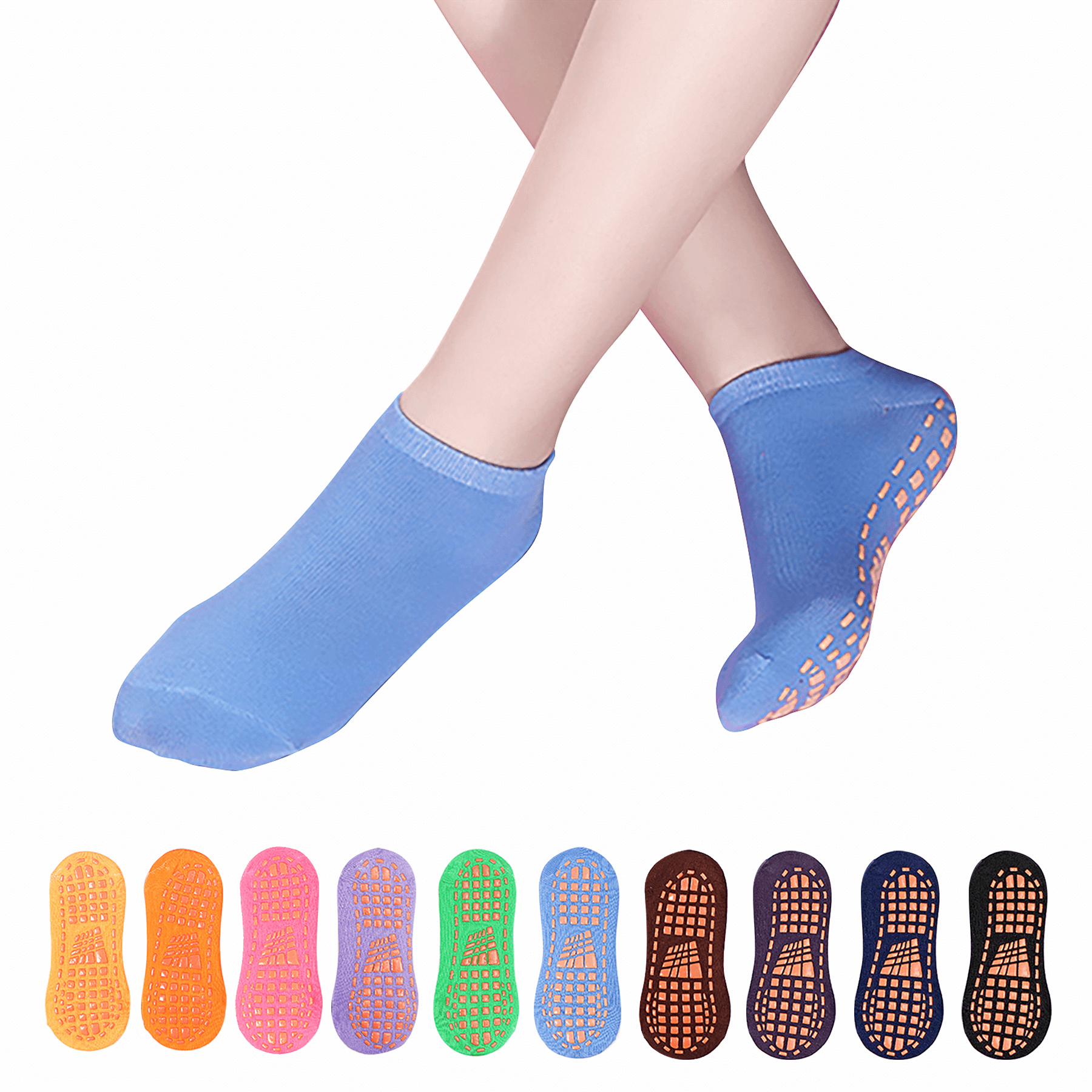
Most people think of these as "hospital socks" with better branding. That’s a mistake. Real technical grip socks are engineered with silicone or PVC patterns on the sole to create a mechanical bond between you and the ground. If you’ve ever felt your ankles wobbling during a Tree Pose, it might not be a lack of core strength. Sometimes, it’s just physics. When your foot lacks a solid foundation, your entire kinetic chain—from your ankles up to your hips—has to overcompensate.
I’ve seen beginners struggle for months because they’re fighting the floor. They can't find their "edge" because their edge is literally sliding away from them.
Why the "Barefoot or Bust" Mentality is Fading
There used to be this weird elitism in yoga circles. If you weren't barefoot, you weren't doing it right. But let's look at the actual hygiene. A study published in the International Journal of Environmental Research and Public Health has highlighted how gym floors and shared mats can be breeding grounds for fungi like Tinea pedis (athlete's foot) and various bacteria. Using yoga non slip socks acts as a barrier. It's not just about the grip; it's about not bringing home a skin infection as a souvenir from your 6:00 PM class.
Plus, studios are cold. Especially in the winter. If your muscles are cold, you’re more prone to injury. Keeping your feet warm helps maintain blood flow, which keeps your ligaments a bit more pliable. It’s a small detail, but it matters when you’re trying to deep-stretch your hamstrings.
Identifying Quality: Not All Grips are Created Equal
You’ll see cheap five-packs at the dollar store. Avoid them. Seriously. Those little plastic dots usually fall off after three washes, and then you’re just left with regular socks that are somehow even more slippery than being barefoot.
High-quality yoga non slip socks use "fused" silicone. Brands like Toesox or Gaiam have spent years refining the placement of these grips. Look at your foot. You don't need grip in the arch. You need it on the heel and the ball of the foot. That’s where the pressure is. If a sock has a uniform pattern across the whole bottom, it wasn't designed by someone who actually practices yoga. It was designed by a factory.
Toes: To Spread or Not to Spread?
This is where things get controversial in the locker room. You have two main styles:
- Five-Toe Socks: These look like gloves for your feet. They allow your toes to splay naturally. This is huge for balance. When your toes are smashed together in a standard sock, you lose your "tripod" base.
- Standard Closed-Toe: These look like normal ankle socks but with grip. Better for warmth, but you lose that tactile toe-spread.
- Half-Toe (Toeless): These have the grip on the sole but your toes are actually poking out. It's the "best of both worlds" for some, giving you grip on the heel while letting your toes touch the mat for sensory feedback.
Personally? I find the five-toe versions a bit fidgety to put on when you’re in a rush, but the stability they offer in balancing poses is objectively better. You’ve gotta decide if you mind the feeling of fabric between your toes. Some people hate it. It’s a total sensory thing.
The Science of Proprioception and Grip
Proprioception is your body's ability to sense its position in space. When you wear a thick, cushioned sock, you numb that sense. That’s why yoga non slip socks are usually very thin. They want to protect the skin and provide traction without disconnecting your brain from the floor.
Think about a mountain climber. They don't wear mittens. They need to feel the rock. You need to feel the mat.
A lot of practitioners find that the extra traction allows them to hold poses longer. When you aren't worried about sliding, you can actually focus on your alignment. You can tuck your tailbone, knit your ribs, and breathe. If 40% of your brain is worried about your foot sliding into the person's mat next to you, you aren't really doing yoga. You’re just surviving.
Common Misconceptions About Grip Socks
People think they make you "lazy." The argument is that you should build the foot strength to grip the mat yourself.
That’s fine in theory. In practice? Most of us are practicing on PVC or TPE mats that get slick the second a drop of sweat hits them. Even the most advanced yogis use towels or specialized gear when the room hits 90 degrees. Using yoga non slip socks isn't "cheating." It's tool optimization.
Another myth: they're only for old people or beginners. Nope. Go to a high-end Pilates or Lagree studio. Almost everyone is wearing them. In fact, many studios now require them for safety on the reformers. Yoga is catching up to that reality. If you’re doing power yoga or anything high-intensity, the "barefoot only" rule is more of a tradition than a practical necessity.
How to Wash Them So They Actually Last
Don't just toss them in with your jeans. If you want the grip to stay "grippy," you have to treat them like the technical gear they are.
- Turn them inside out. This protects the silicone bits from rubbing against the drum of the washing machine.
- Cold water only. Heat is the enemy of elastic and silicone.
- Air dry. Do not—I repeat, do not—put them in the dryer on high heat. You’ll melt the adhesive, and they’ll start peeling. Or worse, they’ll get "crunchy." Nobody wants crunchy socks.
Finding Your Perfect Pair
If you’re ready to try them out, don't buy a bulk pack immediately. Buy one pair of five-toe and one pair of standard "bell" socks. Test them. See if the fabric between your toes drives you crazy or makes you feel like a superhero.
Check the material list. Aim for a high cotton or bamboo content for breathability, but make sure there’s at least 5-10% spandex or elastane. Without the stretch, the sock will slide around your foot while the grip stays stuck to the floor. That’s a recipe for a twisted ankle. You want the sock to feel like a second skin.
Practical Next Steps for Your Practice
- Audit your mat first: If your mat is over two years old, the "sticky" factor is probably gone. If socks don't help, it's the mat.
- Check the grip pattern: Look for socks where the silicone is concentrated on the "ball" and the "heel."
- Test on a hard surface: Before you head to class, try a few lunges on your kitchen floor. If you feel any internal sliding (your foot moving inside the sock), the size is too big.
- Invest in "tab" heels: Look for socks with a little padded tab on the back of the heel. It prevents the sock from sliding down into your shoe or off your foot during mountain climbers or planks.
- Hygiene check: If you practice more than three times a week, you need at least four pairs. Using damp, dirty socks is worse than going barefoot.
Yoga is about focus. If your equipment—or lack thereof—is stealing your focus, it’s time to change the equipment. A solid pair of yoga non slip socks won't do the work for you, but they'll definitely stop the floor from working against you.