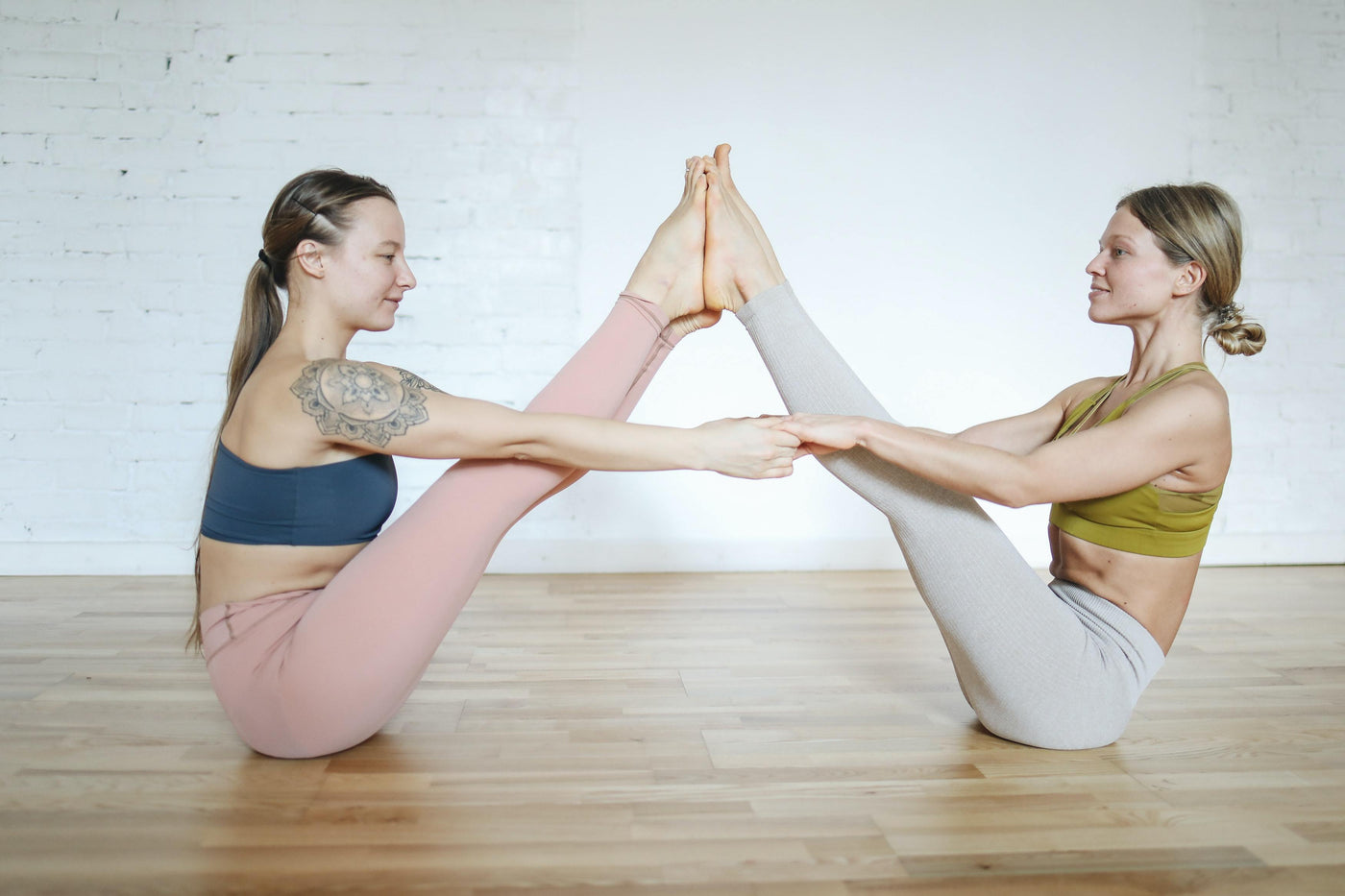
You’re probably here because you tried a basic "Double Tree" pose after seeing a photo on Instagram and ended up in a tangled heap on the living room floor. It happens. Honestly, social media makes yoga moves with a partner look like a seamless, gravity-defying art form, but the reality involves a lot of awkward bumping into each other and accidental elbowing.
Partner yoga isn't just "twice the yoga." It’s a completely different physiological experience. When you practice alone, your nervous system is only managing your own proprioception—your sense of where your body is in space. Add a second person, and your brain has to process a whole new set of external variables. Their weight, their breath, and their specific range of motion become yours to manage too.
The science of why we wobble together
It’s about the "mirror neuron" system.
When you synchronize your breath with someone else during yoga moves with a partner, you aren't just being "zen." You’re engaging in what researchers call physiological synchrony. A 2017 study published in Scientific Reports suggested that when two people are in sync, their heart rates actually start to align. It’s wild. But if one person is stressed or holding their breath, the other person’s body picks up on that tension instantly. This is why you can do a perfect Plank alone but fail miserably when your partner tries to hold your ankles.
Communication is the part everyone skips. You think you can just "feel" the vibe. You can't. You need to talk. "More weight on the left" or "Hey, you're crushing my toes" are valid cues. If you aren't talking, you aren't doing it right.
Breaking down the moves that actually work
Forget the crazy AcroYoga flips for a second. Start with the grounded stuff.
The Back-to-Back Chair Pose
This one is a classic for a reason. You stand back-to-back, feet hip-width apart, and slowly lower into a squat. The trick? You have to lean into each other. If one person pulls away, you both fall. It creates this weirdly intense isometric hold in your quads because you’re essentially using each other as a human wall.
Most people mess this up by not walking their feet out far enough. Your knees should be at a 90-degree angle. If your heels are too close to your partner's, your knees will overshoot your toes, and that’s a one-way ticket to joint pain. Trust me, your knees will thank you for the extra six inches of space.
Seated Forward Fold and Fish Combo
One person sits in a wide-legged fold, and the other leans back over them. This is one of those yoga moves with a partner that feels better than a professional massage if you do it right. The person on the bottom gets a deep hamstring stretch, while the person on top gets a massive chest opener.
But here’s the nuance: weight distribution.
If the person on top just flops down like a dead weight, the person on the bottom is going to have a bad time. You have to communicate. The "folder" should guide the "leaner" down. It’s a delicate dance of spinal decompression. If you feel a sharp pinch, stop. This isn't about pushing through pain; it’s about using the other person’s body weight to find a depth you couldn't reach solo.
Why the "base" and "flyer" dynamic is misunderstood
In more advanced yoga moves with a partner, like the Front Bird, one person stays on the ground (the base) and the other is elevated (the flyer).
People assume the base needs to be incredibly strong. While strength helps, it’s actually about "bone stacking." If the base keeps their legs perfectly vertical—meaning the ankles are directly over the hips—the weight of the flyer travels straight down into the floor. It’s physics. If the legs are at an angle, the base has to use their muscles to hold the weight. That’s exhausting.
The flyer, on the other hand, needs to be "active." Don't be a wet noodle. Tension is your friend here. By engaging your core and keeping your body rigid, you make it much easier for the base to balance you. It’s counterintuitive, but being stiff makes you feel lighter.
Dealing with the inevitable "ego" clash
Let’s be real: someone is usually "better" at yoga than the other.
This creates a power imbalance that can ruin the session. If you’re the flexible one, don't force your partner into a deeper stretch than they're ready for. Yoga teacher and author Donna Farhi often talks about the concept of ahimsa (non-harming). This applies doubly when you’re literally holding someone else’s physical safety in your hands.
If your partner’s hamstrings are tight, don't push on their back. Just don't. You can cause a micro-tear in the muscle or, worse, a disc issue. Partner yoga should be a supportive dialogue, not a competition to see who can get closer to the floor.
Variations you haven't thought of
- Partner Navasana (Boat Pose): Sit facing each other, grab hands, and press the soles of your feet together. Slowly straighten your legs. It’s a core killer.
- Double Downward Dog: One person does a standard dog, the other places their hands about a foot in front of the base’s hands and rests their feet on the base’s lower back/sacrum. It’s basically a handstand with a built-in safety net.
- Temple Pose: Stand facing each other, fold forward at the hips, and touch palms. Walk back until your torsos are parallel to the ground. It’s a massive shoulder opener.
The gear you actually need (and what you don't)
You don't need fancy matching outfits. You do need a high-grip mat. When two people are exerting force on one or two mats, things slide. A thin, cheap mat will bunch up and cause a trip hazard. Look for something with "open-cell" technology or a natural rubber base. Brands like Manduka or Lululemon’s 5mm mat are standard for a reason—they stay put.
Also, wear leggings or shorts that stay put. There’s nothing more distracting than having to adjust your waistband while you’re trying to balance another human being on your feet. Friction is actually helpful in partner yoga, so maybe skip the super-slick "second skin" fabrics if you’re planning on doing any lifting.
Putting it all into practice
Don't jump into a 60-minute session. Start with 10 minutes. Pick three moves.
Step 1: The Check-in. Sit cross-legged, back-to-back. Just breathe. Feel their ribs expand against yours. If you can't sync your breath here, you definitely won't be able to do it while balancing on their feet.
Step 2: Simple Weight Shifts. Try the back-to-back standing transition. Just move from standing to a slight squat and back up. Feel where the pressure points are.
Step 3: The "Safe Word." Pick a word that means "get me out of this pose immediately." "Stop" works, but sometimes a specific word like "down" or "alpha" helps clear the mental fog when you're upside down and panicking.
Step 4: Practice Symmetry. Whatever you do on one side, do on the other. If one person was the "base" for a stretch, swap roles if the physical ability allows. This builds empathy for what the other person is experiencing.
Yoga moves with a partner are a lesson in vulnerability. You're giving up control and trusting someone else with your center of gravity. It’s okay if it’s messy. It’s okay if you laugh the whole time. In fact, if you aren't laughing at least once, you're probably taking it way too seriously.
Focus on the mechanics first, the connection second, and the "cool photo" last. You’ll find that the physical benefits of the deeper stretches are great, but the mental benefit of actually communicating with another person without a screen in the way is where the real value lies.
If you're ready to start, clear a space that is at least twice the size of a standard yoga mat. Remove any sharp-cornered furniture nearby. Start with the Back-to-Back Chair pose to test your mutual stability before moving into any weight-bearing stretches. Maintain constant verbal feedback regarding pressure and tension levels to ensure both practitioners remain within their safe range of motion.