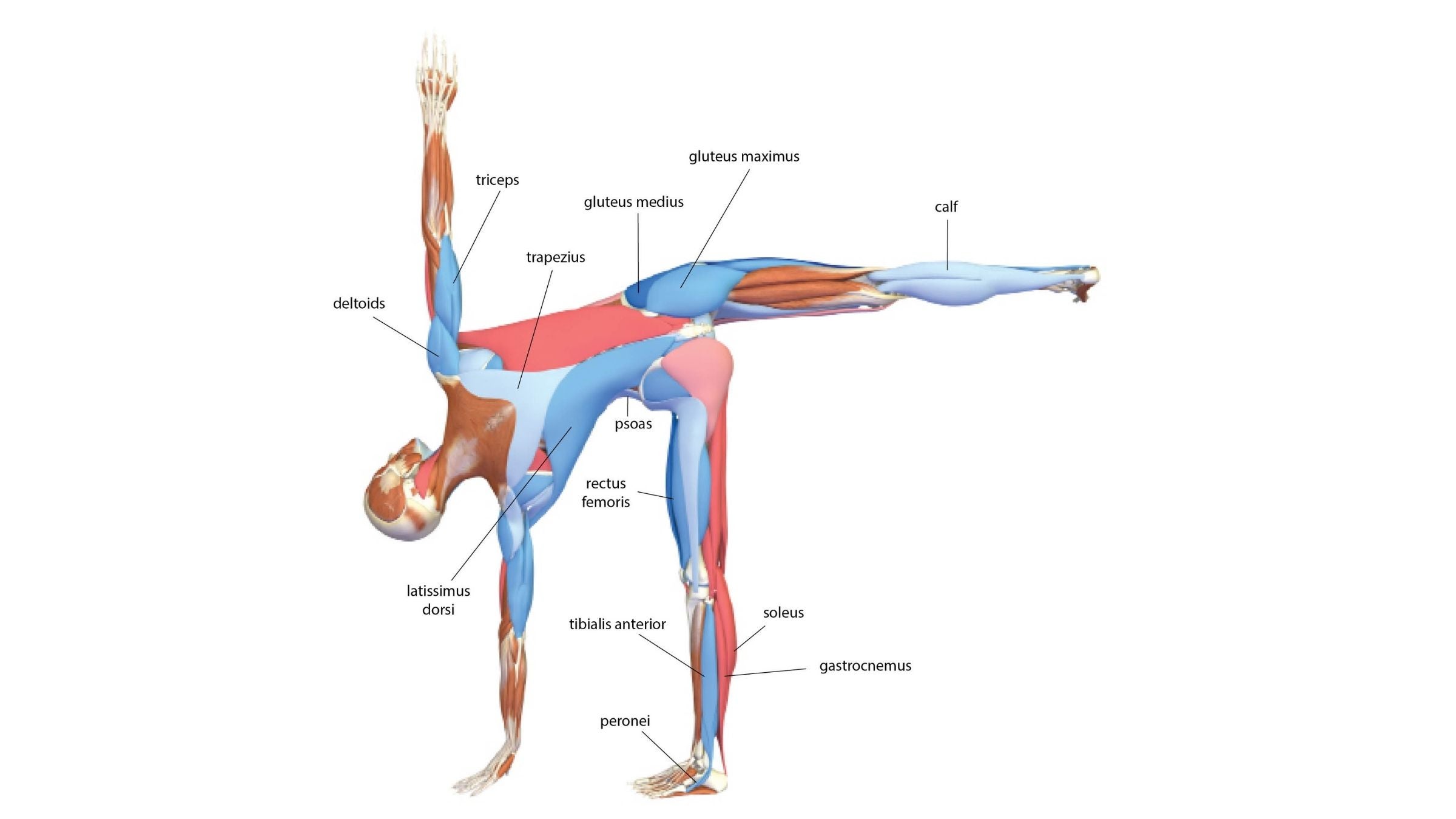
You’re standing on one leg. Your fingertips are grazing the floor, your chest is trying to peel open toward the ceiling, and suddenly, your ankle starts doing that frantic little dance. You know the one. It’s the "I’m about to tip over" shimmy. Honestly, yoga half moon pose, or Ardha Chandrasana if you want to get fancy with the Sanskrit, is one of those shapes that looks incredibly graceful in a filtered Instagram photo but feels like a chaotic disaster the first fifty times you try it in a crowded studio. It’s a literal balancing act between strength and surrender.
Most people approach this pose like they’re trying to pin a butterfly to a board. They stiffen up. They hold their breath. They pray to the yoga gods that they don't take out the person on the mat next to them. But here’s the thing: Ardha Chandrasana isn’t really about the leg that’s in the air. It’s about the relationship between your pelvis and the floor. It’s a side-body opener, a hip strengthener, and a massive test of your proprioception. If you've been struggling with it, you aren't alone. It’s objectively hard. For a more detailed analysis into this area, we recommend: this related article.
The Biomechanics of Why Yoga Half Moon Pose Destroys Your Balance
Let’s get nerdy for a second. When you transition into yoga half moon pose, you’re moving your center of gravity while simultaneously rotating your torso. That’s a lot for the brain to process. According to B.K.S. Iyengar in his seminal text Light on Yoga, the pose is designed to tone the lower spine and the nerves connected with the leg muscles. But if your gluteus medius—that muscle on the side of your hip—isn't firing, your pelvis will "tuck" or "dump," and down you go.
Gravity is pulling your floating ribs toward the floor. Your standing foot is trying to map out a surface area that feels way too small. Most practitioners make the mistake of looking up at their top hand way too early. Big mistake. Huge. Your gaze (or drishti) is your anchor. If your eyes are darting around the room looking at your neighbor's leggings, your nervous system is going to freak out. Keep your eyes on the floor. It’s stable. It’s not moving. To get more background on the matter, comprehensive reporting can also be found at Mayo Clinic.
Common Pitfalls That Make You Fall
- The "Locked Knee" Syndrome: You’re so worried about staying up that you jam your standing knee back into hyperextension. This is a one-way ticket to joint pain. A micro-bend is your friend.
- The Droopy Back Leg: If that lifted leg is just hanging out like a wet noodle, it becomes dead weight. You have to flex that foot. Imagine you’re pushing a heavy door shut with your heel.
- Collapsing the Bottom Shoulder: Don't dump all your weight into your bottom hand. That hand is a kickstand, not a weight-bearing pillar.
The Core-Hip Connection
You’ve probably heard teachers yell about "engaging your core" until the words lose all meaning. In the context of yoga half moon pose, this doesn't mean doing a thousand crunches. It means finding the connection between your inner thighs and your lower abdominals.
Think about the transverse abdominis. It’s like a natural corset. When this is engaged, it stabilizes the sacroiliac (SI) joint. This is crucial because, in Half Moon, you’re basically asking your SI joint to support the weight of your entire upper body while rotated. Without that core support, you’re putting a lot of "shear" force on the lower back. This is why some people complain of a pinch in their glute or lower spine after practicing this pose. It’s usually a stability issue, not a flexibility one.
Using Props Without Feeling Like a Failure
There is this weird stigma in some yoga circles that using a block is "cheating." That is total nonsense. In fact, using a block in yoga half moon pose often makes the pose harder in the right ways. By bringing the floor up to meet you, you allow your torso to actually lengthen.
- Place the block about 12 inches in front of your pinky toe.
- Keep it on the highest setting.
- Press down into the block to find "rebound" energy that lifts your chest.
When the floor is too far away, most people round their spine to reach it. This closes off the heart and makes it impossible to stack the hips. If you use a block, you can actually align your shoulders and find that beautiful, expansive "X" shape that the pose is famous for. Honestly, even advanced practitioners like Jason Crandell frequently advocate for props to maintain the integrity of the spinal alignment.
Variations for Different Bodies
Not everyone is built the same. If you have tight hamstrings, the "traditional" version of yoga half moon pose is going to feel like a nightmare. Your standing leg will shake, and your back will round.
Try Chapasana (Sugarcane Pose) if you want a challenge. This involves reaching back with your top hand to grab your lifted foot. It turns the balance into a heart-opener and a quad stretch. But be warned: the moment you kick that foot into your hand, your center of gravity shifts again. It’s a whole new game.
On the flip side, if you have inner ear issues or vertigo, don't look up. Keep your gaze at the floor. You can also practice with your back against a wall. This takes the "fear of falling" out of the equation and lets you focus entirely on the muscular engagement of the outer hips and the expansion of the chest. It feels amazing. You can actually feel what it’s like to be "flat" like you’re between two panes of glass.
The Mental Game of Balancing
Yoga is 90% mental, and yoga half moon pose is the ultimate BS detector. If you’re frustrated, the pose will show it. You’ll be rigid. If you’re distracted, you’ll wobble.
There’s a concept in yoga philosophy called Abhyasa (practice) and Vairagya (dispassion). You have to put in the effort, but you also have to let go of the result. If you fall, you fall. Big deal. The floor is right there. It’s just yoga. The moment you stop caring about looking "perfect" in the pose is usually the moment you actually find your balance.
Step-by-Step Entry for Maximum Stability
Forget the "graceful leap." Let’s do this methodically.
- Start in Triangle Pose (Trikonasana).
- Look down at your front foot and bend that knee slightly.
- Shift your weight forward and place your hand (or block) on the floor.
- Lift your back leg until it’s parallel to the ground.
- Flex that back foot hard. Like you're standing on an invisible wall.
- Slowly—very slowly—start to straighten your standing leg without locking the knee.
- Peel your top shoulder back.
- If you feel steady, reach your top arm toward the sky.
Science-Backed Benefits of Half Moon
It's not just about looking cool. A study published in the Journal of Physical Therapy Science suggests that single-leg balancing poses significantly improve postural sway and ankle stability. This is huge as we age. Preventing falls is one of the most practical things you can do for long-term health.
Beyond the ankles, you're working the lateral stabilizers of the knee. The IT band, the glute medius, and the tensor fasciae latae (TFL) all have to work in unison. It’s a total lower-body workout disguised as a stretch. Plus, the rotational element provides a gentle massage to the abdominal organs, which some practitioners find helps with digestion, though the evidence there is more anecdotal than clinical.
Summary of Actionable Steps
If you want to master yoga half moon pose, stop trying to "do" the pose and start building it from the ground up. Balance is a dynamic process, not a static destination. You are constantly making micro-adjustments.
- Focus on the standing big toe. Press it into the mat. It’s your primary stabilizer.
- Engage the lifted leg. A lazy leg is a heavy leg. Engage the quad and flex the foot.
- Use a wall. Stand six inches away from a wall and let your butt or shoulder lightly touch it. It builds muscle memory without the stress.
- Check your gaze. Pick a spot on the floor and don't move your eyes until your legs are fully set.
- Breathe into your side ribs. Don't hold your breath; it creates internal pressure that makes you top-heavy.
Start incorporating these tweaks into your next practice. Don't worry about how high your leg is or if you look like a professional gymnast. Focus on the sensation of expansion. When you find that sweet spot where you're both grounded and reaching, you'll finally understand why they call it the "Half Moon." It's about finding light even when you're only halfway there.
Next time you're on the mat, try holding the pose for five full, deep breaths. If you fall out on breath three, just step back in. No biggie. The strength you build while trying to stay up is way more important than the thirty seconds you spend actually being still.