Honestly, most people treating their hips like a stiff door hinge are missing the point entirely. You sit at a desk for eight hours, feel that nagging ache in your lower back or a pinch in your groin, and immediately think you need to "stretch" the life out of your hip flexors. But here’s the thing: yoga for tight hips isn't just about passive stretching. In fact, if you just yank on those tendons without any stability, you might actually be making the problem worse. Your nervous system is smart. If it senses that your hip joint is unstable, it’ll "lock" the surrounding muscles to protect you. That tightness you feel? It’s often a protective spasm, not a lack of flexibility.
We need to talk about why your psoas is acting like a drama queen.
The hip is a ball-and-socket joint, capable of a massive range of motion. Yet, our modern lives have reduced that range to basically two positions: sitting and walking in a straight line. When you dive into a yoga practice specifically targeting this area, you aren't just lengthening muscle fibers. You are re-mapping the brain’s connection to the pelvis. It’s about mobility, which is strength plus flexibility. If you have one without the other, you’re just asking for an impingement or a labral tear down the road.
The Myth of the "Tight" Hip Flexor
Most of us assume that because a muscle feels tight, it must be short. That’s a massive oversimplification. Often, your hip flexors—the iliopsoas group—are actually weak and overstretched. Imagine a rubber band that has been pulled taut for hours. It feels "tight," right? But if you stretch it even more, it snaps. This is why you can do Pigeon Pose until you're blue in the face and still feel like your hips are made of concrete the next morning.
Real progress in yoga for tight hips comes from a mix of eccentric loading and deep, mindful releases. You have to convince your nervous system that it’s safe to let go. This involves the breath, specifically the diaphragm, because the psoas and the diaphragm are anatomically linked through the medial arcuate ligament. If you're breathing shallowly into your chest while trying to stretch your hips, your body stays in a "fight or flight" state. Your brain won't let those hip muscles relax if it thinks you're about to run from a predator.
Why Your Glutes Are Part of the Problem
You can't talk about the front of the hip without talking about the back. The gluteus maximus is the primary extensor of the hip. When it’s "turned off" from hours of sitting—a phenomenon often called "gluteal amnesia"—the hip flexors have to work overtime to stabilize the pelvis. This creates a tug-of-war.
A truly effective yoga sequence for hip relief must include bridge poses or locust variations to wake up the posterior chain. When the glutes fire properly, the hip flexors can finally relax through a process called reciprocal inhibition. Basically, when one side of a joint contracts, the other side is neurologically signaled to release. It’s simple biology, yet so many yoga classes skip the strengthening part.
Poses That Actually Change Things (And How to Do Them)
Let’s get specific. Forget the "Insta-perfect" deep lunges for a second. We want functional range.
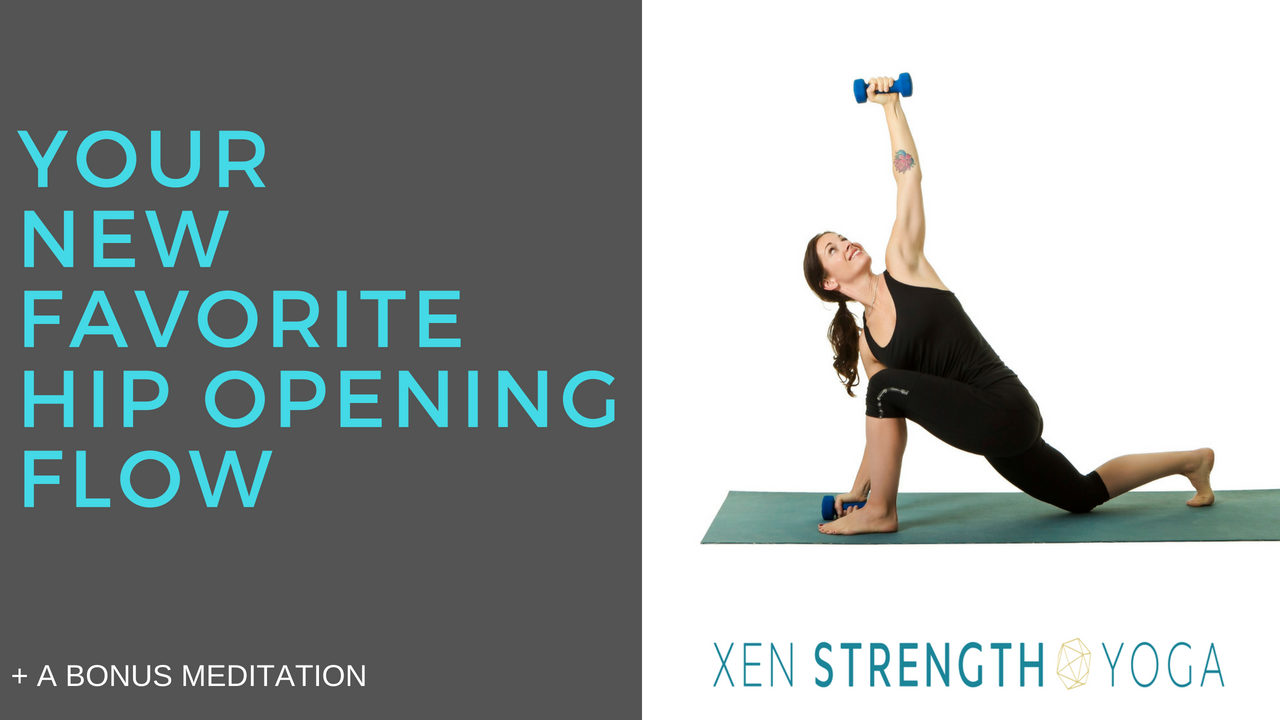
Low Lunge (Anjaneyasana) with a Twist Don't just dump your weight into your pelvis. Instead, tuck your tailbone slightly—think of pulling your belly button toward your spine. This "posterior pelvic tilt" targets the rectus femoris and the psoas much more effectively than just sagging toward the floor. Now, reach the arm on the side of the back leg up and slightly over to the opposite side. You’ll feel a line of tension from your knee all the way up to your ribs. That’s the entire myofascial chain opening up.
90/90 Shin Box This isn't a traditional Hatha pose, but it’s becoming a staple in modern therapeutic yoga. Sit on the floor with your front leg at a 90-degree angle and your back leg at a 90-degree angle. This works on internal and external rotation simultaneously. Most people lack internal rotation, and that’s often what causes that "pinching" feeling in the front of the hip during squats or deep folds.
Malasana (Squat) with a Block Squatting is a human birthright, but we've lost it. If your heels lift or your back rounds painfully, sit on a block. The goal here is pelvic floor relaxation. The pelvic floor and the hip rotators are best friends; if one is tight, the other is too. Spend three minutes here. Breathe into your low back.
The Emotional Connection: Is it Real?
You’ve probably heard a yoga teacher say we "store emotions in our hips." Sounds kind of woo-woo, right? But there’s a physiological basis for it. The psoas is closely tied to the sympathetic nervous system. When you're stressed, you subconsciously curl inward—a fetal position reflex. This tenses the hips. Over years of chronic stress, this physical "curling" becomes your default posture. When you finally open those tissues in a pose like Frog or Pigeon, it can trigger a significant parasympathetic shift. People cry in hip openers because they are finally exiting a years-long state of physical bracing. It's not magic; it’s just your fascia finally letting down its guard.
Stop Overstretching Your Hamstrings
A common mistake in yoga for tight hips is focusing too much on the hamstrings. Yes, they are attached to the sit bones (ischial tuberosity), but overstretching them without addressing pelvic tilt can lead to "yoga butt"—a literal pain in the butt caused by proximal hamstring tendinopathy.
If you have an anterior pelvic tilt (your butt sticks out like a duck), your hamstrings are already being pulled long. Stretching them further just irritates the tendon. You'd be better off strengthening your hamstrings and stretching your quads. Balance is the goal. Always.
The Role of the Adductors
We usually focus on the outer hips, but the inner thighs (adductors) are massive hip stabilizers. If these are tight, they pull the pelvis into a tilt that makes the outer hips feel tight as a secondary symptom.
- Try a wide-legged forward fold (Prasarita Padottanasana) but keep a slight bend in your knees.
- Focus on pushing the outer edges of your feet into the mat.
- This engages the lateral line while the medial line (the inner thigh) gets to release.
Moving Toward Sustainable Mobility
How often should you do this? Doing a 90-minute "hip killer" class once a week is less effective than doing five minutes of movement every single day. The body craves frequency over intensity when it comes to changing connective tissue. Fascia, the "fuzz" that surrounds your muscles, takes a long time to reshape. Think of it like orthodontic braces—gentle, consistent pressure wins the race.
You also have to look at your environment. If you do yoga for tight hips in the morning and then sit in a bucket seat in your car for an hour, followed by eight hours in an office chair, you're fighting an uphill battle. Stand up. Pace while you're on the phone. Do a standing figure-four stretch while your coffee brews.
Avoiding Common Injuries
Be careful with the knee. The hip is a ball-and-socket, but the knee is a hinge. If your hip is tight, the body will try to find that rotation in the knee joint instead. This is how people tear their meniscus in Pigeon Pose. If you feel any "twinge" or "pulling" on the inside of your knee, back off immediately. Flex your foot hard; this engages the muscles around the shin and protects the knee joint. Or, better yet, do "Thread the Needle" on your back. It’s the same stretch for the hip, but with zero gravity-induced risk to the knee.
Actionable Next Steps for Hip Health
- Assess your rotation: Sit on a chair and cross your ankle over your knee. If your top knee is pointing toward the ceiling, you have limited external rotation. Don't force it; use this as your baseline.
- The 2-Minute Rule: Every hour you spend sitting, spend two minutes in a lunging position or a deep squat. This prevents the fascia from "setting" in a shortened position.
- Strengthen the Glutes: Incorporate three sets of Bridge Poses (Setu Bandhasana) into your daily routine. Hold for five breaths, focusing on driving through the heels.
- Check your breath: When you are in a deep hip stretch, count your exhale. Make it twice as long as your inhale. This signals the nervous system to deactivate the "guarding" reflex in the pelvic muscles.
- Vary your seated positions: If you must sit, try sitting on the floor in cross-legged or "V" positions occasionally. Changing the angles of the femur in the socket prevents stagnation.
- Hydrate the tissue: Fascia is made largely of water. If you are dehydrated, your tissues are literally more brittle and resistant to change. Drink water before your practice.
- Prioritize the "un-cool" poses: Poses like Supta Virasana (Reclining Hero) are difficult and often avoided, but they target the quads and hip flexors in a way that forward folds never will. Use bolsters and pillows to make it accessible.
The goal isn't to be a contortionist. The goal is to walk, run, and sit without pain. Treat your hips with a mix of strength and surrender, and they will eventually stop shouting at you.