You're lying on a rubber mat, staring at a water stain on the ceiling, and trying your absolute hardest not to think about that email you forgot to send. The instructor says to "let it go." You want to laugh. Or cry. Honestly, if it were that easy to just stop worrying, you wouldn't be paying twenty bucks to sweat in a room full of strangers.
But here’s the thing.
Yoga for reducing stress and anxiety isn't about clearing your mind or reaching some magical state of Zen where your problems vanish. It's actually much more mechanical than that. It’s about hacking your nervous system. When you're stressed, your sympathetic nervous system—the "fight or flight" mode—is stuck in the 'on' position. Your cortisol levels spike, your heart rate climbs, and your breath gets shallow. Yoga, specifically certain types of movement and breathwork, physically forces your parasympathetic nervous system (the "rest and digest" mode) to take the wheel.
It’s biology, not just "vibes."
Why Your Vagus Nerve is the Real Star of the Show
Most people think yoga is about stretching tight hamstrings. Sure, that happens, but the real magic is what you're doing to your vagus nerve. This is the longest cranial nerve in your body, running from your brainstem all the way down to your abdomen. It acts like a superhighway for the parasympathetic system. When you engage in the slow, rhythmic breathing typical of a yoga practice, you're essentially sending a "manual override" signal to your brain.
A 2012 study published in Medical Hypotheses by Chris Streeter and colleagues at Boston University School of Medicine found that yoga specifically increases levels of gamma-aminobutyric acid (GABA) in the brain. GABA is a neurotransmitter that basically acts like a brake pedal for your brain activity. Low GABA levels are linked to high anxiety. Yoga pumps those levels up.
It’s basically a natural anti-anxiety shot.
The Problem With "Power" Yoga
If you’re already vibrating with anxiety, jumping into a high-intensity, 95-degree Power Vinyasa class might actually backfire. I’ve seen it happen. You’re already stressed, and now you’re putting your body under intense physical heat and cardiovascular strain. For some, this helps "burn off" the nervous energy. For others, it just adds more cortisol to the fire.
If your goal is yoga for reducing stress and anxiety, you might actually want to slow down. Restorative yoga or Yin yoga are often much more effective for mental health than a fast-paced flow. In Restorative yoga, you use props—bolsters, blankets, blocks—to support your body completely. You stay in poses for five, ten, even twenty minutes.
It sounds boring. It is boring. That’s the point. It forces you to sit with the discomfort of stillness until your nervous system finally realizes it’s safe to relax.
The Moves That Actually Matter
You don’t need to put your foot behind your head to feel better. In fact, complex poses can sometimes make you more anxious because you’re worried about doing them "right." Instead, focus on these specific types of movement that have been shown to lower the heart rate.
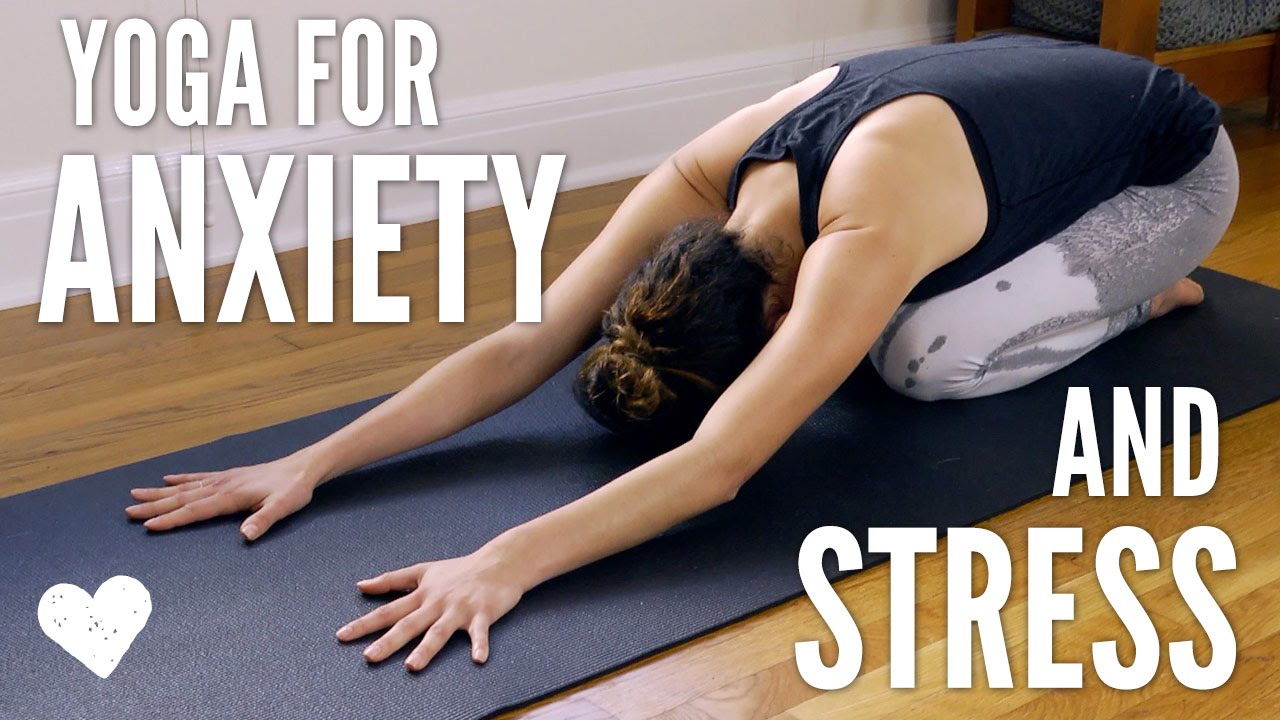
Forward Folds Anytime your head is lower than your heart, it has a calming effect. Think of Child’s Pose (Balasana) or a simple Standing Forward Fold (Uttanasana). These poses physically draw your focus inward, cutting off the external stimuli that usually fuel anxiety.
Legs Up The Wall This is the holy grail. Viparita Karani. You literally just lie on your back and rest your legs against a wall. It sounds too simple to work, but it shifts the blood flow and tells your heart it can stop pumping so hard against gravity. Ten minutes of this before bed can do more for your anxiety than an hour of cardio.
The Breath (Pranayama) Yoga is really just a breathing practice disguised as a workout. The Ujjayi breath—that "ocean sound" you hear in classes—is deliberate. By constricting the back of the throat and breathing through the nose, you're creating a slight resistance that further stimulates the vagus nerve.
Another big one? Nadi Shodhana, or alternate nostril breathing. It sounds a bit "woo-woo," but researchers have found it helps balance the autonomic nervous system.
It's Not Just in Your Head: The Somatic Connection
We tend to treat the mind and body like they’re separate departments in a large corporation that never talk to each other. They’re not. Anxiety often manifests as "somatic" symptoms—the tight chest, the clenched jaw, the knot in the stomach.
Dr. Bessel van der Kolk, author of The Body Keeps the Score, has spent decades researching how trauma and stress are stored in our physical tissues. He’s a huge advocate for yoga because it helps people re-establish a sense of safety within their own bodies. When you’re anxious, you often feel "disconnected" or like you’re just a floating head of worries. Yoga anchors you back into your limbs. It makes you feel your feet on the floor.
That "grounding" isn't just a metaphor. It’s a sensory reality.
Common Misconceptions That Keep People Stressed
One of the biggest hurdles is the "Instagram version" of yoga. If you think you need to be a flexible, vegan, 22-year-old in $100 leggings to do yoga, you’ve been lied to. In fact, if you’re naturally flexible, you might actually get less out of the stress-reduction aspect because you aren't feeling the same physical sensations that force you to focus.
- "I can't quiet my mind." Good. Nobody can. The goal isn't to stop thoughts; it's to notice them and choose not to chase them.
- "I'm too stiff." That's like saying you're too dirty to take a bath.
- "It takes too long." Even five minutes of intentional breathing and stretching can lower your blood pressure.
Real Talk: When Yoga Isn't Enough
Let’s be honest. Yoga is a tool, not a cure-all. If you’re dealing with a clinical anxiety disorder or a major life crisis, a downward dog isn't going to fix everything. It’s a piece of the puzzle.
It’s also important to acknowledge that for some people with severe trauma, the stillness of yoga can actually trigger "panic attacks" or intrusive thoughts. This is why trauma-informed yoga exists. If being still feels scary, that’s a real thing, and you should listen to your body rather than forcing yourself to stay in a pose that feels unsafe.
Making It Work in the Real World
If you want to use yoga for reducing stress and anxiety, consistency beats intensity every single time. Doing 10 minutes every morning is infinitely better for your brain than doing one 90-minute class every two weeks.
Here is how you actually start without making it another "to-do" list item that stresses you out:
- Stop waiting for the perfect time. Do it in your pajamas. Do it on your carpet. You don't need a fancy mat.
- Focus on the exhale. Make your exhales longer than your inhales. This is the physiological "switch" for the parasympathetic nervous system.
- Pick three poses. Just three. Maybe it's a cat-cow, a low lunge, and legs up the wall. Stick to those.
- Notice the jaw. Most people clench their jaw when they're stressed. Throughout your practice, consciously drop your tongue from the roof of your mouth.
Yoga isn't a performance. It's a maintenance schedule for your meat-suit. When you approach it that way—as a functional necessity rather than a spiritual quest—the stress reduction starts to happen naturally.
Actionable Next Steps
Tonight, before you get into bed, try Legs Up The Wall for exactly five minutes. Don't look at your phone. Just feel the weight of your hips on the floor and focus on making your exhales twice as long as your inhales. Watch how your heart rate slows down. That's the first step in retraining your brain to handle the chaos of your daily life. Tomorrow, add one minute of Child’s Pose. Keep it small, keep it boring, and keep it consistent. This is how you actually use yoga to change your baseline anxiety levels over time.