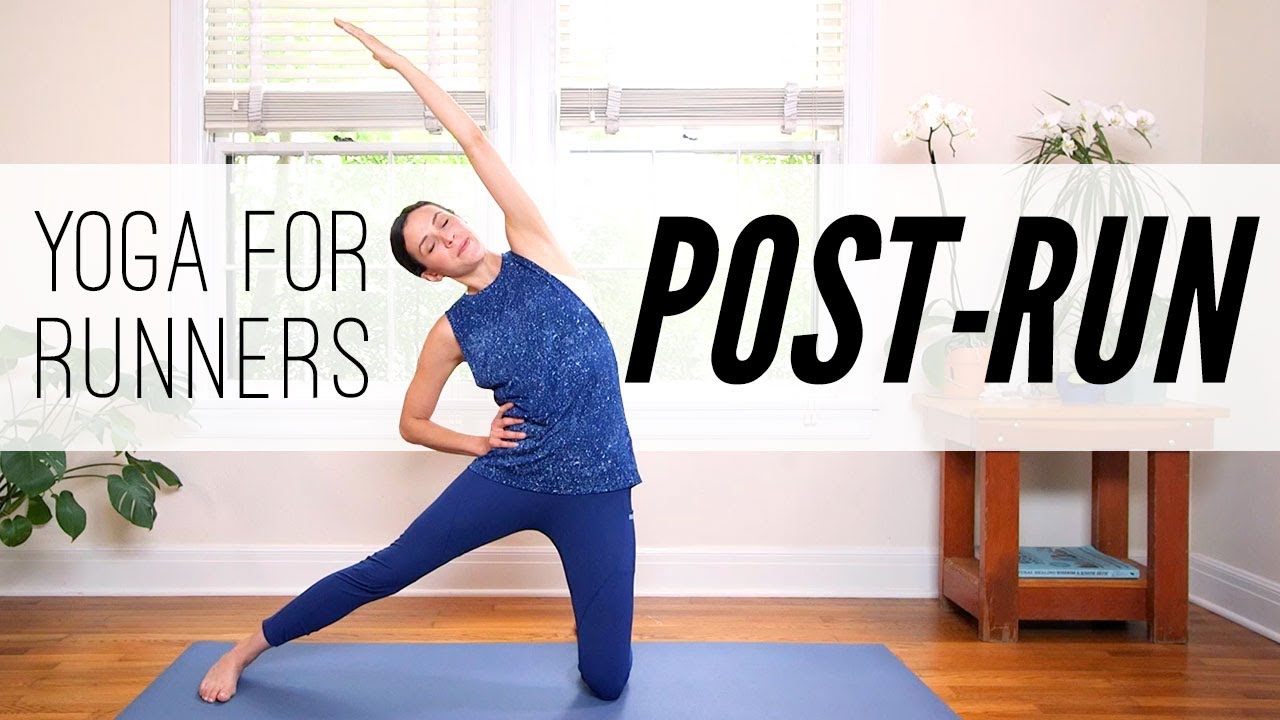
You just finished six miles. Your lungs are burning, your heart is thumping against your ribs like a trapped bird, and your hamstrings feel like over-tightened guitar strings. What do you do? Most runners just sort of lean against a tree, grab their ankle for a half-hearted quad stretch, and call it a day. Honestly, that’s why you’re still waking up with "old man knees" and hips that creak every time you stand up from your desk.
It’s frustrating. You put in the work, but your body feels like it's punishing you for it. Building on this idea, you can find more in: Inside the Congo Ebola Crisis the Aid Industry Fails to Understand.
The thing is, yoga for post run isn't just about being flexible enough to touch your toes or looking "zen" in a studio. It’s functional maintenance. Think of your muscles like a sponge that’s been wrung out and left in the sun to dry. If you just try to snap that dry sponge back into shape, it’ll tear. You need to rehydrate the tissue—not just with water, but with blood flow and targeted movement.
The Science of Why You're Actually Tight
Running is a repetitive, high-impact activity. Every time your foot hits the pavement, your muscles undergo "eccentric loading." This creates microscopic tears in the muscle fibers. That’s a good thing! It’s how you get stronger. But when those fibers heal, they tend to knit back together in a tangled mess if you don't encourage them to lengthen. Experts at Psychology Today have also weighed in on this trend.
A study published in the International Journal of Yoga found that regular practice significantly improves flexibility and balance in athletes, but more importantly, it helps manage the "autonomic nervous system." Basically, running kicks you into "fight or flight" (sympathetic) mode. Yoga pulls you back into "rest and digest" (parasympathetic) mode. If you stay in that high-stress state post-run, your cortisol stays elevated, and your recovery slows to a crawl.
Most runners have a specific "tightness profile." It’s usually the "Big Three": the hip flexors, the hamstrings, and the IT band. But here’s the kicker—your IT band isn't actually a muscle. It’s a thick band of fascia. You can’t "stretch" it like a rubber band. You have to move the muscles around it, like the gluteus medius and the tensor fasciae latae (TFL), to take the pressure off.
Stop Pulling Your Hamstrings
Seriously. Stop.
When you finish a run and immediately bend over to touch your toes with locked knees, you’re mostly just pulling on your sit-bones and your lower back. It doesn’t do much for the belly of the muscle.
Instead, try a Downward Facing Dog with a heavy bend in your knees. Forget about getting your heels to the floor. Nobody cares if your heels touch the grass. Focus on tilting your tailbone toward the sky. This creates space in the posterior chain without straining the attachment points at the back of your knees.
Then, there’s the Crescent Lunge. If you’ve been running hills, your psoas is probably screaming. A low lunge with your back knee on the ground (Anjaneyasana) is basically the holy grail of yoga for post run. But don't just dump your weight into your hips. Tuck your pelvis. Squeeze your glute. You’ll feel a zingy stretch right in the front of the hip that a standing quad stretch could never touch.
The "Secret" to Happy Ankles
We talk about hips and knees constantly, but your ankles are the first point of contact with the ground. If your ankles are stiff, your knees have to compensate. If your knees are unstable, your hips take the hit. It's a chain reaction.
Virasana, or Hero’s Pose, is polarizing. Some people love it; some people’s knees hate it. If you can sit back on your heels (maybe with a block or a rolled-up towel between your feet), you’re giving the tops of your feet and your shins a massive release. This is huge for preventing shin splints. If you feel a sharp pain? Back off immediately. Yoga isn't about "no pain, no gain." It’s about "smart movement, big rewards."
Why Your Breath is Actually a Tool
It sounds woo-woo, I know. But listen: if you’re holding your breath while you stretch, your brain thinks you’re in danger. It sends a signal to your muscles to contract and protect the joint. You’re literally fighting yourself.
Deep, diaphragmatic breathing—the kind where your belly expands like a balloon—signals to your nervous system that it’s safe to let go. Try to make your exhales longer than your inhales. Count to four on the way in, and six on the way out. You’ll find that after about three rounds, your body "drops" into the pose.
Real Talk: The Myth of the 60-Minute Session
You don’t need an hour. You don’t even need thirty minutes. Honestly, if you can give yourself seven minutes of targeted movement right after you kick off your shoes, you’re ahead of 90% of the running population.
Consistency beats intensity every single time.
I’ve seen runners who can run a sub-3:00 marathon but can’t sit cross-legged on the floor without their back rounding. That’s a recipe for a herniated disc eventually. You want to be running when you're 70, right? Then you have to care about your joints now.
The Problem with "Power Yoga" for Runners
A lot of runners gravitate toward intense, sweaty Vinyasa classes because they like the "workout" feel. But if you’ve just pounded out ten miles, the last thing your joints need is fifty Chaturangas and high-impact lunges.
You need Yin Yoga or Restorative Yoga.
Yin involves holding poses for 3 to 5 minutes. It sounds boring. It kind of is, at first. But it targets the connective tissue—the fascia and ligaments—rather than just the muscles. It’s the difference between washing the surface of your car and getting an oil change. One is for show; the other keeps the engine from seizing up.
A Practical Post-Run Flow (The No-Fluff Version)
Don't overthink this. Just do these four things after your next session:
- Low Lunge (Anjaneyasana): Keep the back knee down. Focus on the pelvis tuck. Hold for 1 minute per side.
- Half Splits (Ardha Hanumanasana): From the lunge, shift your hips back. Flex your front toes. Keep a micro-bend in that front knee. This is for the hamstrings. 1 minute per side.
- Pigeon Pose (Eka Pada Rajakapotasana): This is the king of hip openers. If your hip is way off the ground, shove a pillow under it. Don't let your body tilt to one side. Stay here for 2 minutes. It’ll feel intense, then it’ll feel like a release.
- Legs Up The Wall (Viparita Karani): Literally just lay on your back with your butt against the baseboard and your legs vertical. It helps with lymphatic drainage and reduces swelling in the ankles. It's basically a "reset" button for your circulatory system.
The Long-Term Reality
Yoga isn't a "cure" for a lack of training or poor form. If you're overstriding and slamming your heels into the ground, a few Downward Dogs won't save your knees. However, integrating yoga for post run creates a feedback loop. You become more aware of your body. You notice that your right hip is tighter than your left, which might explain why your left knee has been twinging.
That "proprioception"—the fancy word for knowing where your body is in space—is what makes you a better runner. You start to move more efficiently. You waste less energy. You recover faster.
Actionable Next Steps
Instead of diving into a full-scale lifestyle overhaul, just pick one run this week. After that run, do the "Legs Up The Wall" pose for five minutes. That’s it. See how your legs feel the next morning.
If you feel less "heavy" or "wooden," add the Low Lunge the next time. Build the habit slowly. You don't need a fancy mat or Lululemon leggings. You just need a floor and the willingness to be still for a second. Your PRs will thank you later.
Check your mobility before your next run by trying to touch your toes with straight legs. Then, do a 10-minute yoga session after your run and check again the next morning. Most people notice a significant difference in "morning stiffness" within just three sessions. If you're dealing with chronic pain like plantar fasciitis, focus specifically on calf stretches and toe-tucking poses like "Broken Toe Pose" (tucking your toes under and sitting on your heels) to stretch the fascia on the bottom of the foot.