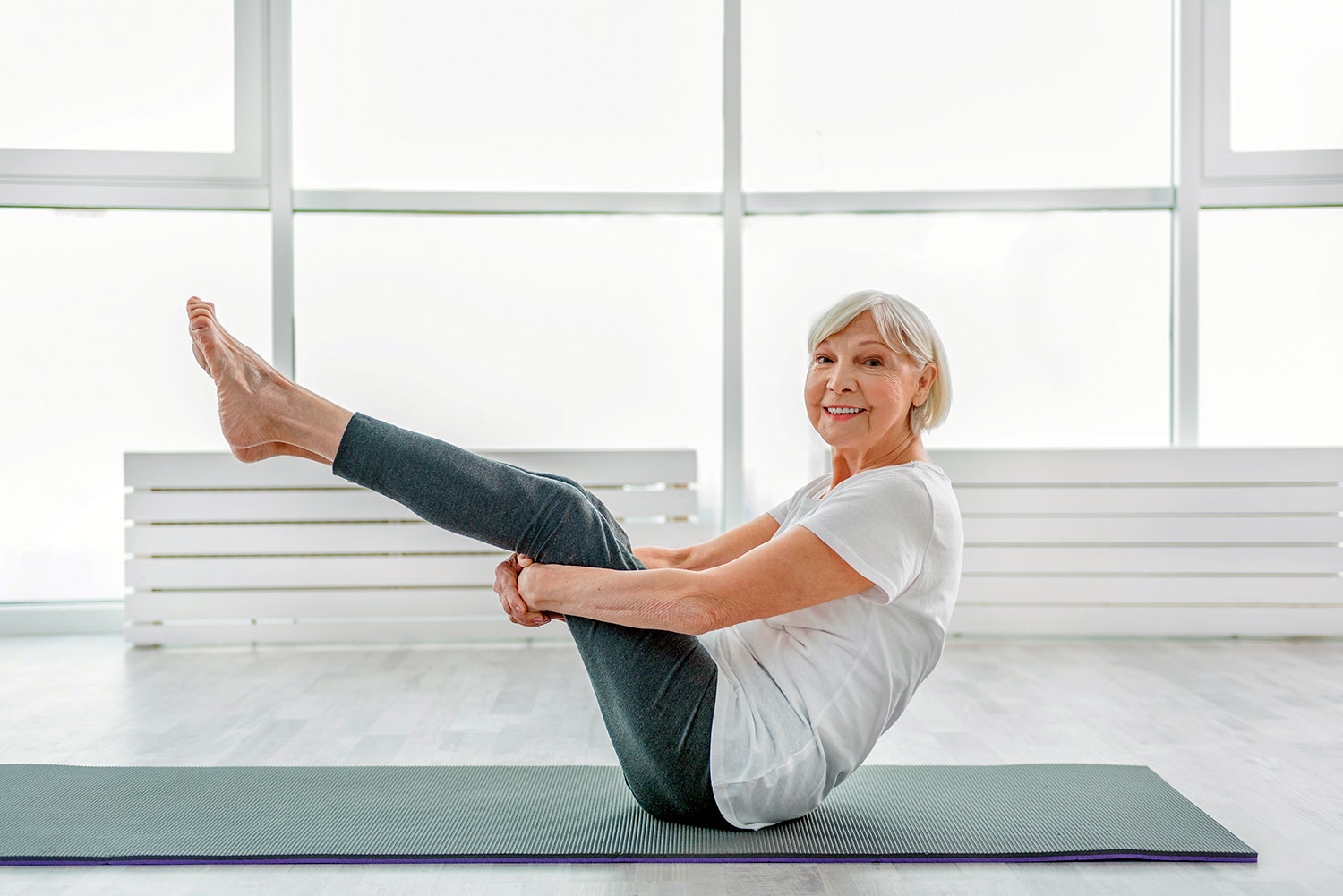
You’ve seen the photos. Usually, it’s a twenty-something influencer twisted into a pretzel on a beach at sunrise. It’s intimidating. Honestly, it’s also kinda irrelevant if you’re looking at yoga for beginners over 60 from a practical, real-world perspective. If you’re sixty, seventy, or eighty, you aren't trying to put your foot behind your head for a "like" on social media. You’re trying to make sure you can still reach the top shelf of the pantry or tie your shoes without a grunt of pain.
Yoga isn’t just stretching. That’s the first thing people miss. It is a systematic way of maintaining the "machinery" of the human body. As we age, our joints lose synovial fluid, and our muscles lose mass—a process doctors call sarcopenia. Yoga fights back. But you have to do it right, or you'll just end up at the chiropractor.
The big "flexibility" myth
Most people think you need to be flexible to start. That’s like saying you need to be in shape to go to the gym. It's backward. Yoga is the tool you use to get the mobility you've lost over decades of sitting in office chairs or driving cars.
There’s a massive difference between "flexibility" (how far a muscle can stretch) and "mobility" (how well a joint moves through its intended range). For seniors, mobility is king. According to the Journal of Aging and Physical Activity, consistent yoga practice significantly improves balance and gait speed in older adults. This isn't just about feeling good; it’s about fall prevention. Falls are the leading cause of injury-related visits to emergency departments for people over 65, according to the CDC.
If you can balance on one leg for 30 seconds, your statistical risk of a life-altering hip fracture plummets. Yoga gives you that balance. It trains the proprioceptors—those tiny sensors in your joints that tell your brain where your body is in space.
Real talk: Your joints have a history
You aren't a blank slate. By 60, most of us have some "mileage." Maybe it's a touch of osteoarthritis in the knees or a lower back that flares up if you sneeze too hard. You can't just jump into a power yoga class at the local YMCA and expect your body to be okay with it.
Why the "No Pain, No Gain" mentality is dangerous here
In your 20s, you can push through a twinge. At 66? That twinge is a warning light on the dashboard. Yoga should never hurt. There’s a sensation teachers call "sensational stretch"—that’s fine. But sharp, stabbing, or electric pains? Stop. Immediately.
Many beginners make the mistake of trying to mimic the teacher exactly. If the teacher is 30 years younger, their bone structure and collagen levels are different. You have to listen to your "inner teacher." If your hamstrings are tight, bend your knees. There is no prize for straight legs. In fact, keeping a slight bend in the knees during forward folds actually protects your lower back (the lumbar spine) from excessive strain.
Props are not "cheating"
There is this weird stigma that using a block or a strap means you’re "bad" at yoga. That’s total nonsense.
In the Iyengar tradition of yoga—named after B.K.S. Iyengar, who practiced well into his 90s—props are essential. They bring the floor to you. If you can't touch your toes, you use a block. Now the floor is six inches higher. Problem solved.
- Chair Yoga: This is the ultimate "gateway drug" for yoga for beginners over 60. You do the same poses, but the chair provides a safety net for your balance.
- The Wall: The wall is the best alignment tool ever invented. Leaning against it during a standing pose takes the fear of falling out of the equation.
- Bolsters: These are basically firm pillows. Putting one under your knees during the final relaxation (Savasana) can instantly decompress a tight lower back.
The Bone Density Factor
Weight-bearing exercise is the gold standard for bone health. While most people think of lifting dumbbells, yoga is essentially lifting your own body weight.
Dr. Loren Fishman, a physical medicine and rehabilitation specialist at Columbia University, conducted a decade-long study on yoga and osteoporosis. His research, published in Topics in Geriatric Rehabilitation, suggested that just 12 minutes of daily yoga can increase bone mineral density in the spine and hips. That’s huge. It’s a non-pharmacological way to strengthen your skeleton.
When you hold a pose like Warrior II, you’re placing a "healthy stress" on your femur and hip socket. The bone responds by laying down more tissue. It’s a biological "use it or lose it" scenario.
Breathe like your life depends on it (Because it does)
We breathe shallowly when we’re stressed. Most of us are stressed. Over time, the diaphragm—the main muscle of respiration—gets weak.
Yoga forces you to use the full capacity of your lungs. This isn't just "woo-woo" spirituality. It’s physiology. Deep, diaphragmatic breathing stimulates the Vagus nerve. This is the "on-switch" for your parasympathetic nervous system, also known as the "rest and digest" mode.
By slowing down the breath, you lower your cortisol levels. High cortisol is linked to inflammation, weight gain, and poor sleep. If you’re over 60, managing inflammation is basically the secret to longevity.
How to actually start without feeling like an idiot
Don't go to a "Level 1/2" class at a trendy studio. You'll be surrounded by people in designer leggings doing handstands. It’s discouraging.
Instead, look for classes specifically labeled:
- Seniors Yoga
- Gentle Yoga
- Restorative Yoga
- SilverSneakers (often covered by Medicare Advantage plans)
Many community centers and libraries offer these for free or very cheap. If you prefer to stay home, YouTube is a goldmine. Look for "Yoga with Adriene" (she has great senior-friendly sequences) or "Yoga with Kassandra" for 10-minute morning stretches.
A typical "Day One" sequence
You don't need a 90-minute session. Ten minutes is plenty.
Start sitting in a sturdy chair. Not a rolling office chair—that’s a recipe for disaster. Sit tall. Imagine a string pulling the crown of your head toward the ceiling. Inhale and shrug your shoulders to your ears, then exhale and drop them down. Do that five times. You’ll be surprised how much tension you’re holding there.
Next, try a seated twist. Reach your right hand to the outside of your left knee. Use the back of the chair for leverage. Twist from the belly, not the neck. Breathe.
Finally, stand up and use the back of the chair for balance. Lift your heels off the ground. Hold for three seconds. Lower them. This strengthens the calves and improves the "ankle strategy" your body uses to prevent trips.
Mental hurdles and the "Old Dog" syndrome
"I'm too old to start something new."
Honestly, that’s just a story you’re telling yourself. The brain is neuroplastic. Learning new movements—like how to coordinate a breath with an arm reach—actually builds new neural pathways. It’s cross-training for your gray matter.
Yoga also addresses the isolation that often comes with aging. If you go to a local class, you meet people. You realize everyone’s hip hurts a little bit. There’s a communal aspect to it that is just as healing as the physical stretching.
Practical Next Steps for Your First Week
Getting started with yoga for beginners over 60 doesn't require a lifestyle overhaul. It just requires a few intentional choices.
1. Audit your gear. You don't need fancy clothes. Wear pajamas or sweatpants. You do need a non-slip surface. If you aren't using a chair, buy a "sticky" yoga mat. 1/4 inch thickness (6mm) is usually better for sensitive knees than the thin travel mats.
2. Pick your "anchor." Decide when you’ll do it. Right after your morning coffee? Before you get in the shower? Link the new habit to an old one.
3. Set a timer for 5 minutes. Don't promise yourself an hour. Promise yourself five minutes. If you want to keep going after five minutes, great. If not, you’ve still succeeded.
4. Clear the space. Make sure there are no rugs you can trip on. If you’re using a video, set the tablet or laptop at eye level so you aren't craning your neck downward while trying to move.
5. Talk to your doctor. If you’ve had a joint replacement or have glaucoma (some inverted poses can increase eye pressure), get the green light first. Most doctors are thrilled when patients want to start yoga, but they might give you specific "don'ts" based on your medical history.
Yoga isn't a destination. You never "finish" it. It's just a way to keep the house you live in—your body—in good working order for as long as possible. Start where you are. Use the chair. Breathe deep. The rest is just details.