You're staring at the ceiling again. It’s 11:45 PM, your brain is recycling a weirdly specific conversation from 2014, and your lower back feels like it’s being squeezed by a giant invisible hand. We’ve all been there. Most people think the solution is a heavier blanket or an extra dose of magnesium, but honestly, the missing link is usually how you handle the transition from "productive human" to "resting human." That’s where yoga exercises before sleep come into play, and no, I’m not talking about doing headstands in your pajamas.
Actually, doing the wrong kind of yoga can actually make your insomnia worse. If you’re over there flowing through Sun Salutations at midnight, you’re basically telling your nervous system to wake up and hunt a mammoth. You need to chill.
The Science of Why Your Nervous System Is Constanty "On"
Modern life is basically a giant stress-induction machine. We have this thing called the autonomic nervous system, which is split into the sympathetic (fight or flight) and the parasympathetic (rest and digest) branches. A 2022 study published in the journal Sleep Medicine Reviews highlighted that mind-body interventions, specifically those involving slow-motion stretching and rhythmic breathing, significantly lower cortisol levels.
Cortisol is the enemy of sleep. When you sit at a desk for eight hours, your hip flexors shorten and your chest tightens. This physical "closing off" of the body signals to your brain that you’re under threat. By the time you hit the mattress, you’re physically coiled like a spring.
Why Most Evening Yoga Advice Is Just Wrong
I see this all the time on social media: "10-minute bedtime flow!" followed by someone doing high-energy lunges. Stop. Yoga exercises before sleep should be about down-regulation. This means we aren’t trying to build muscle or get a "good stretch" in the traditional sense. We are trying to stimulate the Vagus nerve.
The Vagus nerve is the superstar of the parasympathetic system. It runs from your brain through your neck and down into your abdomen. When you compress it gently or use deep diaphragmatic breathing—what yogis call Ujjayi or "Ocean Breath"—you’re essentially flipping a switch that tells your heart rate to slow down.
The "Big Three" Poses for Real Sleep
If you only do a few things, make them these. Don't worry about looking like a pretzel. Honestly, the messier and more supported these look, the better they work.
1. Legs Up The Wall (Viparita Karani) This is the holy grail. It’s exactly what it sounds like. You scoot your hips as close to the baseboard as possible and swing your legs up the wall. Why? Because it reverses the blood flow. Your heart doesn't have to work as hard to pump blood back from your feet. According to Dr. Sat Bir Singh Khalsa, a researcher at Harvard Medical School who specializes in yoga, this inversion helps shift the body into a state of deep relaxation by altering the baroreflex, which manages blood pressure. Stay here for five minutes. Or ten. Your feet might get tingly. That’s fine. Just breathe.
2. Supported Child’s Pose (Balasana) Don't just crouch on the floor. Grab a pillow—a big one. Hug it. Let your knees go wide and just melt into the cushion. This pose is about "pratyahara," or withdrawal of the senses. By closing off the front of your body, you feel safe. It’s primal. If your ankles hurt, put a rolled-up towel under them.
3. Reclined Butterfly (Supta Baddha Konasana) Gravity does the work here. Lie on your back, bring the soles of your feet together, and let your knees fall open. This opens the hips where we store a ridiculous amount of emotional tension. If it feels too intense on your inner thighs, shove some books or pillows under your knees. You shouldn't feel a "burn." You should feel a "release."
The Breathing Trick Nobody Uses
You can do all the yoga exercises before sleep you want, but if you’re huffing and puffing, it’s useless. You need to master the "exhale extension."
Basically, make your exhale twice as long as your inhale. Inhale for a count of four, exhale for a count of eight. When you exhale longer than you inhale, you are physically forcing your heart rate to drop. It’s biology. You can’t argue with it.
Common Mistakes That’ll Keep You Awake
- Pushing too hard: If you’re gritting your teeth, you’re failing. Yoga for sleep is about 60% effort, max.
- Bright lights: If you’re doing these poses under a 100-watt LED bulb, your brain thinks it’s noon. Dim the lights. Use a candle. Or do it in total darkness.
- The "One More Email" Trap: Don't do your yoga and then check your phone. The blue light will immediately nukes the melatonin your body just started producing.
- Forgetting your neck: We carry so much tension in our jaw and neck. While you're in these poses, consciously unstick your tongue from the roof of your mouth. Soften your eyes.
Setting Up Your "Sleep Sanctuary"
Your environment matters as much as the movement. If your bedroom is a mess, your brain is going to stay in "task mode." You don't need a Zen temple, but clear the laundry off the floor. Use props. Bolsters, blocks, blankets—these aren't "cheating." In restorative yoga, props are used to convince the muscles that they are fully supported so they can finally let go.
I once spoke with a physical therapist who argued that the biggest barrier to sleep isn't pain, but the anticipation of discomfort. By using props in your evening yoga, you remove that anticipation. You’re telling your body, "Hey, I’ve got you. You can stop holding on now."
The 15-Minute Protocol
If you’re ready to actually try this, here is a non-linear way to approach it tonight. Don't worry about the clock too much.
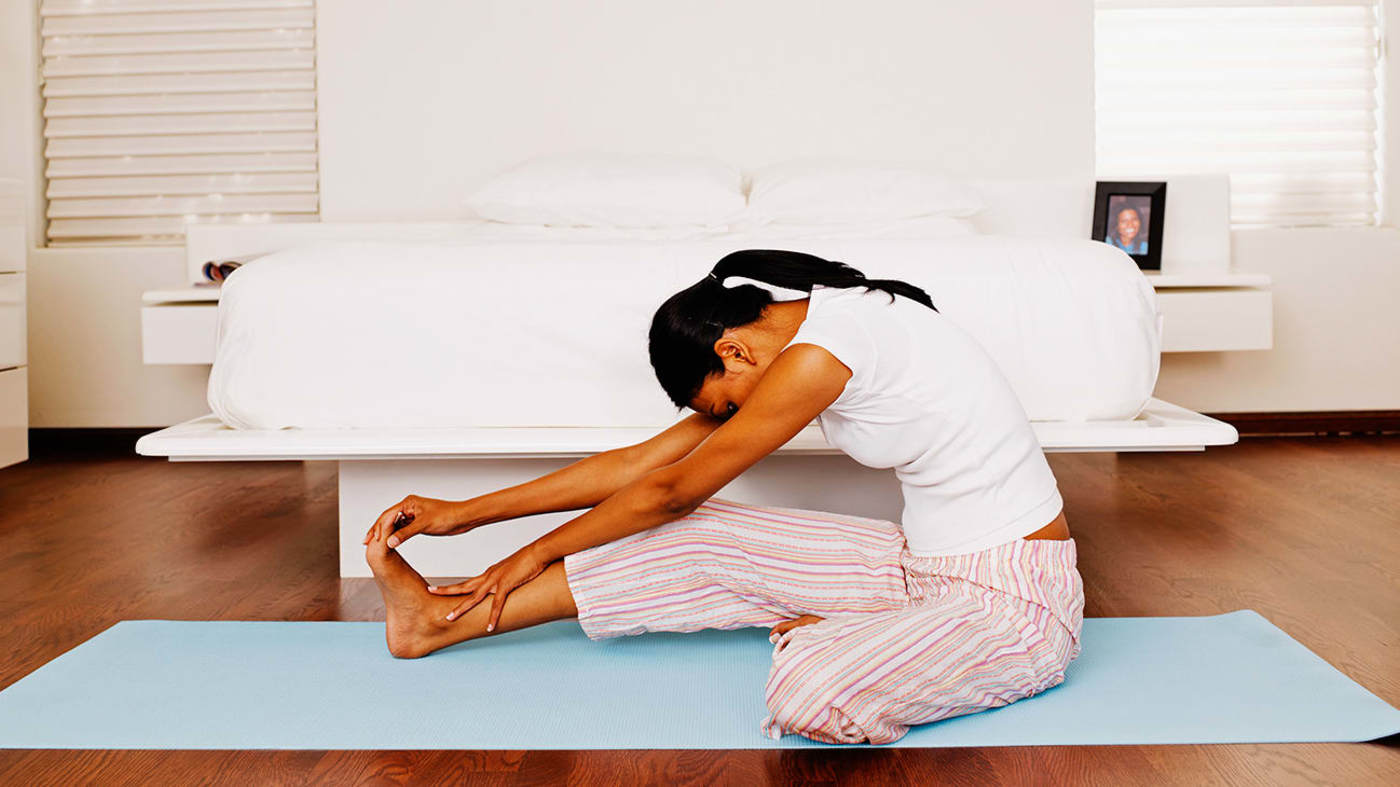
First, spend about three minutes in a seated forward fold. Keep your knees bent. A lot. Just flop over your legs. This isn't about touching your toes; it's about stretching the fascia along your spine.
Then, move to the wall for Legs Up The Wall. Stay there until you feel a sense of heaviness in your torso.
Finish in bed with a simple spinal twist. Lie on your back, drop both knees to the left, and look to the right. Take five deep breaths. Switch sides.
Finally, lie flat in Savasana (Corpse Pose). This is the most important part of yoga exercises before sleep. Don't skip it. It's the moment where your brain registers the changes you just made.
Actionable Next Steps
Instead of trying to master a whole routine tonight, just choose one pose. Start with Legs Up The Wall for five minutes right before you climb under the covers. Do it for three nights in a row. Notice the difference in how quickly you fall out of "thought loops" and into actual drowsiness.
Invest in a dedicated "sleep bolster" or just use two firm bed pillows stacked together. The physical act of grabbing your "sleep tools" acts as a psychological trigger—a Pavlovian response that tells your brain the day is officially over.
Keep your movements slow, like you’re moving through honey. No sudden jerks. No ego. Just gravity and breath. Your nervous system will thank you by finally letting you drift off.