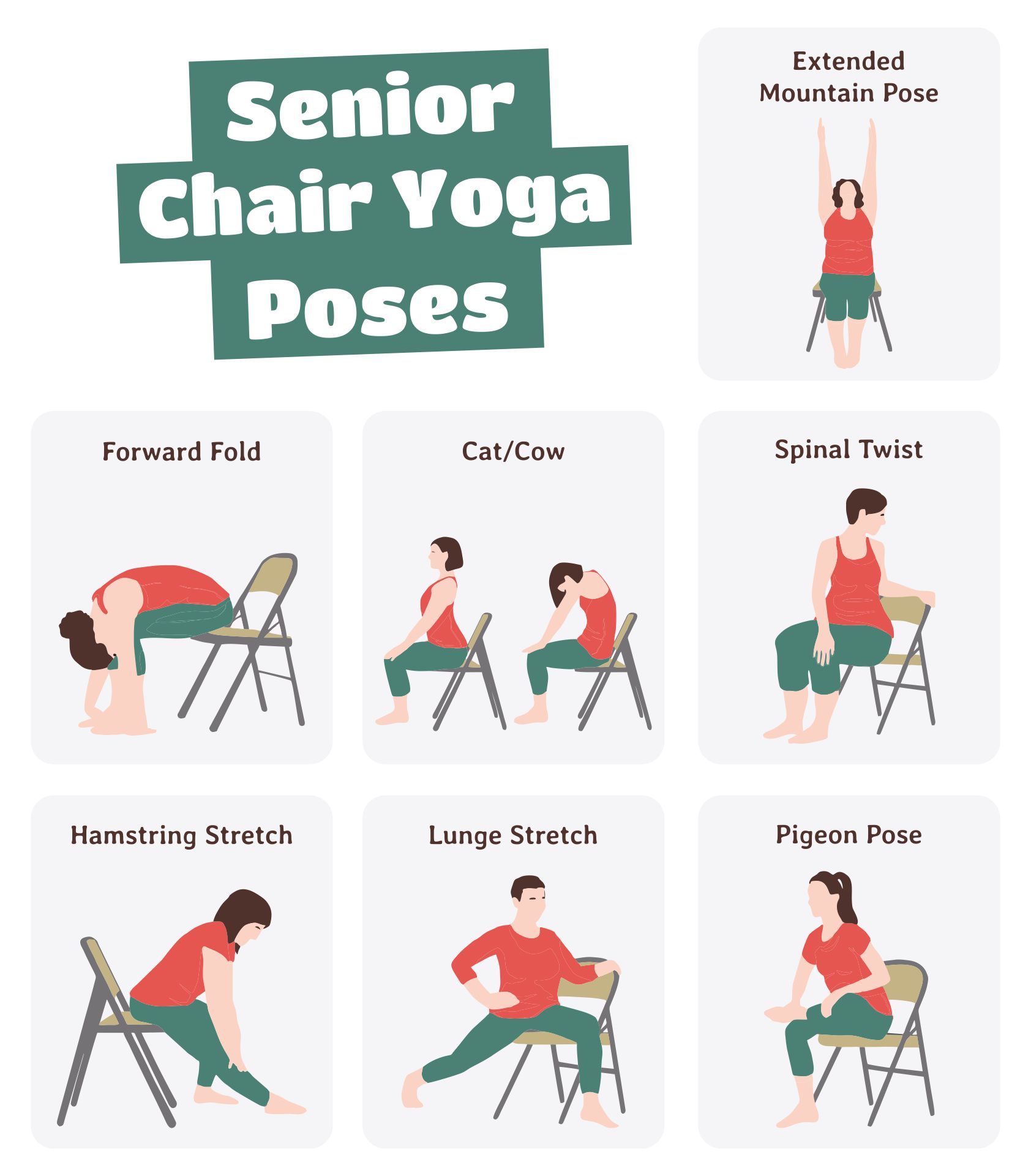
You’re standing in a bright studio, or maybe just your living room, and the instructor says "downward dog." Your knees ache just thinking about the floor. Your balance feels a little... off today. Honestly, it’s frustrating. We’re told that staying active is the "fountain of youth," but nobody mentions that the floor seems to get further away every single year.
This is where a yoga chair for seniors comes into play. It isn't a "cheat" or a sign of weakness. It’s a tool. It’s the difference between skipping a workout because your back hurts and actually getting your heart rate up while feeling totally supported.
Most people think of chair yoga as just sitting down and waving your arms around. That's a huge misconception. Using a chair—specifically one designed for the task—allows for deep lunges, stable balance work, and spinal extensions that might be dangerous or impossible otherwise. It's about accessibility, sure, but it's also about intensity and precision.
Not every chair is a yoga chair
Let’s be real: you can’t just grab a rolling office chair or a squishy recliner and call it a day. That’s a recipe for a fall. A proper yoga chair for seniors needs to be "armless." Why? Because you need space to move your legs and torso without hitting a barrier.
Ideally, you're looking for a classic metal folding chair, but with a twist. The backrest shouldn't have that middle bar. This allows you to slide your legs through the back for certain poses like Bharadvajasana (a seated twist). If you've ever tried to twist in a standard kitchen chair, you know the struggle of getting your hips to stay put while your spine rotates.
The stability factor is non-negotiable. We're talking about a weight capacity that makes you feel secure. Most high-quality yoga chairs are rated for at least 250 to 300 pounds. They have non-marking, non-slip rubber feet. If the chair slides when you lean on it, it's not a yoga tool; it's a hazard.
The science of why sitting (sometimes) beats standing
As we age, proprioception—our body's ability to sense its location in space—starts to decline. A study published in the International Journal of Yoga Therapy found that chair-based interventions significantly improved balance and reduced the fear of falling in older adults. It's psychological as much as physical. When you aren't worried about toppling over, your muscles actually relax enough to get a better stretch.
Think about Virabhadrasana II (Warrior II). Standing, your quadriceps are screaming, and you might be wobbling. Now, imagine sitting on the edge of a yoga chair for seniors, one leg draped over the side, the other extended back. You’re still engaging your core. You’re still stretching your hip flexors. But your nervous system isn't in "panic mode" trying to keep you upright.
You get the benefits of the pose—the chest opening, the arm strengthening—without the catastrophic risk of a hip fracture. It’s smart training. It’s what elite athletes do when they use props to refine their form. You're just doing it for longevity.
Real-world impact: More than just stretching
Take a look at the work of Alice Christensen, founder of the American Yoga Association. She was one of the early pioneers pushing for modified yoga for seniors back when everyone thought yoga was only for flexible teenagers in India. She emphasized that the chair isn't just for the "infirm." It’s for anyone who wants to maintain a full range of motion without straining the heart or the joints.
- Improved Circulation: Moving the ankles and wrists while seated helps pump blood back to the heart.
- Lubricated Joints: Synovial fluid doesn't move unless you do. The chair allows for "cat-cow" movements that keep the vertebrae from feeling like they’re fused together.
- Better Breathing: When you sit tall on a firm surface, your diaphragm has more room to move than when you're slumped on a couch.
What to look for when you're shopping
Don't let "pro-grade" labels scare you off. You basically want a "backless" metal folding chair. Brands like Pune or even some specialized versions on Amazon work well.
- Height Matters: If you’re 5'2", a standard chair might be too tall, leaving your feet dangling. You want your feet flat on the floor with your knees at a 90-degree angle.
- Seat Texture: A slick plastic seat is annoying. You’ll slide right off. Look for a matte finish or a slightly padded (but firm) seat.
- Weight: It needs to be heavy enough to stay put, but light enough for you to move it around the room.
If you already have a sturdy folding chair at home, you can sometimes pop the backrest out with a screwdriver, but be careful. You don't want sharp metal bits sticking out. Honestly, it’s usually worth the $50 or $60 to buy one specifically built for yoga.
Common mistakes seniors make with chair yoga
One big mistake? Thinking you don't need to warm up. Even in a chair, your muscles need to get warm. Start with neck circles. Gentle ones.
Another one is "over-twisting." Just because the chair gives you leverage doesn't mean you should use it to crank your spine around like a wrench. Use your muscles to twist, and the chair just to steady yourself.
And please, check your surface. Never use a yoga chair for seniors on a loose rug. Put it on a sticky yoga mat. This locks the chair and your feet into the ground. It creates a unified, stable base.
Moving beyond the basics
Once you're comfortable, the chair becomes a partner for standing poses. You can stand behind it and use the backrest like a ballet barre for Tree Pose. This allows you to work on your standing leg strength while having a "safety net" just an inch away from your hand.
You can also do a modified Downward Facing Dog by placing your hands on the seat of the chair and walking your feet back. It takes the weight off your wrists—a huge plus for anyone with carpal tunnel or arthritis—while still giving you that incredible stretch through the hamstrings and calves.
Actionable steps for starting your practice
If you're ready to integrate a yoga chair for seniors into your daily routine, don't overthink it. You don't need a 60-minute session to see results. Consistency beats intensity every single time.
- Clear the space: Find a spot with a hard floor and lay down a non-slip yoga mat. Place your chair firmly in the center.
- Check your posture: Sit toward the front edge of the seat. Don't lean back into the rest. Feel your "sit bones" pressing down. This engages your core immediately.
- Start with the 5-minute rule: Commit to five minutes of seated cat-cow (arching and rounding the back) and seated side stretches every morning.
- Listen to the "pinch": If a movement feels like a sharp pinch, stop. Yoga should feel like a "wide" or "dull" stretch. Sharp pain is your body's "no" signal.
- Focus on the exhale: Seniors often hold their breath when concentrating. This raises blood pressure. Try to make your exhales longer than your inhales to calm the nervous system.
By choosing a chair that fits your body and using it as a tool for alignment rather than a crutch, you're effectively bulletproofing your body against the typical declines of aging. It's about staying in the game. It’s about being able to reach the top shelf or garden without a week of recovery time. Grab a chair, sit tall, and just start moving.
Next Steps for Your Practice
- Measure your leg length: Ensure your current chairs allow your feet to rest flat; if not, look for a "short" version of a yoga chair.
- Find a specialized instructor: Look for "Silver Sneakers" programs or YouTube creators like Adrienne or Silver Yoga who specifically use props.
- Inspect your equipment: Every month, check the bolts on your chair and the rubber feet to ensure nothing has loosened or worn down.