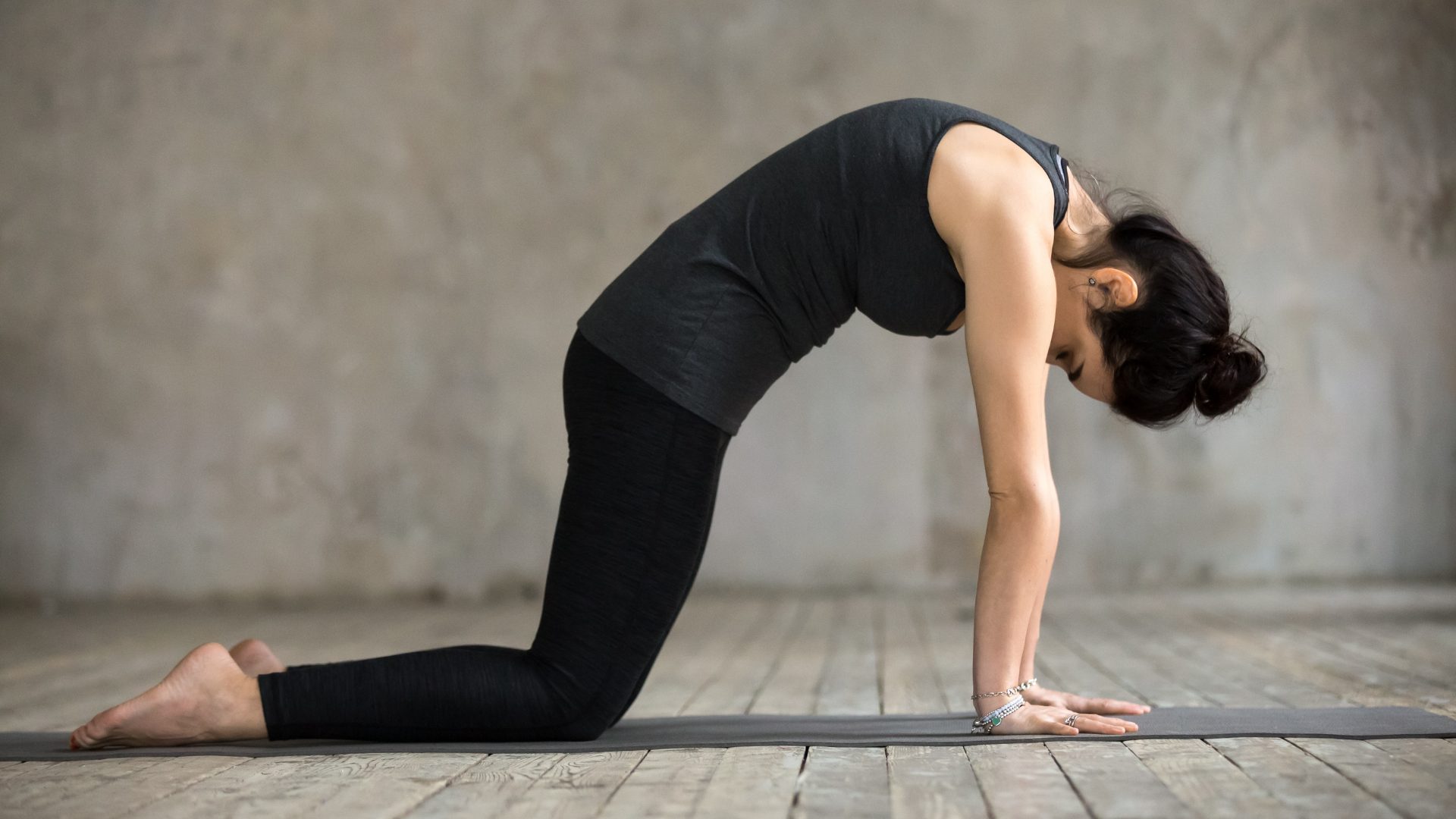
You've seen it in every single beginner class. The teacher says "inhale, drop the belly," and suddenly everyone is arching their backs like they’re trying to win a limbo contest. It’s called Marjaryasana-Bitilasana. Most people just call it the yoga cat and cow pose. It’s the bread and butter of spinal mobility, yet honestly, a lot of people are just going through the motions without actually feeling anything.
If you’re just flapping your spine up and down, you’re missing the point.
The spine isn't a single rod. It’s 24 moveable vertebrae. When we do the yoga cat and cow pose, we aren't just stretching; we’re trying to find "segmental control." That’s a fancy way of saying we want to move one bone at a time. Most of us have "sticky" spots, usually in the mid-back or the lower lumbar, where the bones move as one big, clunky block. That's where the injury risk hides.
The Mechanical Reality of the Yoga Cat and Cow Pose
Let’s get into the weeds for a second. When you transition into Cow Pose (Bitilasana), you’re putting your spine into extension. Your anterior longitudinal ligament stretches. Your abdominal muscles lengthen. But if you have tight hip flexors—which, let's be real, everyone does because we sit at desks all day—your pelvis might "dump" forward too fast. This pinches the facet joints in your lower back. That sharp "crunchy" feeling? Yeah, that’s not a good stretch. That’s compression.
Then there’s Cat Pose (Marjaryasana). This is spinal flexion. You’re protracting the scapulae—spreading the shoulder blades wide. This is supposed to be a massive relief for the rhomboids and the trapezius muscles. But I see so many people just tucking their chin to their chest and calling it a day. They forget the tailbone. If the tailbone isn't tucking, you aren't getting the full posterior tilt of the pelvis. You're basically just giving yourself a neck stretch and ignoring the other 80% of the movement.
Dr. Stuart McGill, a world-renowned expert in spine biomechanics at the University of Waterloo, has actually looked at this. He often notes that while cat-cow is great for reducing "viscous shear" (basically spinal stiffness), it shouldn't be pushed to the end range of motion. You don't need to force the stretch. You just need to move.
Stop Making These Mistakes Right Now
Most people treat their arms like kickstands. They lock the elbows. This is a mistake. When you lock your elbows, you’re dumping all your weight into the joint capsule rather than using your serratus anterior and triceps to stabilize. Keep a micro-bend. It’s harder. It’s annoying. It’s also how you save your wrists from carpal tunnel issues over time.
Another thing: the breath.
We’re told to inhale on Cow and exhale on Cat. Why? It’s physiological. When you inhale, your diaphragm moves down and your belly expands, which naturally complements the "dropping" of the belly in Cow. When you exhale, your core naturally wants to contract, which helps you "hollow out" the belly in Cat. If you’re breathing backward, you’re fighting your own internal pressure system.
Try this: do the yoga cat and cow pose but start the movement from the tailbone first. Imagine a wave traveling up your spine. The head should be the very last thing to move. Most people do it the other way around—they lead with the head. Your neck is already mobile; it doesn't need the extra work. Your mid-back does.
A Quick Reality Check on Wrist Pain
I hear it constantly. "I can't do cat-cow because my wrists hurt."
Fair.
If your wrists are screaming, you're probably leaning too far forward. Your shoulders should be directly over the wrists. If that still hurts, try making fists (knuckles down) or use yoga blocks to change the angle. Some people even do "Forearm Cat-Cow," which actually targets the upper thoracic spine even better because it locks the lower back in place. It's a game changer for office workers.
The Neurological Benefit Nobody Talks About
Yoga isn't just physical. We know this. But the yoga cat and cow pose is specifically tied to the Vagus nerve. This nerve is the highway of your parasympathetic nervous system—the "rest and digest" mode. By moving the spine rhythmically with the breath, you’re essentially massaging the internal organs and sending "all clear" signals to the brain.
It’s why you feel less stressed after just five rounds. It’s not magic. It’s biology.
There was a study published in the International Journal of Yoga that looked at how even short-term yoga practices affect autonomic functions. Slow, rhythmic movements like these help shift the body out of a "fight or flight" state. So, if you’ve had a garbage day at work, five minutes of cat-cow is legitimately more effective than scrolling on your phone.
Modifications for Different Bodies
Not everyone can get on all fours. If you have knee issues (meniscus tears, bursitis), kneeling on a thin mat is torture. Use a blanket. A thick one. Or, honestly, just do it in a chair.
Sit on the edge of a chair with your feet flat. Hands on your knees.
- Inhale: Pull your chest forward, look up slightly, and arch the back.
- Exhale: Round the spine, tuck the chin, and push your mid-back toward the chair's backrest.
It’s the same mechanical benefit without the joint pressure. Pregnancy is another big one. In the third trimester, you don't want to "drop" the belly too hard in Cow pose because the hormone relaxin has already made your ligaments loose. You could overstretch the linea alba (the midline of your abs). Keep the Cow pose "neutral-ish" and focus more on the "Cat" rounding to relieve the weight of the baby off your spine.
Why "Perfect" Form is a Myth
I hate the word "perfect" in yoga. Your spine is unique. Some people have deeper lumbar curves (lordosis), and others have flatter backs. Your yoga cat and cow pose won't look like the person's on the mat next to you. And it shouldn't.
The goal is sensation, not a specific shape.
If you feel a pinch, back off. If you feel a dull, spreading stretch, stay there. Explore the side-to-side movement too. Sometimes I like to wag my "tail" in Cow pose to get into the side body—the quadratus lumborum muscles. These are the muscles that usually seize up when your back "goes out." Stretching them while the spine is extended is a pro move.
Moving Beyond the Basics
Once you've mastered the standard movement, start playing with "Barrel Rolls." Imagine your ribcage is inside a literal wooden barrel and you’re trying to touch every single slat of wood with your ribs. It’s a circular version of the yoga cat and cow pose. It hits the intercostal muscles between your ribs, which are crucial for deep breathing.
Most people breathe "shallow" into their upper chest. By opening the ribs through these circular movements, you literally increase your lung capacity over time.
Actionable Steps for Your Next Practice
Don't just read this and go back to sitting hunched over. Here is how you actually integrate this properly into your life:
- The 2-Minute Rule: Do five rounds of cat-cow every morning before you check your phone. It wakes up the spinal fluid (cerebrospinal fluid) and gets things moving after eight hours of stagnation.
- The Tailbone Lead: Next time you're on the mat, consciously keep your head still until the very end of the movement. See how much harder it is to move the middle of your back.
- Check Your Hands: Spread your fingers wide. Press into the thumb and index finger knuckles. This takes the pressure off the "heel" of the hand and saves your wrists.
- Close Your Eyes: Seriously. Take the visual competition out of it. Feel where the spine is "stuck" and send your breath exactly there.
The yoga cat and cow pose is a tool, not a chore. Use it to map your body. If you find a spot that doesn't want to move, don't force it. Just breathe into it. Over time, those "sticky" vertebrae will start to find their independence again. That’s when the back pain actually starts to disappear.
Yoga doesn't have to be complicated to be effective. Sometimes the simplest movements are the ones that save your mobility in the long run. Get on the floor, move your spine, and stop worrying about looking like a magazine cover. Just move.