Most people treat that giant, inflatable orb in the corner of the gym like a piece of furniture. They sit on it. They bounce. Occasionally, they try a crunch, feel a weird twinge in their neck, and go back to the floor. It’s a shame. Honestly, if you aren't using yoga ball ab exercises, you're leaving about 40% of your muscle fiber activation on the table.
The stability ball—originally called the "Swiss Ball"—wasn't even meant for fitness nerds. It was developed in 1963 by Aquilino Cosani, an Italian plastics manufacturer, and primarily used by pediatric physical therapists in Switzerland. It only hit the mainstream because it works. It forces your body to fight gravity in a 360-degree environment. On the floor, the ground does the stabilizing for you. On a ball? You're on your own.
The Science of Why You’re Wobbly
When you perform yoga ball ab exercises, you’re engaging in what kinesiologists call "unstable surface training." A 2007 study published in the Journal of Strength and Conditioning Research found that performing a crunch on an unstable surface resulted in significantly higher EMG activity in the rectus abdominis and external obliques compared to traditional floor crunches.
It’s basic physics.
To keep from rolling off the ball, your nervous system has to fire "micro-adjustments." These are tiny, lightning-fast contractions in your deep core muscles—the transverse abdominis and the multifidus. You don't even think about it. You just do it. If you don't, you fall. Simple.
But there’s a catch. Most people use the ball wrong. They inflate it halfway so it's squishy and stable, or they pick a size that’s totally mismatched for their height. If your hips aren't level with or slightly higher than your knees when sitting, the biomechanics are shot. You’re just wasting time.
The Dead Bug (Stability Version)
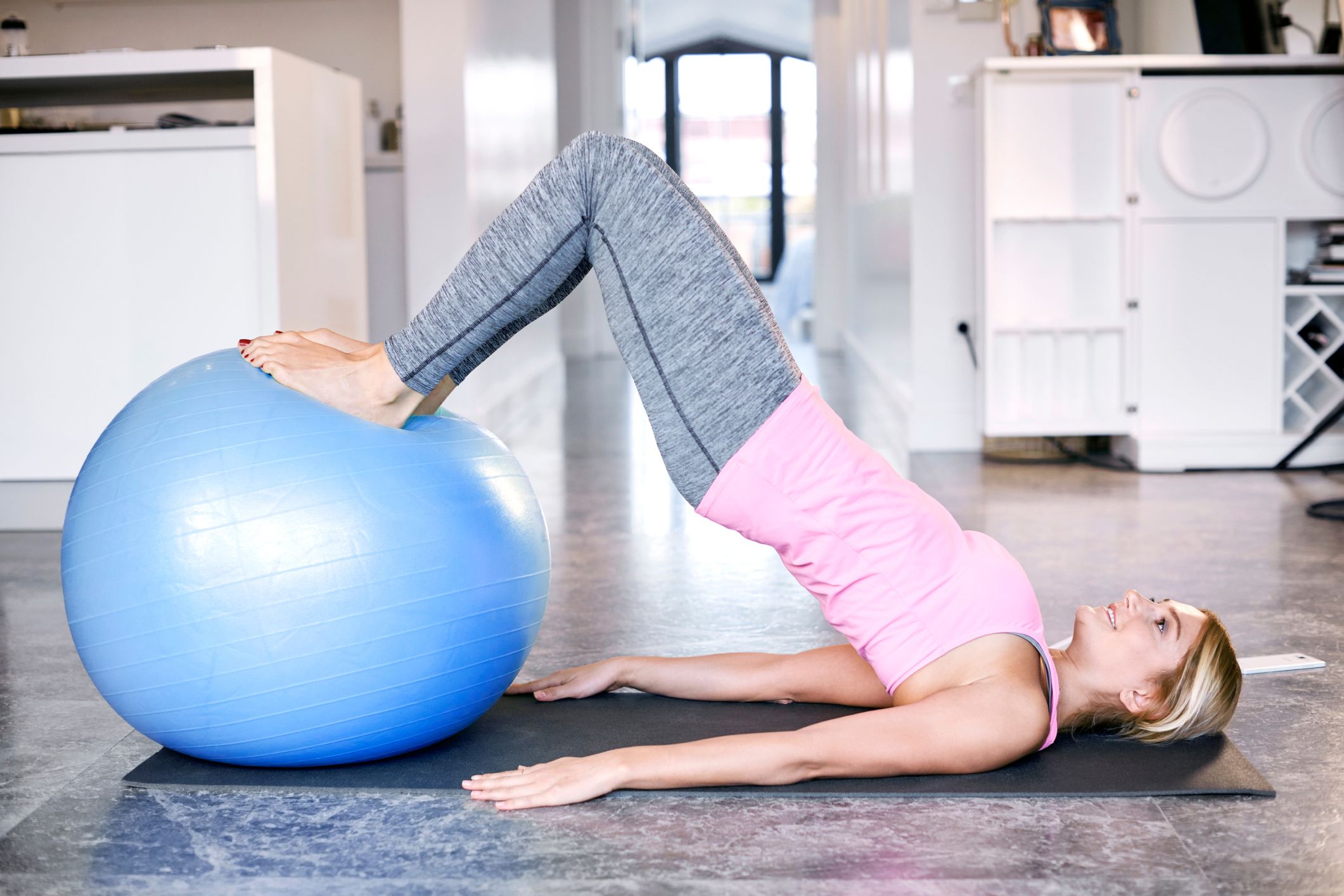
Forget the floor version. To do this right, lie on your back and pin the ball between your knees and your palms. Now, press. Hard. You should feel your lower back flatten against the ground immediately.
Slowly extend your right arm back and your left leg forward. The trick? The ball cannot move. The remaining limbs—your left hand and right knee—have to crush that ball to keep it in place. It sounds easy. It is not. Most people start shaking within ten seconds. That shaking is your nervous system screaming because it’s being forced to stabilize a moving load while maintaining isometric pressure.
Do about 10 reps. Go slow. If you’re rushing, you’re cheating.
Yoga Ball Ab Exercises That Actually Target the Lower Core
The "lower abs" aren't technically a separate muscle, but the lower region of the rectus abdominis is notoriously hard to wake up. Most people just end up overusing their hip flexors.
Try the Ball Pike.
Get into a plank position with your shins on the ball. Your hands should be directly under your shoulders. Now, instead of just pulling your knees in, think about lifting your tailbone toward the ceiling. The ball should roll toward your chest as your body forms an inverted "V."
This move is brutal.
Dr. Stuart McGill, a world-renowned spine biomechanics expert, often talks about the importance of "proximal stiffness." The Pike requires you to maintain a rigid torso while your hips hinge. If your back arches, stop. You’ve lost the form. A 2010 study in the Journal of Orthopaedic & Sports Physical Therapy highlighted that the "roll-out" and the "pike" were among the most effective exercises for activating the internal and external obliques.
The Stir-the-Pot
This is the holy grail of yoga ball ab exercises. It was popularized by Dr. McGill himself.
- Get into a forearm plank on the ball.
- Keep your feet wide for stability or narrow if you’re a masochist.
- Move your forearms in a small circle.
Basically, you’re trying to keep your torso perfectly still while the ball tries to pull you out of alignment. Don't make huge circles. Small, controlled movements are way more effective. It’s about resisting rotation. Anti-rotation is the most underrated aspect of core strength. We spend so much time moving our spines that we forget the core's primary job is often to prevent movement to protect the spine.
Stop Doing "Sit-Ups" on the Ball
Seriously. Just stop.
When you do a full sit-up on a stability ball, you often end up putting excessive shear force on your lumbar spine. Plus, once you pass a certain point, gravity takes over and the tension leaves your abs.
Instead, try the Ball Crunch with a Reach. Sit on the ball and walk your feet forward until your lower back is supported by the curve of the ball. Lean back until your head is lower than your hips—this gives you a range of motion you can't get on the floor. Now, crunch up only about 30 degrees. Reach your arms toward the ceiling, not your knees.
This keeps the tension squarely on the upper fibers of the rectus abdominis. It’s short, sharp, and effective.
Common Mistakes That Kill Your Progress
I see it every day at the gym. Someone grabs a ball that’s too big, their form goes to trash, and they wonder why their back hurts.
- Over-inflation: If the ball is too hard, it’s actually harder to balance, which is good—to a point. But if it’s so hard it’s sliding across the floor, you're going to slip.
- The "Squish" Factor: If the ball is under-inflated, it creates a "cradle" for your body. This makes the exercise easier, which defeats the entire purpose of using an unstable surface.
- Neck Pulling: If your hands are behind your head, don't yank. Rest your fingertips lightly behind your ears. Better yet, cross your arms over your chest.
- Holding Your Breath: This is huge. If you don't breathe, you can't properly engage the diaphragm, which is a key part of your core canister.
The Anatomy of a Perfect Routine
You don't need 20 exercises. You need four that you do perfectly.
Start with the Ball Slams (if you have a weighted slam ball) or Overhead Med-Ball Reaches while sitting on the yoga ball. This wakes up the stabilizers. Move into the Stir-the-Pot for 45 seconds. Take a break. Hit the Pikes for 12 reps. Finish with the Dead Bug.
Most people think more is better. It's not. Quality over quantity is a cliché because it’s true. If you can do 50 reps of a yoga ball exercise, you aren't doing it right. You should be struggling by rep 12.
Why Your Height Matters
Check the sizing. It’s not one-size-fits-all.
- Under 5'4": 55 cm ball.
- 5'4" to 5'11": 65 cm ball.
- Over 6'0": 75 cm ball.
If you're using a 75 cm ball and you're 5 feet tall, your center of gravity is going to be all wrong. You'll likely strain your hip flexors trying to stay on the thing.
The Mental Game of Stability
There is a cognitive component to yoga ball ab exercises that people rarely talk about. Because the surface is unpredictable, your brain has to stay "on." You can't zone out and watch the news on the gym TV while doing these.
This creates a better mind-muscle connection. You start to feel how your obliques kick in when you shift your weight. You learn how to "brace" rather than just "hollow" your stomach. Bracing is like getting ready for someone to punch you in the gut. It’s a total-core contraction.
Actionable Steps for Your Next Workout
To get the most out of these movements, stop treating them like an afterthought at the end of your session.
- Test your inflation: Sit on the ball. Your thighs should be parallel to the floor. If they slope down, it’s too big. If they slope up, it’s too small or needs air.
- Slow down the tempo: Use a 3-1-3 tempo. Three seconds to lower, one-second pause at the peak of tension, three seconds to return.
- Focus on "The Brace": Before every rep, imagine pulling your belly button toward your spine and then tightening your entire midsection.
- Integrate, don't isolate: Mix one yoga ball exercise between your sets of heavy lifts like squats or overhead presses. This keeps your core primed and active throughout the whole workout.
The yoga ball isn't a miracle tool, but it is a brutally honest one. It won't let you cheat. If your core is weak, the ball will tell you immediately by rolling away. Listen to it. Master the wobble, and the strength will follow.