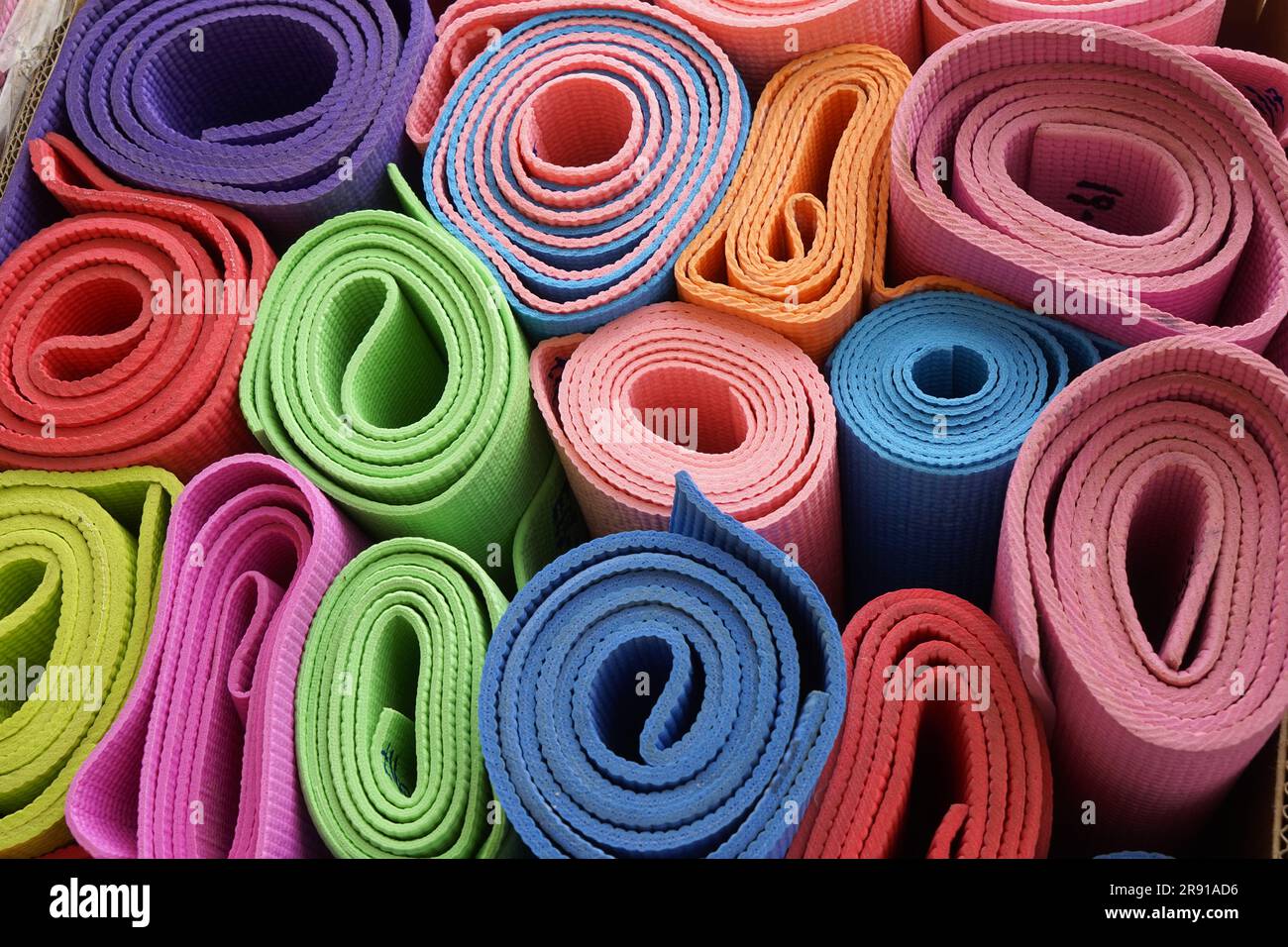
Your floor is harder than you think. Honestly, most people just grab the cheapest roll of foam they see at a big-box store and wonder why their wrists ache after three Sun Salutations or why their knees feel bruised after a round of mountain climbers. It’s a mess. Picking between yoga and exercise mats isn't just about the color or how "squishy" it feels when you poke it with your thumb. It’s about density, open-cell versus closed-cell construction, and whether you’re actually going to slip and faceplant when you start sweating.
I've seen it a thousand times. Someone buys a thick, pillowy "fitness mat" for a Vinyasa flow class. They try to hold a Tree Pose, and their ankle wobbles like Jello because there’s zero stability. Or worse, a hardcore weightlifter tries to do burpees on a thin 1/16th-inch travel yoga mat and ends up with shin splints.
We need to talk about the physics of the foam.
The big divide: Yoga versus everything else
Basically, a yoga mat is designed for "grounding." You want to feel the floor, but you don't want the floor to hurt you. Most standard yoga mats are about 1/8 inch thick (around 3mm). If you go thinner, like those 1.5mm travel mats, you're basically doing yoga on a piece of paper. Great for packing, terrible for hardwood floors.
Exercise mats are a different beast. They are built for impact. Think about jumping jacks or dropping a kettlebell. If you use a standard yoga mat for P90X or HIIT, you’re going to shred the material within a month. I've seen mats literally disintegrate under the friction of a sneaker sole. Most exercise mats are 1/2 inch thick or more. They use closed-cell PVC or NBR (Nitrile butadiene rubber) to absorb the shock that would otherwise go straight into your joints.
But here is the kicker: you can’t really do yoga on a thick exercise mat. The "squish factor" ruins your balance. Try doing a Warrior III on a half-inch of foam. You'll spend more time trying not to fall over than actually stretching.
Material science is kinda boring but super important
Let’s get into the weeds for a second because this is where the money is wasted. Most cheap mats are made of PVC. It’s durable and sticky, which is great for grip, but it's not exactly eco-friendly. If you’ve ever unrolled a new mat and it smelled like a chemical factory, that’s the phthalates.
Then you have TPE (Thermoplastic Elastomer). It’s the middle ground. It’s lighter than rubber and usually recyclable. But if you’re a heavy sweater? TPE can turn into a slip-and-slide.
For the serious practitioners, natural rubber is the gold standard. Brands like Manduka (specifically the eKO line) or Jade Yoga use sustainably harvested tree rubber. The grip is insane. You feel like Spider-Man. But—and this is a big but—rubber smells like a tire shop for the first few weeks. Also, if you have a latex allergy, stay far away.
Quick tip: If your rubber mat smells, don't leave it in the sun. UV light breaks down natural rubber faster than you can say "Namaste," leaving you with a crumbly, dry mess.
Why your "sticky" mat isn't actually sticking
You bought a "sticky mat" and you're still sliding? It’s probably because you’re looking at the wrong type of "grip."
There are two ways a mat handles moisture. Closed-cell mats (like the famous Manduka PRO) don’t absorb anything. This is great for hygiene because bacteria can't get inside. But the sweat stays on top. If you don't use a yoga towel, you're going to slide.
Open-cell mats act like a sponge. They suck the sweat down into the core of the mat. This keeps the surface dry and grippy even in a 105-degree hot yoga room. Lululemon’s "The Mat" is a classic example of this. The downside? They are a nightmare to clean. All that sweat, skin cells, and oil are trapped inside. If you don't deep-clean an open-cell mat, it will eventually start to smell like an old locker room.
The durability lie
People think "more expensive" means "lasts forever." That’s not always true. A high-end polyurethane (PU) mat—the kind that feels buttery soft and incredibly grippy right out of the box—is actually quite fragile. The oils from your skin will eventually "clog" the surface, and the PU layer will begin to peel or lose its grip after a year or two of heavy use.
Meanwhile, a dense PVC mat like the Manduka PRO is basically indestructible. They literally come with a lifetime guarantee. The catch? You have to "break them in." Pro users often do a salt scrub on new PVC mats to wear down the initial film. It’s a chore. You’re basically sanding down your mat so it works better.
Real talk about "Exercise Mats" for home gyms
If you're building a home gym, stop looking at "yoga mats" entirely. You need something that can handle lateral movement. When you’re doing lateral lunges, you’re putting a lot of shear force on the material.
Look for "Large Exercise Mats" or "Gym Flooring Tiles." These are usually made of high-density EVA foam. EVA is cheap, lightweight, and provides a lot of cushion. However, it compresses over time. If you leave a heavy dumbbell on an EVA foam mat, that dent is permanent. It’s a "memory" foam that never forgets its trauma.
For those doing heavy lifting or using equipment like a Peloton or a treadmill, you want crushed rubber. It’s the stuff you see in commercial gyms. It doesn’t compress, it doesn't slip, and it mutes the vibration of the machines.
Specific recommendations based on how you actually move
If you’re doing Hot Yoga, get a Cork mat. Cork has a natural substance called suberin that actually becomes more grippy when it gets wet. It’s also naturally antimicrobial. Brands like Yoloha have pioneered this. It feels earthy and firm.
If you’re doing Pilates, you need thickness. Pilates involves a lot of rolling on the spine. A 3mm yoga mat will make you feel every single vertebra hitting the floor. Go for at least 6mm to 10mm. Your back will thank you.
For General HIIT and Cardio, look for a mat with a textured "waffle" bottom. This prevents the mat from sliding across your floor while you’re moving. There is nothing more dangerous than a mat that moves while you’re landing a jump.
Maintenance: You're probably ruining your mat
Stop using harsh wipes. Bleach or heavy detergents break down the molecular structure of most yoga and exercise mats.
For closed-cell mats, a simple mix of water and a drop of dish soap is fine. For open-cell mats, you need a dedicated cleaner or a very diluted vinegar solution. And never, ever put your mat in the washing machine unless the manufacturer explicitly says so. Most of the time, the agitator will tear the foam to shreds, and you’ll be left with a soggy mess of blue crumbs.
What to look for on the label
When you're shopping, ignore the marketing fluff like "pro-performance" or "zen-grip." Look at the specs:
- Weight: Heavier usually means better quality rubber or denser PVC. If a 71-inch mat weighs less than 2 pounds, it's probably cheap foam that will stretch and tear.
- Dimensions: Standard is 68" x 24". If you're over 5'10", you'll be miserable. Look for "Extra Long" (72" or 84").
- Certification: Look for OEKO-TEX certification. This ensures the mat was tested for harmful substances. Since your face is often inches away from the mat, breathing in toxic off-gassing isn't ideal.
Your actionable checklist for buying
Don't overthink it, but don't under-buy either.
- Check your floor: If you're on carpet, you need a thin, very firm mat to avoid "sinking." If you're on tile or wood, you need more cushion (5mm+).
- Test the "Pinch": If you pinch the mat and your fingers easily meet, the foam is too low-density. It will bottom out under your body weight.
- Identify your "Sweat Level": If you don't sweat much, stick with closed-cell (PVC/Rubber). If you're a human fountain, go for PU or Cork.
- Measure your space: Don't buy a "Giant" 6x6 mat if you have to move your coffee table every time you use it.
Buying the right surface is the difference between a workout you look forward to and one that feels like a chore. Spend the extra $30. A good mat should last you years, not months. High-density rubber or specialized PVC might feel like a big investment upfront, but it beats replacing a $15 foam mat every time the seasons change.
Go for density over thickness. Go for grip over aesthetics. Most importantly, make sure the mat you choose matches the highest-impact activity you plan to do on it. Your joints are worth the research.



