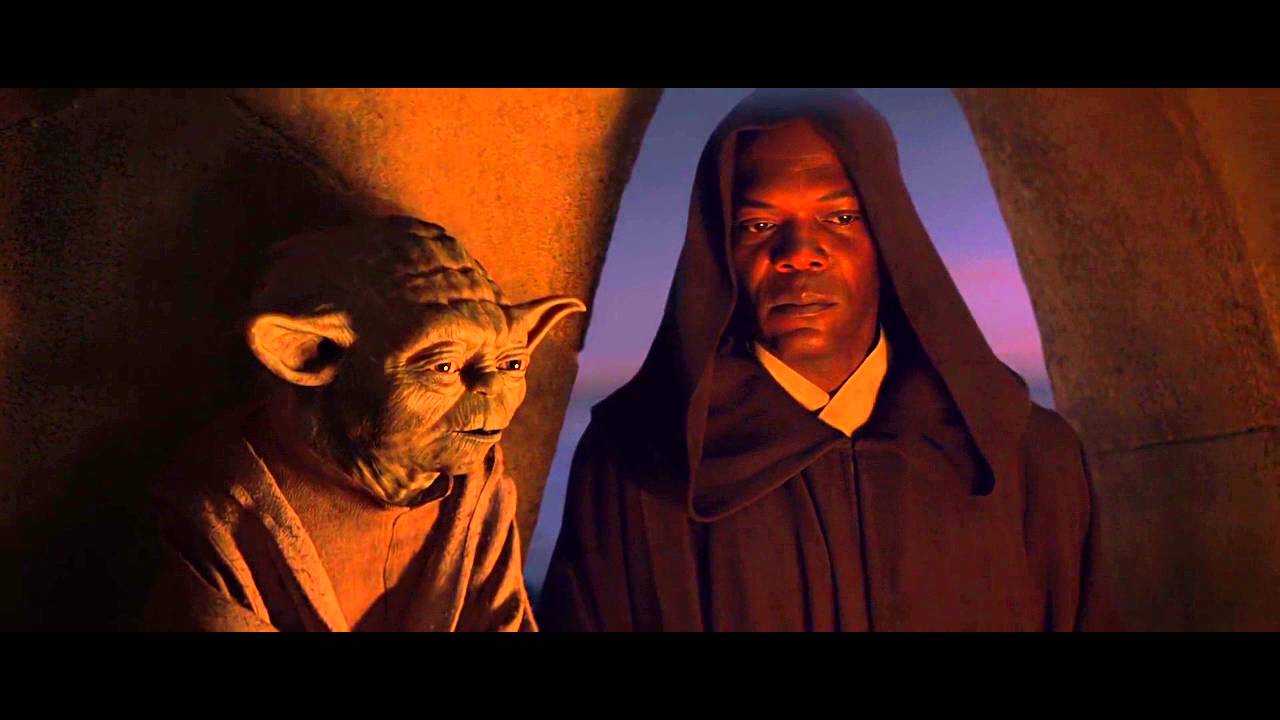
The Jedi High Council wasn't a monolith. Even though pop culture often lumps the Prequel-era Jedi into one big group of robe-wearing monks, the dynamic between Yoda and Mace Windu was actually the heartbeat of the Republic’s final years. It was a weird, tense, and ultimately tragic partnership. You have Yoda, the 800-year-old grandmaster who speaks in riddles and smells like swamp water, paired with Mace Windu, the blunt, aggressive warrior who literally invented a lightsaber style that dances on the edge of the Dark Side.
They weren't always on the same page. Honestly, their inability to reconcile their different worldviews is a huge reason why Palpatine was able to waltz right into a dictatorship while they were sitting ten feet away.
The Grandmaster and the Champion: A Study in Contrasts
Yoda was the spiritual North Star. By the time of The Phantom Menace, he had been training Jedi for centuries. He was all about the "Living Force"—that nebulous, hippy-dippy feeling of being connected to all things. Then you have Mace Windu. Mace was the elected Leader of the Council, a role that was much more about policy, Republic politics, and being the Order’s primary enforcer.
If Yoda was the soul, Mace was the fist.
Mace Windu is famous for Vaapad. If you aren't a deep-lore nerd, Vaapad is the seventh form of lightsaber combat. It’s dangerous. It requires the user to channel their own inner darkness and the opponent's aggression into a weapon of light. Yoda reportedly looked askance at this. He tolerated it because Mace was disciplined, but there was always this underlying friction. Yoda feared the dark; Mace tried to use it as a tool. This fundamental disagreement on how to handle "the shadow" eventually bled into how they handled Anakin Skywalker.
Why Yoda and Mace Windu Couldn't Agree on Anakin
When Qui-Gon Jinn brought a sandy-haired kid from Tatooine into the council chambers, the vibe shifted. Yoda and Mace Windu both felt the disturbance, but they reacted in ways that showcased their individual flaws. Yoda was hesitant. He saw the fear in Anakin. He knew fear leads to the Dark Side—it's his most famous line for a reason.
Mace, however, was more concerned with the prophecy and the immediate threat of the Sith.
While Yoda wanted to stick to the old ways and deny the boy training, Mace eventually pivoted toward using Anakin as a political and military asset. Think about Revenge of the Sith. Mace is the one who tells Anakin to spy on the Chancellor. Yoda is the one telling Anakin to just "let go" of his fears of death. Neither approach worked. Yoda was too detached, and Mace was too pragmatic. By trying to balance these two extremes, they left Anakin in a middle ground where he felt unsupported by both.
The Palpatine Blind Spot
How did two of the most powerful Force-sensitives in history miss a Sith Lord sitting across the desk?
It’s the question everyone asks.
The answer lies in the specific way the Dark Side clouded their vision. Yoda admitted that the Jedi's ability to use the Force was diminished. He felt it as a spiritual failing. Mace Windu saw it as a tactical problem. During the Clone Wars, Mace became a General. He was obsessed with winning battles and maintaining the Republic’s integrity. He was so busy looking at star charts and troop movements that he stopped looking for the "shroud" Yoda kept complaining about.
There’s a specific moment in the Shatterpoint novel by Matthew Stover—which, even if it's "Legends" now, perfectly captures Mace’s psyche—where he realizes that the war itself is a trap. But he can't stop. He’s a man of action. Yoda, conversely, spent much of the war in meditation, searching for answers in the Force that simply weren't coming because the "dark side clouds everything." They were stuck. One was too busy fighting to see the big picture, and the other was too busy looking at the big picture to see the fight happening in the room.
The Final Confrontation: Separate Paths to Failure
When the end finally came, the divergence between Yoda and Mace Windu became a chasm.
Mace went for the kill.
When he cornered Palpatine in the Chancellor's office, he didn't try to bring him to justice in a spiritual sense. He decided that Palpatine was "too dangerous to be left alive." This was the ultimate expression of Mace’s philosophy: the end justifies the means. It was also the moment he lost Anakin forever. By acting as an executioner rather than a keeper of the peace, he validated every lie Palpatine had told Anakin about the Jedi trying to take over.
Yoda’s failure was different. After Mace died and the Temple fell, Yoda went to face Sidious in the Senate pod. He fought to a stalemate and then... he left.
"Failed, I have," he said.
He realized that the Jedi of his era could not win this war. The old way—his way—was broken. While Mace died fighting the symptoms, Yoda lived to realize he had ignored the disease for eight hundred years. He chose exile on Dagobah not just to hide, but to wait for a new generation that wasn't tainted by the political mess he and Mace had helped create.
Real-World Takeaways from the Jedi Council
You don't have to be a space monk to learn something here. The breakdown between these two leaders is a classic case study in organizational failure.
- Avoid Echo Chambers: Yoda and Mace respected each other too much to truly challenge each other's fundamental biases until it was too late.
- Values vs. Logistics: Mace focused on the logistics of the Republic; Yoda focused on the values of the Force. They rarely found a way to make them work in tandem.
- The Middle Manager Problem: Anakin was essentially a high-performing employee with "culture fit" issues. Mace treated him like a tool, and Yoda treated him like a liability. Nobody treated him like a person.
If you’re looking to apply this to your own life or leadership style, start by identifying who the "Mace" or "Yoda" is in your circle. Are you so focused on the spiritual or "big picture" goals that you're missing the immediate threats? Or are you so busy putting out fires that you've forgotten why you started the fire department in the first place?
To really understand the nuances of this era, you should re-watch the original Clone Wars 2D micro-series (2003) alongside the 3D series. The 2D version shows Mace Windu as an unstoppable god of war, which makes his eventual defeat by a desperate Anakin even more jarring. Also, check out the book Brotherhood by Mike Chen; it gives a great look at how the Council functioned right as the war began. Seeing how they interacted before the bitterness set in makes the ending of their story much harder to swallow.
The Jedi didn't fall because they were weak. They fell because their two greatest leaders were looking in opposite directions while the floor was being cut out from under them.



