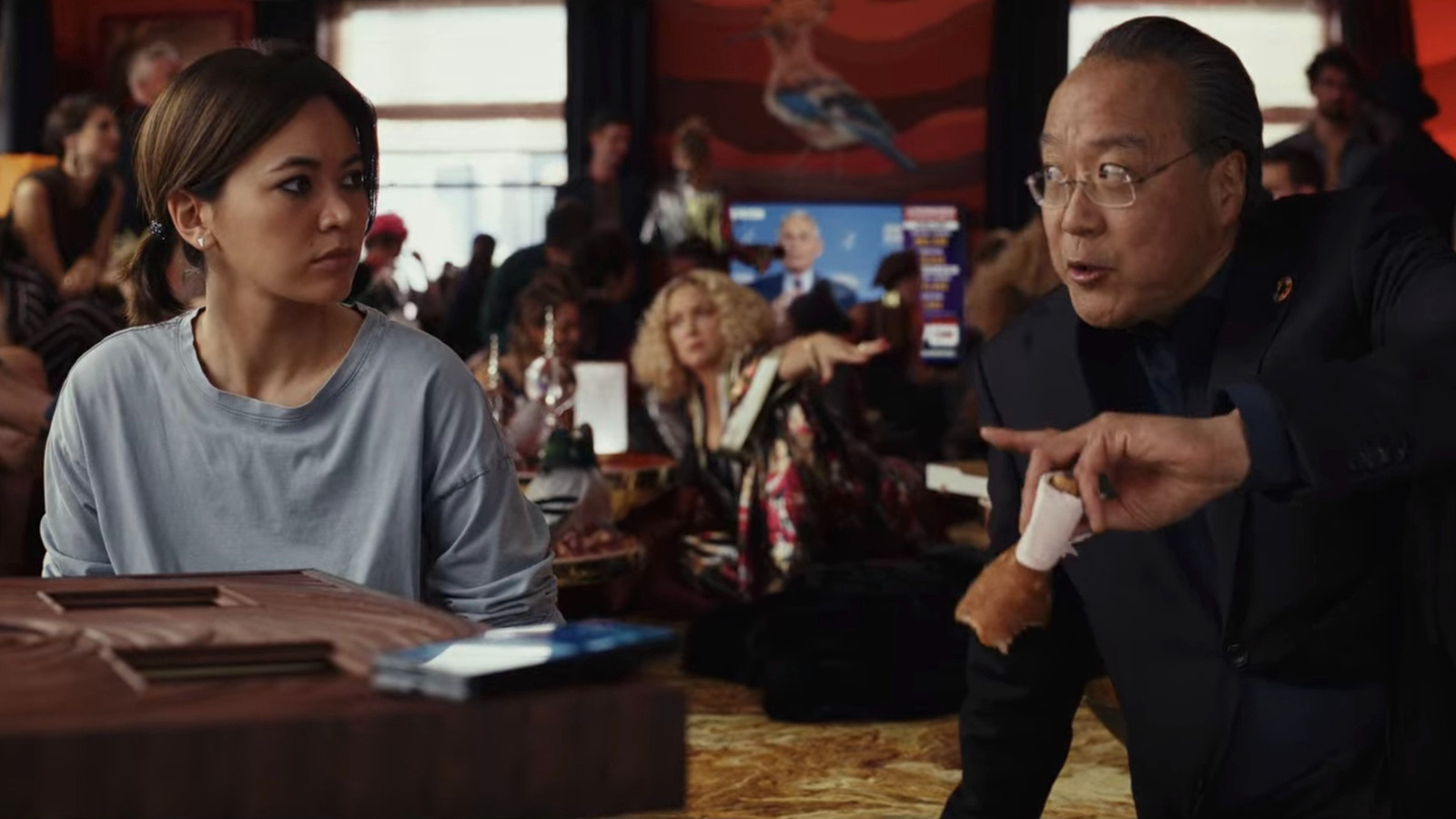
You’re at a party. It’s loud. People are wearing ridiculous outfits, and someone starts playing a high-stakes game of "name that tune" with a literal pipe organ. Then, out of nowhere, the greatest living cellist in the world pops up. He's just... there. Hanging out. Holding a slice of pizza. This isn’t a fever dream; it’s one of the best moments in Rian Johnson’s Glass Onion: A Knives Out Mystery.
The Yo-Yo Ma Glass Onion cameo isn't just some random celebrity shoehorned in for a cheap laugh. It actually serves the plot. That’s the magic of it.
Honestly, most cameos feel like the director just called a famous friend and asked them to stand in the background for five seconds. Think about those "blink and you'll miss it" spots in big-budget sequels. But Yo-Yo Ma? He’s integral to the scene. He’s the one who identifies a piece of music that establishes exactly how "pseudo-intellectual" the main characters really are. He isn't playing a character. He’s playing himself—a man who happens to know every single note of the classical canon by heart.
Why That Pizza Scene Works So Well
The scene happens early. We’re at a party thrown by Birdie Jay (Kate Hudson). Everyone is trying to solve a complex puzzle box sent by tech billionaire Miles Bron (Edward Norton). It’s chaotic. It’s frantic.
Suddenly, the puzzle box starts emitting a melody.
While the "disruptors" are scratching their heads, Yo-Yo Ma leans in. He’s casual. He's eating pizza. He casually identifies the track as a "fugue." Specifically, he notes it's a reference to Bach. It’s a brief, thirty-second interaction, but it tells the audience everything they need to know about the world Miles Bron has built. He surrounds himself with the elite—not just the wealthy, but the absolute masters of their crafts—even if he doesn't actually understand the art himself.
Glass Onion is a movie about layers. It’s about people who pretend to be deeper than they are. By having a literal genius like Yo-Yo Ma explain a basic musical concept to these "geniuses," Rian Johnson is winking at us. He’s showing us that the people in this room are out of their depth.
The Bach Connection
The music playing from the box is J.S. Bach’s Little Fugue in G Minor.
If you know music, you know a fugue is a composition where a short melody is introduced by one part and then taken up by others and developed by interweaving the parts. It’s complex. It’s layered. Just like the titular Glass Onion.
Ma explains this to the group with the patience of a man who has taught masterclasses to the best musicians on earth. His delivery is perfect. He’s not being a snob. He’s just helpful. That’s the real-life Yo-Yo Ma vibe, right? He’s known for being incredibly kind and accessible. Seeing him in this setting—surrounded by vapid influencers and crooked politicians—is hilarious because he is the only truly authentic person in the room.
How They Got Him to Do It
You might wonder how a guy who has won 19 Grammy Awards and the Presidential Medal of Freedom ends up in a murder mystery comedy.
Rian Johnson has been vocal about this in interviews. He wanted someone who represented true excellence. The production reached out, and surprisingly, Ma was game. He filmed his part in New York, separate from the main Mediterranean shoot, but his presence looms large over the opening act.
It’s worth noting that Ma isn't a stranger to the screen. He’s appeared on Mister Rogers' Neighborhood, The West Wing, and even The Simpsons. He seems to have a genuine love for pop culture. He understands that his "brand"—if you can call it that—is about connecting people through music. Whether that’s in a concert hall or a Netflix movie about a billionaire’s private island, he’s there to bridge the gap.
The Accuracy of the Musical "Easter Egg"
Most movies mess up the technical details. They’ll show a violinist holding a bow wrong or a pianist playing chords that don’t match the audio.
But with the Yo-Yo Ma Glass Onion appearance, the technicality is spot on. The way he describes the fugue is musicologically sound. It’s not "movie science" or "movie music." It’s real. This adds a layer of E-E-A-T (Experience, Expertise, Authoritativeness, and Trustworthiness) to the film itself. When you bring in an expert to play themselves, you can't fake the dialogue. You have to let the expert be an expert.
What This Says About Miles Bron
The cameo is a character study of Miles Bron.
Think about it. Why is Yo-Yo Ma at Birdie Jay’s party? He’s likely there because Miles invited him or because he’s part of that ultra-exclusive circle. Miles wants to be seen as a polymath. He wants to be the guy who has Yo-Yo Ma on speed dial.
But as the movie progresses, we realize Miles is a fraud. He’s a "turd," as Benoit Blanc (Daniel Craig) eventually calls him. He uses people like Ma to provide a veneer of intellectualism to his otherwise shallow existence. The fact that Ma has to explain the music to the group shows that while they have access to the best things in the world, they don't actually understand them.
Practical Takeaways for Movie Buffs
If you're watching Glass Onion for the first time—or the fifth—keep an eye on the background during the party scenes. There are dozens of tiny details that hint at the ending.
- Listen to the prompts. The music Ma identifies isn't just background noise. It's a clue about the structure of the mystery itself.
- Observe the "Disruptors." Notice how they interact with Ma. They treat him like an object, a piece of furniture that talks. They don't actually listen to the brilliance of the music; they just want the answer to the puzzle.
- Research the Bach piece. If you listen to the Little Fugue in G Minor after watching the film, you’ll hear the "layers" that Miles keeps talking about. You'll also realize the irony: a fugue is structured and mathematical, while Miles's life is chaotic and built on lies.
Why We Still Talk About This Cameo
Years after its release, people still search for the Yo-Yo Ma Glass Onion scene. Why? Because it was unexpected.
Usually, celebrities in these movies play themselves as caricatures. They’re either jerks or they’re over-the-top. Ma is just... a guy. A guy who knows a lot about Bach. It feels grounded. It feels like something that could actually happen in that weird, high-society world.
It’s also a testament to Rian Johnson’s writing. He doesn't waste space. Every line of dialogue, every guest star, and every prop serves the central theme: the difference between something that is complex and something that is just complicated.
The Glass Onion is a complicated object that is actually transparent at its center. Yo-Yo Ma is a complex human being who brings clarity to a complicated moment.
Next Steps for the Curious Viewer
If you want to dive deeper into the world of Glass Onion and the music that inspired its structure, start by listening to the full Bach piece Ma mentions. It’s available on almost every streaming platform. You’ll start to hear the patterns.
Next, re-watch the opening sequence of the film. Now that you know Ma is there to signal the group's lack of true intelligence, his lines hit differently. You realize he’s almost pitying them. He’s the smartest guy in the room, and he’s just there for the snacks.
Finally, look into the other cameos. From Ethan Hawke as "The Assistant" to the various voices on the phone, the movie is a treasure trove of "if you know, you know" moments. But none are as musically significant—or as charming—as the cellist with the pizza.
Stop looking for the hidden meaning in the "disruption" and start looking at the experts who are actually telling you the truth. Just like Yo-Yo Ma did in that living room. He told us exactly what the box was. We, like the characters, were just too distracted by the spectacle to realize the answer was right in front of us.
The real lesson? If Yo-Yo Ma tells you something is a fugue, believe him. And if a billionaire tells you he's a genius, maybe check if he can actually solve the puzzle himself first.



