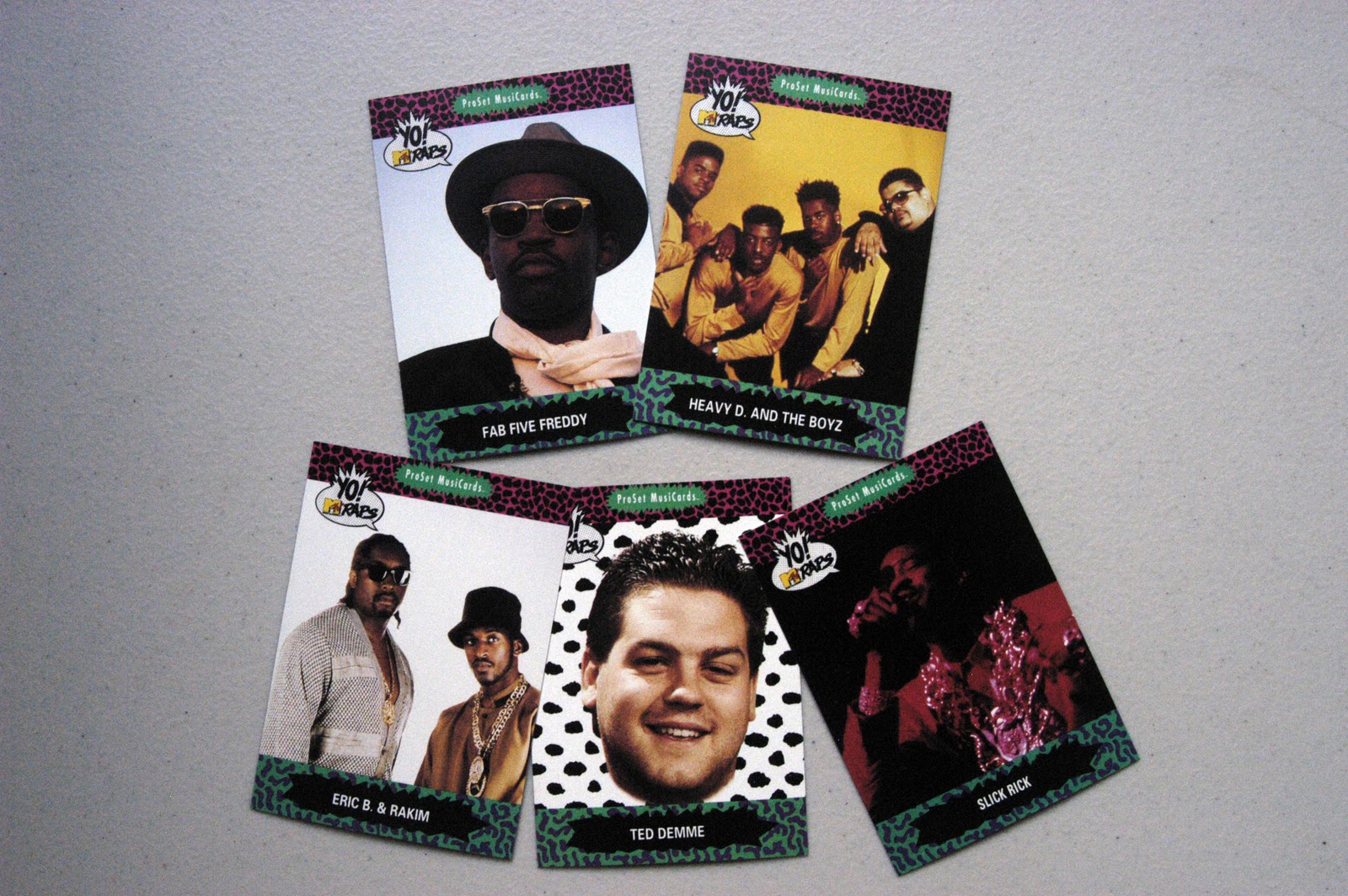
Hip-hop in 1991 wasn't just music. It was a takeover. You couldn't turn on a television without seeing Fab 5 Freddy leaning against a graffiti-covered wall or Ed Lover and Doctor Dré doing the "Ed Lover Dance." It was chaotic, loud, and incredibly colorful. Naturally, ProSet—a company that was basically the king of overproducing sports cards at the time—decided to bottle that lightning. They released Yo! MTV Raps trading cards, and honestly, the hobby has never been the same since.
If you grew up during the "Junk Wax" era, you know exactly what these look like. They’ve got those neon borders. They’ve got the funky geometric shapes. Most importantly, they have the rappers who defined a generation before hip-hop became the global corporate behemoth it is today.
The ProSet Gamble and the Birth of Rap Wax
ProSet was a company on a mission to put everything on cardstock. Football? Obviously. The Super Bowl? Sure. The Little Mermaid? Why not? But Yo! MTV Raps trading cards were different because they captured a subculture that the mainstream was still trying to figure out. This wasn't just a licensed product; it was a physical archive of the Golden Era.
The set consisted of 100 cards in the first series, followed by a second series that bumped the total up to 150. You had legends like Public Enemy, Run-D.M.C., and LL Cool J. But you also had the deep cuts—people like Nikki D, Stereo MC's, and Young MC. It was a democratic snapshot of the Billboard charts and the underground.
ProSet didn't just stick to the artists, though. They included cards for the hosts, the producers, and even some "behind the scenes" looks at the show's production. It felt like a backstage pass.
Why collectors ignored them for decades
For a long time, these cards were worthless. I mean, literally a dollar for a box at some card shows in the late 90s. Collectors were obsessed with Michael Jordan rookies or Upper Deck baseball. Rap cards? They were seen as a gimmick. A novelty that would end up in a landfill.
That changed.
The nostalgia cycle is a powerful thing, but it’s more than just people wanting to feel like they’re twelve again. We realized that these cards are some of the only high-quality, officially licensed physical media from that specific window of time. If you want a rookie card of The Notorious B.I.G., you’re looking at 1994 sets. But if you want the first appearances of the OGs? You go to 1991.
The Most Valuable Yo! MTV Raps Trading Cards Today
Value is a tricky word in the card world. If you find a dusty pack in your garage, you aren't retiring tomorrow. Sorry. Most of these were printed in such massive quantities that "raw" cards—cards that haven't been professionally graded—still sell for pennies.
But the "slab" changed the game.
When you send a card to PSA (Professional Sports Authenticator) or BGS (Beckett Grading Services) and it comes back as a Gem Mint 10, the price skyrockets. Because the quality control at the ProSet factory was, frankly, terrible. The cuts were off-center. The edges frayed if you looked at them too hard. The ink would smudge.
- Card #1: Public Enemy. This is often considered the "title" card of the set. Finding a perfectly centered PE card is like finding a needle in a haystack.
- Card #34: Beastie Boys. Always a collector favorite. The image is iconic, capturing MCA, Ad-Rock, and Mike D in their prime.
- Card #67: Ice-T. Before he was a staple on Law & Order: SVU, he was the epitome of West Coast gangster rap. This card is a must-have for historians.
- The ProSet MusiCards Holograms. These were the "chase" cards. They weren't in every pack. If you pulled a hologram back in '91, you were the king of the playground.
The market for these has transitioned from "junk" to "cultural artifacts." A PSA 10 of a major artist can now command several hundred dollars, sometimes more depending on the scarcity of the grade. It’s not about the cardboard; it’s about the provenance of the culture.
The Weirdness of Series 2
A lot of people don't realize there was a second series. While Series 1 is the most common, Series 2 (numbers 101-150) introduced some artists who were just starting to blow up. This is where you see the expansion of the "Yo!" brand into a broader musical landscape.
The photography also got a bit more experimental. The first 100 cards were mostly promotional shots provided by the labels. By Series 2, you started seeing more candid moments from the set of the show itself. It felt more like the program we watched every afternoon.
Spotting Errors and the "Junk Wax" Trap
If you're looking to buy into this hobby now, you have to be careful. The "Junk Wax" era (roughly 1987-1994) was defined by overproduction. There are millions of these cards sitting in warehouses.
Don't buy individual raw cards on eBay expecting them to be perfect. They won't be. Most have "silvering" on the edges or "soft corners." If you want an investment, buy the PSA 9 or 10. If you just want the memories, buy a "complete set" for thirty or forty bucks and put them in a binder.
One thing to look out for: The ProSet error cards. ProSet was notorious for typos. Wrong names on the back, flipped photos, misspelled song titles. In the sports world, some of these errors are worth a fortune (like the Billy Ripken "F-Face" card). In the Yo! MTV Raps trading cards set, most errors are just... errors. They don't always add value, but they’re fun conversation starters.
Why the aesthetic still works
Look at the design of these cards. The "Yo!" logo is a masterclass in early 90s street art aesthetic. It uses a primary color palette—red, yellow, blue—mixed with heavy black outlines. It mirrors the transition of hip-hop from the "boombox on the corner" era to the "bright lights of MTV" era.
Modern card designs are often too sleek. Too much chrome. Too many "refractors" and "autograph patches." These ProSet cards feel tactile. They feel like the era of baggy jeans and Cross Colours jackets.
How to Start Your Collection Without Getting Ripped Off
So you want in? Cool. Start by deciding what kind of collector you are.
If you're a completionist, look for a "Series 1 & 2 Factory Set." These usually come in a black or blue box. Make sure the seal isn't tampered with, though even if it is, people rarely "search" these packs like they do with Pokémon or high-end sports cards.
If you’re a fan of a specific artist, go for the singles. It’s much cheaper to buy a single Slick Rick or Salt-N-Pepa card than to hunt for it in packs.
- Check the centering. Look at the borders. Is the yellow border thicker on the left than the right? If so, the card is worth significantly less to a high-end collector.
- Look for "Wax Stains." These cards were packed with a stick of gum in some versions (though ProSet often skipped the gum), or the wax from the wrapper could seep into the cardstock over thirty years. It looks like a dark, oily patch. Avoid these.
- Check the "U.K. Edition." There was actually a version released in the United Kingdom. The cards look almost identical, but the numbering and some of the artist selections differ slightly. These are actually much rarer than the U.S. versions and are highly sought after by hardcore collectors.
The Cultural Legacy of 1991 ProSet Yo! MTV Raps
We talk about digital immortality a lot these days. Everything is on the cloud. But the cloud can be edited. Metadata can be changed.
A trading card is a physical record. When you hold a Yo! MTV Raps trading card of 2Pac (who appears in the 1992-93 sets, though often associated with this era of collecting) or the 1991 card of Queen Latifah, you are holding a piece of history that cannot be "updated." It shows how the industry viewed these artists at that exact moment.
It’s also a reminder of the "MTV Effect." Before the internet, MTV was the curator. If you were on a ProSet card, you had arrived. You weren't just a local rapper anymore; you were a trading card. You were in the same category as Joe Montana or Ken Griffey Jr.
That validation meant everything to a genre that was still fighting for respect from the Grammys and the mainstream media.
Next Steps for the Aspiring Collector
If you want to dive into the world of hip-hop collectibles, start with the basics. Don't go hunting for high-grade "slabs" until you understand the market.
- Step 1: Browse eBay for "1991 ProSet Yo MTV Raps Sealed Box." You can usually find Series 1 boxes for under $100. It’s the cheapest way to get 36 packs of pure nostalgia.
- Step 2: Download a grading app or use a centering tool. Practice looking at your cards to see which ones might actually be worth sending to PSA.
- Step 3: Look into the "Series 2" and "1992" iterations. While Series 1 is the classic, the later cards feature artists who would go on to define the mid-90s, making them great long-term holds.
Collecting these isn't about getting rich; it's about preserving a moment when hip-hop was fun, vibrant, and taking over the world one pack of cards at a time.



