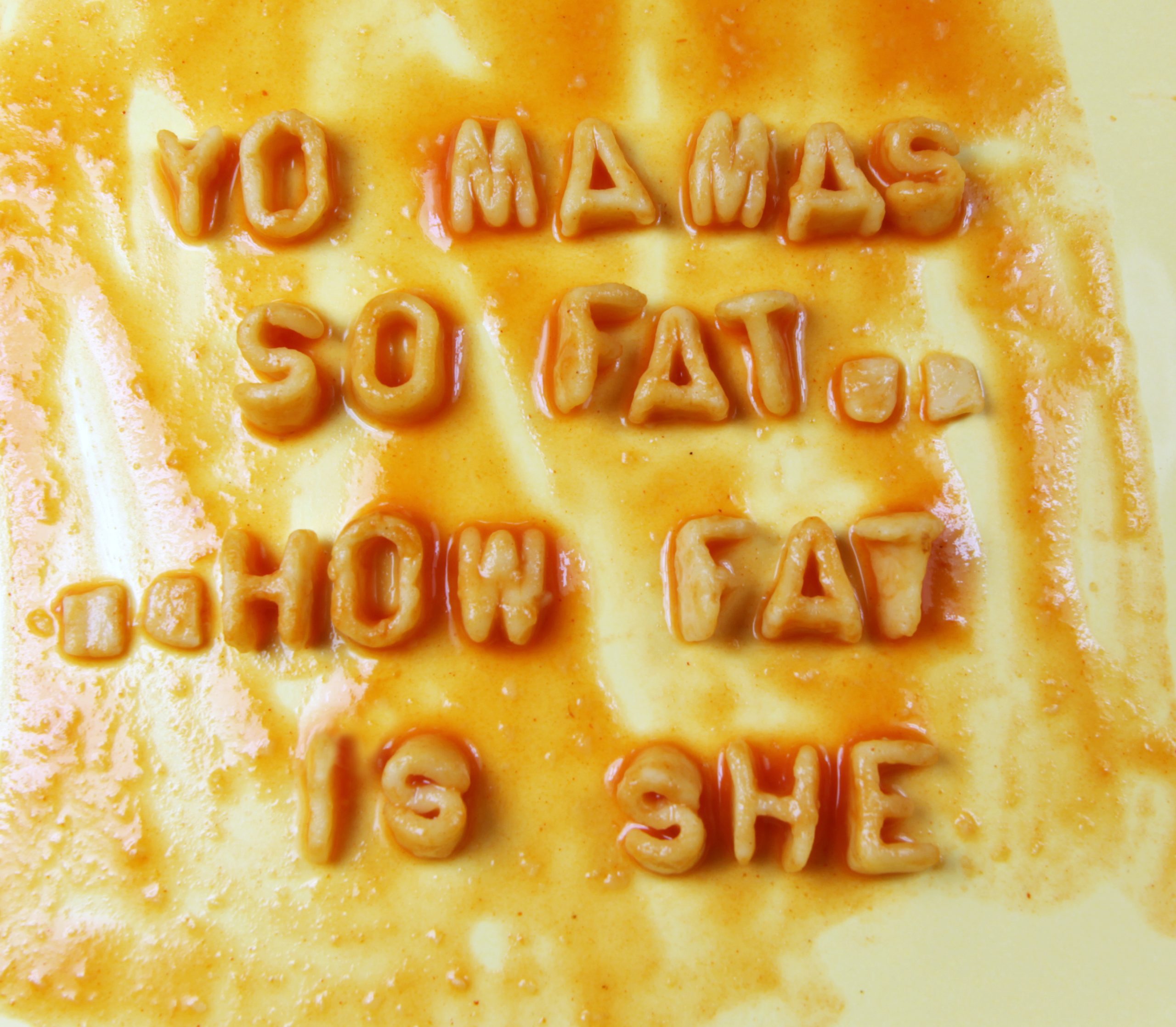
Everyone remembers that one kid in middle school. The one who had a comeback for everything, usually starting with those two specific words. It’s a weird phenomenon. We’re talking about yo mama fat jokes, a genre of humor that is objectively mean, incredibly repetitive, and somehow, completely immortal. You’d think by 2026 we would have moved on to something more sophisticated.
We haven't.
Actually, these jokes are baked into the very fabric of how we use language to establish social hierarchies. It's not just about being "mean." It's about "the dozens." If you've never heard of the dozens, it's an ancestral game of verbal combat primarily rooted in African American culture, where the goal is to keep your cool while someone else systematically dismantles your family’s dignity. If you get mad, you lose.
The weirdly long history of yo mama fat jokes
Most people think these jokes started with 90s sitcoms or on the back of the school bus. That's wrong. Archaeologists actually found a Babylonian tablet dating back to roughly 1500 B.C. that contains what many scholars consider to be the oldest "your mother" joke. It’s a bit of a rough translation, but the spirit is there. It basically mocks someone's mother for being sexually promiscuous or less than graceful.
Humans have been doing this forever.
The "fat" variation specifically blew up in the late 20th century. During the 1990s, shows like In Living Color and the MTV hit Yo Momma hosted by Wilmer Valderrama brought the art of the "snap" into the mainstream. It transformed from a niche cultural ritual into a global commodity.
Suddenly, kids in suburbs who had never heard of the "dozens" were shouting about celestial bodies and gravitational pulls.
Why "fat" specifically?
It's about scale. In comedy, exaggeration is the easiest lever to pull. If you tell a joke about someone being "slightly overweight," it’s just a rude observation. It isn't funny. But if you say, "Yo mama is so fat she has her own zip code," you’ve crossed into the realm of the absurd.
The humor doesn't come from the weight itself; it comes from the impossible physics required to accommodate it. It's the same reason we laugh at Looney Tunes characters falling off cliffs and leaving a hole in the ground the shape of their body. It’s hyperbole.
The structure of the snap
Almost every single one of these jokes follows a rigid linguistic formula. You have the setup: "Yo mama so fat..." followed by the punchline: "...that [insert impossible physical feat or comparison]."
It’s a linguistic template. It’s so easy to use that even a six-year-old can master it, which is exactly why it stays popular. You don't need a deep understanding of satire to get why a woman being mistaken for a small planet is a "burn."
The psychology of the insult
Let's get real for a second. Why do we target mothers? Psychologists like Sigmund Freud (who, honestly, had an obsession with mothers that was a bit much) would have had a field day with this. In most cultures, the mother is the ultimate symbol of sanctity and protection.
By attacking the mother, the insulter is testing the target's emotional resilience. If you can stay calm when someone says your mom uses a Hula Hoop as a wedding ring, you’re perceived as socially dominant.
It's a defensive mechanism disguised as an attack.
Interestingly, a study published in the journal Evolution and Human Behavior suggests that ritualized insults serve to reduce actual physical violence. Basically, we’d rather trade "yo mama fat jokes" than trade punches. It’s a way to let off steam and establish who’s the funniest (and thus the most influential) in a group without anyone actually getting a black eye.
Is it still "okay" to tell them?
This is where things get tricky in the current cultural climate. Body positivity has changed the way we talk about weight. What was a harmless playground zinger in 1995 might get you a trip to HR or the principal’s office in 2026.
Honestly, the humor has shifted. The most popular "fat jokes" today often lean into the "anti-joke" territory or become so surreal they lose the sting.
"Yo mama so fat... she is a valued member of her community and we are concerned about her cardiovascular health."
Not exactly a knee-slapper, but it shows how the genre is evolving. People are becoming more aware of the impact of "fat-shaming," yet the "yo mama" framework is so sturdy that it just absorbs the new cultural norms and keeps moving.
Famous examples that defined the genre
We can’t talk about this without looking at the "classics." These are the jokes that have been recycled so many times they’re basically part of our collective DNA.
- The Geographic: "Yo mama so fat, when she turns around, they throw her a surprise party."
- The Astronomical: "Yo mama so fat, she’s got smaller moms orbiting her."
- The Practical: "Yo mama so fat, she puts on her belt with a boomerang."
These jokes rely on vivid imagery. You can almost see the boomerang. That's the hallmark of a "good" bad joke. It forces the listener to mentalize a ridiculous scenario instantly.
The celebrity influence
In the early 2000s, comedians like Katt Williams and Anthony Anderson pushed these jokes into the stratosphere. They weren't just telling jokes; they were performing them. The delivery—the pause after "Yo mama so fat," the dramatic intake of breath—became as important as the punchline.
Even "Pharrell" and other artists jumped on the trend in music and media. It became a way for celebrities to seem "down to earth" or "street," tapping into that schoolyard nostalgia that everyone shares regardless of their tax bracket.
Where do we go from here?
The "yo mama fat joke" isn't going anywhere. It might change its face. It might become more "meta." But as long as there are people who want to prove they’re quicker, funnier, and tougher than the person standing next to them, the "yo mama" setup will remain the go-to weapon.
It’s the Swiss Army knife of insults.
If you’re actually going to use these, or if you’re just observing them from a distance like a linguistic anthropologist, there are a few things to keep in mind.
Understand your audience. Telling these jokes in a professional setting is a career suicide move. These are "inner circle" jokes. They require a level of trust. If you tell a "yo mama" joke to a stranger, you're not being funny; you're just being a jerk.
Timing is everything. The best "yo mama" jokes are reactive. They’re comebacks. Using one unprompted makes you look like you’re trying too hard.
Know when to stop. The "dozens" only works if both people are playing. If the other person isn't laughing or firing back, the game is over.
Actionable Insights for the Modern Jokester
If you find yourself in a situation where the "yo mama" jokes start flying, don't just reach for the "fat" trope. It's played out. The real pros in 2026 are diversifying.
- Try the "Yo mama so poor" or "Yo mama so old" variants. They offer fresh territory for hyperbole without getting bogged down in the weight-shaming debate.
- Lean into the surreal. The funnier jokes these days are the ones that make no sense. "Yo mama so fat, she forgot how to use a fork" is weirdly funnier because it’s nonsensical.
- Practice the "reversal." When someone hits you with a "yo mama fat joke," the best defense is to agree and escalate. "Yeah, she is, and she's still faster than you." It kills the momentum of the bully instantly.
The reality is that humor is a living thing. It breathes, it grows, and sometimes, it says things it probably shouldn't. The "yo mama" joke is the cockroach of the comedy world—it can survive a nuclear blast of cultural change and still come out on the other side, ready to insult someone's parent.
Whether you love them or hate them, you have to respect the longevity. Just maybe keep the "fat" ones to a minimum if you want to keep your friends.



