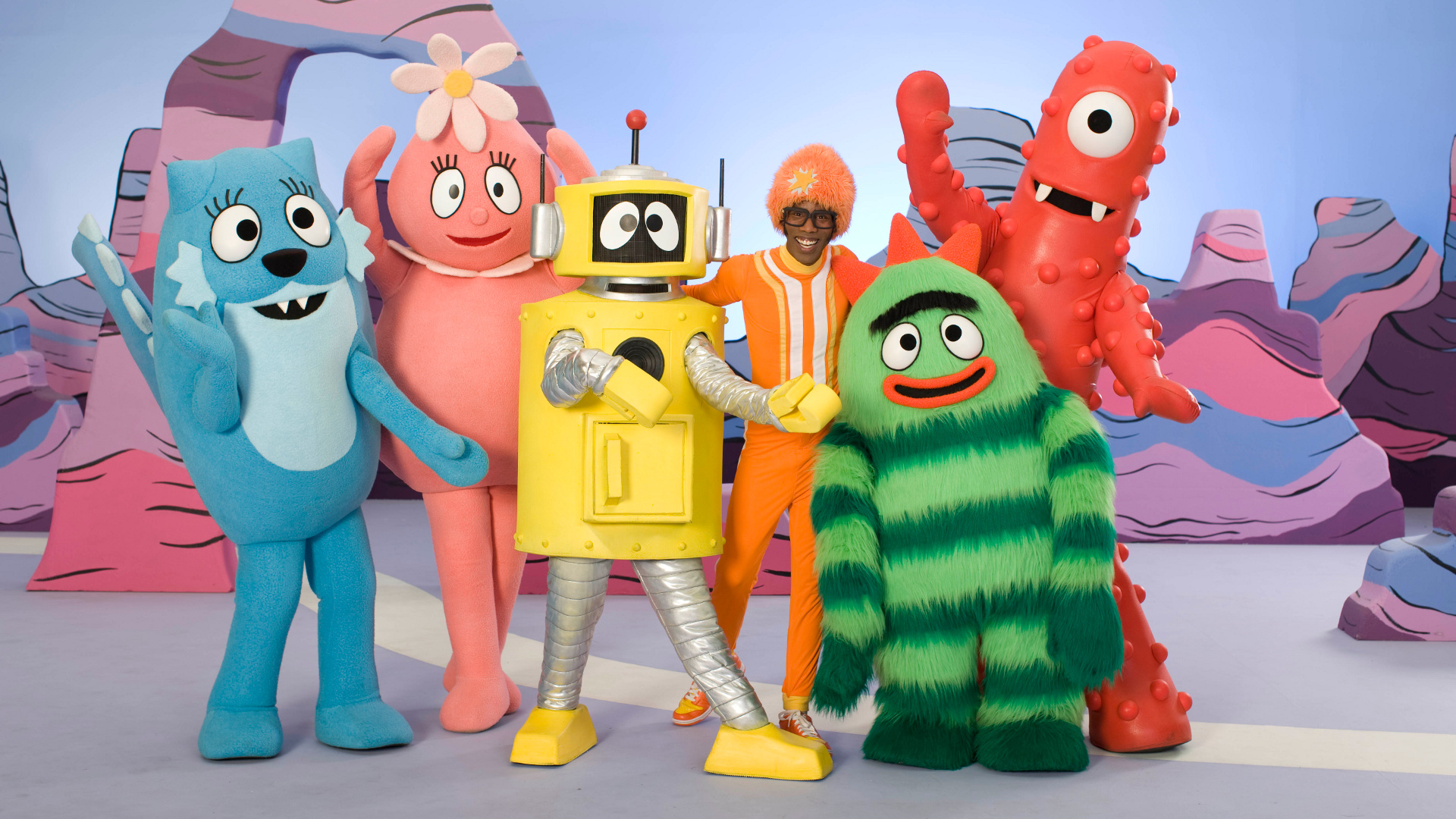
It started with a giant orange cyclops. Honestly, if you were scrolling through channels back in 2007, seeing a seven-foot-tall, bumpy orange creature named Muno standing next to a guy in a bright yellow tracksuit and a fuzzy hat probably felt like a fever dream. But that was Yo Gabba Gabba, and it didn't care if it looked weird to adults. It wasn't trying to sell you a plastic toy—at least not at first. It was trying to be cool.
Most kids' TV is, frankly, soul-crushing for parents. You've got the high-pitched screeching, the repetitive songs about basic hygiene, and that weirdly condescending tone that assumes children have the intellectual depth of a teaspoon. Yo Gabba Gabba changed that. Created by Christian Jacobs (the lead singer of the ska-punk band The Aquabats) and Scott Schultz, the show felt like it was born in a garage in Orange County rather than a boardroom at Nickelodeon. It was "indie-rock Sesame Street."
The Secret Sauce of the Yo Gabba Gabba TV Show
Why did it work? It wasn't just the bright colors. It was the rhythm.
Every episode of the Yo Gabba Gabba tv show followed a specific, almost hypnotic flow. DJ Lance Rock would bring his boombox, flip a switch, and suddenly five distinct lands—and their respective monsters—would come to life. You had Foofa, the pink flower bubble; Brobee, the little green one who was always hungry; Toodee, the blue cat-dragon; Muno, the aforementioned cyclops; and Plex, the yellow robot who was basically the only adult in the room.
The show utilized a "Super Music Friends Show" segment that brought in actual, legitimate bands. We're talking The Shins, Weezer, MGMT, and The Roots. This wasn't "Baby Shark." This was music that parents actually liked, performed by artists who looked like they were having the time of their lives in cardboard sets.
Why the visual style felt so different
If you look closely at the early seasons, you’ll notice the animation isn't that slick. That was intentional. Jacobs and Schultz grew up on 80s public access TV and Japanese kaiju films. They wanted something tactile.
The monsters were puppets and suits, not CGI blobs. The backgrounds were 8-bit inspired. It felt "lo-fi" in a world that was becoming increasingly high-definition and sterile. This aesthetic choice made the show feel approachable. It looked like something a kid could draw with crayons, which is exactly the point.
Biz Markie and the "Cool" Factor
You can't talk about this show without mentioning the late, great Biz Markie. "Biz’s Beat of the Day" was a revolutionary segment. He didn't just perform; he taught kids how to beatbox.
Think about that for a second.
A legendary hip-hop figure was teaching four-year-olds how to make percussion sounds with their mouths. It was inclusive, it was rhythmic, and it treated hip-hop as a foundational element of childhood education rather than something "edgy." Markie’s presence gave the show an immediate stamp of authenticity that no amount of marketing budget could buy.
Then you had Mark Mothersbaugh from Devo. Every episode, he’d do "Mark’s Magic Pictures," showing kids how to draw simple shapes that turned into characters. These weren't just "celebrity cameos" for the sake of it. These were pioneers of alternative culture teaching the next generation how to be creative.
Handling the Big Emotions (Without Being Preachy)
A lot of people think of Yo Gabba Gabba as just a collection of songs about "Don't Bite Your Friends" or "There's a Party in My Tummy." But the show tackled some surprisingly heavy stuff.
Brobee was the emotional core. Because he was "the little one," he often felt left out or overwhelmed. The show didn't tell him to "cheer up." It gave him a song to express that it's okay to be sad or scared. The "Wait Your Turn" song wasn't a lecture; it was a groove.
The science of the "Dancey Dance"
Movement was baked into the DNA of the Yo Gabba Gabba tv show. In a world where childhood obesity was a growing concern, the show didn't talk about "exercise." It talked about "the dancey dance."
Celebrities like Jack Black, Anthony Bourdain, and even Sarah Silverman would show up just to do a silly dance. It lowered the stakes. It told kids (and their parents) that it’s okay to look ridiculous as long as you're moving. The psychology here is simple: mirror neurons. When kids see a "cool" adult or a monster they love jumping around, they do it too. It was active viewership before "interactive TV" was a buzzword.
The Hiatus and the 2024 Revival
For years, the show was in a weird limbo. After the original run ended, fans were left with reruns and a lingering sense of nostalgia. Then Apple TV+ stepped in.
Yo Gabba GabbaLand! premiered in 2024, and honestly, many were skeptical. Would it lose the soul? Would it be too polished? Thankfully, Christian Jacobs stayed at the helm.
The new version, hosted by Kamryn Smith as Kammy Upp, keeps the boombox spirit alive. It’s a rare example of a "reboot" that actually understands what made the original special. They didn't replace the monsters with 3D models. They kept the fuzzy suits. They kept the weirdness. They understood that the Yo Gabba Gabba tv show isn't a brand—it's an atmosphere.
How to actually use the Gabba philosophy today
If you're a parent or just someone interested in how media affects development, there's a lot to learn from this show's legacy. It wasn't just "eye candy."
- Focus on the "Three-Legged Stool" of Creativity. The show combined music, art, and movement in every single 22-minute block. If you want to engage a child, you can't just give them one; you have to give them the trifecta.
- Don't talk down. The creators often mentioned in interviews that they made the show for themselves as much as for kids. If you find a piece of media boring, your kid probably does too, even if they're staring at it. Choose content that has "layers."
- Embrace the "Dancey Dance" break. In our current high-stress environment, the idea of stopping everything just to wiggle around for 60 seconds is actually great mental health advice. It breaks the cortisol loop.
- Music choice matters. You don't have to listen to "kiddie music." Introducing kids to diverse genres early—electronic, synth-pop, hip-hop, indie—builds a better "ear" and a more curious mind.
What most people get wrong about the show
The biggest misconception is that Yo Gabba Gabba was "druggy" or "trippy" just for the sake of the "stoner" audience. While it certainly had a following in that demographic because of its surrealist visuals, the creators have always been clear: the "trippiness" is actually just what the world looks like to a toddler.
To a three-year-old, everything is vibrant. Colors are louder. Sounds are bigger. Proportions are weird. The show wasn't trying to be "retro" for the sake of hipster cred; it was attempting to replicate the sheer, unadulterated wonder of being small in a big world.
Actionable Steps for Parents and Creators
If you want to bring some of that Gabba energy into your daily life, start small. You don't need a yellow tracksuit.
- Create a "Wait Your Turn" Playlist: Use music to transition between activities. Instead of yelling that it's time to clean up, use a specific, high-energy song. When the song ends, the task is done.
- The 60-Second Drawing Challenge: Mimic Mark Mothersbaugh. Give your kid a single shape—a circle or a squiggly line—and see who can turn it into the weirdest monster in one minute.
- Find the "New" Gabba: If you've exhausted the old episodes, look for creators who prioritize "handmade" over "digital." Shows like The Aquabats! Super Show! or certain segments of Sesame Street still carry that torch.
The Yo Gabba Gabba tv show remains a masterclass in "Alternative Childhood." It proved that you don't have to follow a formula to be successful. You just have to be authentic, a little bit weird, and willing to invite everyone—monsters and humans alike—to the party.
Next Steps for Deepening the Experience:
Check out the "Super Music Friends Show" archives on YouTube to see the full list of musical guests—it’s essentially a time capsule of 2000s indie culture. If you are watching the 2024 revival on Apple TV+, pay attention to how they’ve updated the guest list to include modern icons like Flea and Anderson .Paak, proving the show’s "cool" factor hasn't aged a day. Lastly, look into the discography of The Aquabats; if you like the show’s energy, their music is the literal foundation of the Gabba universe.



