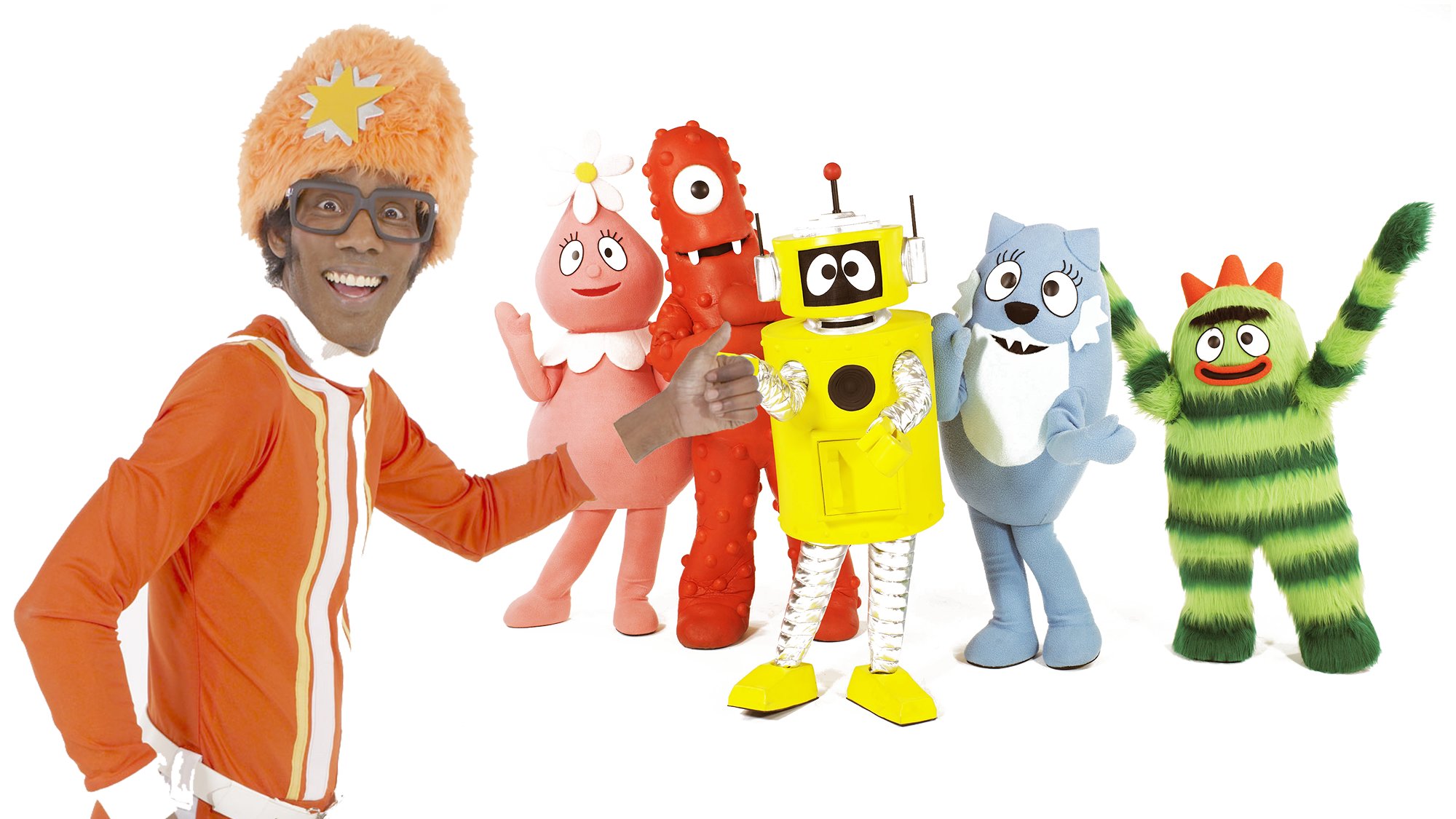
It started with a giant orange cyclops. Honestly, if you were flipping through channels in 2007 and landed on Nick Jr., you probably thought you were having a fever dream. There was this tall guy in a bright orange jump suit named DJ Lance Rock, standing in front of a white void, holding a boombox that looked like it belonged in a Beastie Boys video. He’d shout "Yo Gabba Gabba!" and suddenly, a group of bizarre plastic-looking monsters would spring to life.
People called it "hip-hop Sesame Street." Some called it "indie rock for toddlers." But the Yo Gabba Gabba! TV show was actually something much weirder and more brilliant than a simple kids' program.
It wasn't just "educational." It was a cultural bridge. Christian Jacobs (who you might know as the lead singer of The Aquabats) and Scott Schultz didn't want to make another show about talking purple dinosaurs or polite engines. They wanted something they could actually watch with their kids without wanting to pull their hair out. They succeeded. They created a world where Biz Markie taught beatboxing and Elijah Wood did a "Puppet Dance."
The Secret Sauce of the Yo Gabba Gabba! TV Show
Most people think the show was just about bright colors and dancing. That's wrong. The real magic was the music.
Unlike most kids' shows that use generic, synthesized nursery rhyme melodies, the Yo Gabba Gabba! TV show recruited actual underground legends. We’re talking about The Shins, MGMT, The Roots, and Devo. Mark Mothersbaugh had a recurring segment called "Mark’s Magic Pictures" where he taught kids how to draw. It was basically a gateway drug to alternative culture.
The pacing was chaotic but intentional.
One minute, Muno—the bumpy red one—is learning that he shouldn't bite his friends. The next, Jack Black is wandering into Gabba Land wearing a matching orange track suit, looking genuinely confused but thrilled to be there. It broke the "fourth wall" before kids even knew what a wall was.
Why the characters weren't just costumes
The core cast represented different musical and aesthetic vibes. You had Plex, the yellow robot who was basically the "adult" in the room, capable of teleporting items and providing logic. Then there was Foofa, the pink flower bubble thing, who represented everything "girly" but in a way that wasn't annoying. Toodee, the blue cat-dragon, brought the "cool girl" energy, usually playing bass.
Brobee? The little green guy with the long arms? He was the emotional center. He was the one who got sad when his balloon popped or when he couldn't eat too much candy.
These weren't just puppets. They were archetypes of childhood development wrapped in neon fur.
The Weird Genius of Christian Jacobs and Scott Schultz
To understand why this show worked, you have to look at its creators. Christian Jacobs spent years in the Southern California punk and ska scene. He knew that kids don't actually want to be talked down to. They want to be included in the "cool" stuff.
They filmed the pilot with their own money.
Big networks actually turned them down at first because it was "too weird." Nickelodeon eventually took the gamble, and it paid off because the show tapped into the "millennial parent" demographic perfectly. It was the first time a TV show recognized that parents were people with taste.
There’s this famous segment called "Super Music Friends Show." It featured bands like Jimmy Eat World playing songs about being nice to others. Think about that. You had the guys who wrote "The Middle" singing to a bunch of three-year-olds about sharing. It shouldn't have worked. It should have been cringey. But because the production design was so authentic to the DIY punk aesthetic, it felt real.
The "Dancey Dance" Phenomenon and Guest Stars
If you were a celebrity in the late 2000s, appearing on the Yo Gabba Gabba! TV show was a status symbol. It was the kid-version of being on The Simpsons.
- Anthony Bourdain showed up to eat some "tasty snacks."
- Solange Knowles performed "Momma Loves Baby."
- The Killers dressed up as skeletons and sang "Spaceship Adventure."
- Fred Armisen and Bill Hader would show up just to do weird bits.
It was a variety show. That’s the best way to describe it. It took the format of The Electric Company or Laugh-In and gave it a 21st-century makeover.
The "Dancey Dance" segment was the highlight of every episode. A celebrity would come on and teach a specific, often ridiculous, dance move. It was short. It was high energy. It was perfectly designed for the short attention spans of toddlers—and, honestly, adults.
Is Yo Gabba Gabba! Still Relevant?
You might wonder why we’re still talking about a show that finished its original run years ago.
Apple TV+ recently revived the franchise with Yo Gabba GabbaLand!, bringing back the original creators and the same DIY spirit. It’s rare for a kids' brand to survive a decade-long hiatus and come back without losing its soul. Usually, when a show gets revived, it gets "cleaned up." The colors get too bright, the animation gets too smooth, and the "weirdness" gets sanded off by corporate focus groups.
Surprisingly, the new iteration kept the grit.
They kept the costumes that look like costumes. They kept the slightly off-beat humor. They kept the focus on real instruments and real guest stars.
The Yo Gabba Gabba! TV show matters because it taught a generation of kids that "different" is good. It taught them that being a "monster" is okay as long as you’re a kind monster who likes to dance. It taught them that music isn't just something you listen to; it's something you do.
What You Should Do Next
If you’re a parent looking for something that won't rot your brain, or just a nostalgic adult, here’s how to dive back in:
- Watch the original "Biz’s Beat of the Day" segments on YouTube. They are masterclasses in rhythm and confidence. Biz Markie (RIP) had a way of making every kid feel like a superstar just by making weird noises with their mouth.
- Check out the soundtrack on Spotify. Seriously. The songs "There's a Party in My Tummy" and "Don't Bite Your Friends" are unironic bangers.
- Look for the "Live" show recordings. Yo Gabba Gabba! Live was a legendary touring production that felt more like a Coachella set for five-year-olds than a theatrical play.
- Compare the old episodes to the new Apple TV+ version. It’s a great exercise in seeing how production values have changed while the core "weirdness" remains the same.
The legacy of the show isn't just the merchandise or the catchy tunes. It’s the fact that it made it okay for kids' media to be "cool" again. It stopped the trend of saccharine, condescending programming and replaced it with a boombox, a man in an orange suit, and a message that everyone—even a bumpy red cyclops—has a place on the dance floor.



