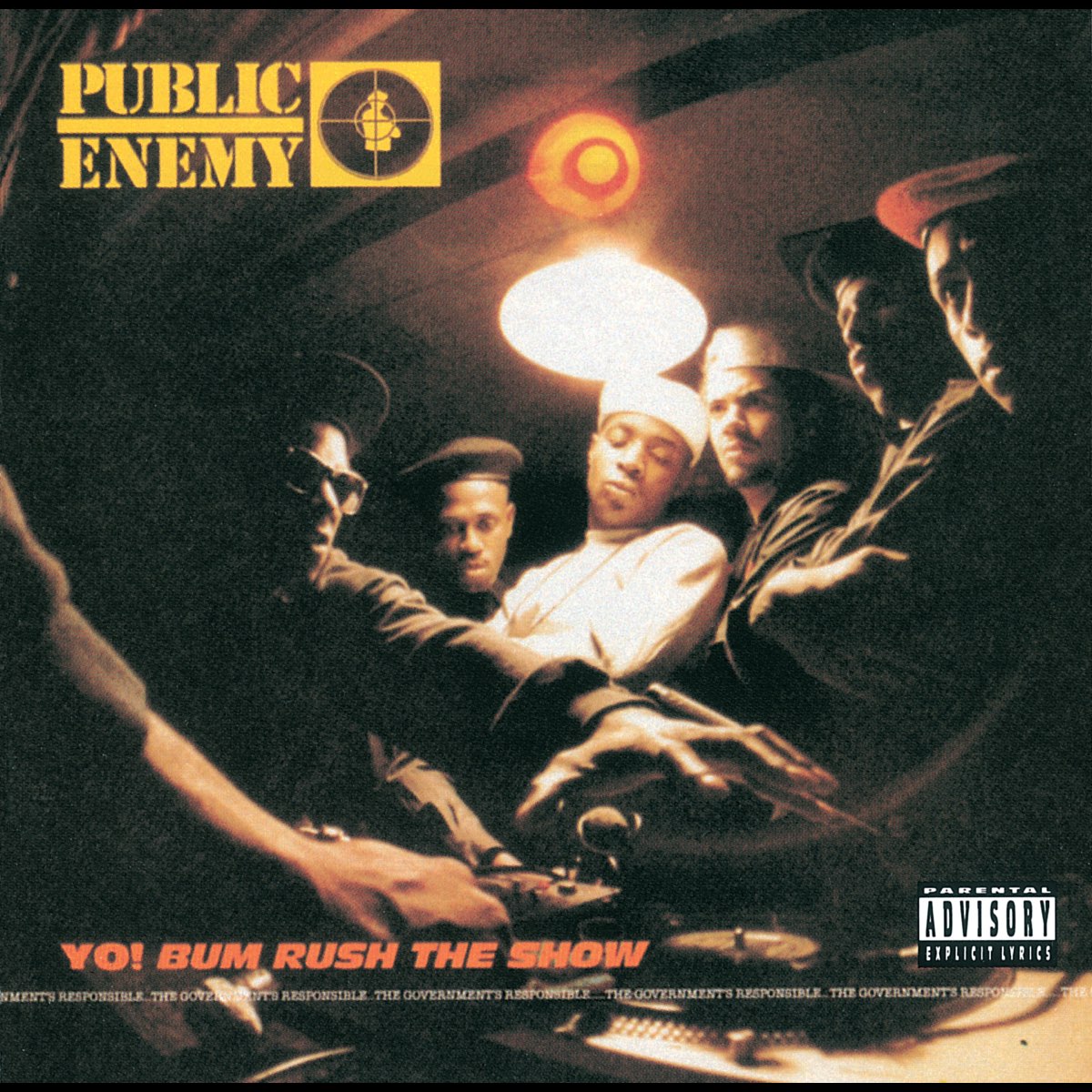
In 1987, the radio sounded nothing like Public Enemy. It just didn't. You had the smooth, synthesized sheen of New Jack Swing starting to bubble up and the lingering echoes of old-school party raps. Then, out of Long Island, came this abrasive, dense, and frankly terrifying wall of noise. Yo! Bum Rush the Show wasn't just an album title; it was a threat. When Chuck D’s baritone first rattled speakers, it changed the DNA of hip-hop forever. Honestly, if you listen to it today, the production by the Bomb Squad—even in its early, stripped-back form—feels more punk rock than most actual punk records from that era.
People forget how risky this was. At the time, Def Jam was riding high on the massive crossover success of Licensed to Ill and Radio. Rick Rubin was the man with the Midas touch. But Public Enemy? They weren't looking for a "Fight For Your Right" moment. They were looking to dismantle the system. Yo! Bum Rush the Show is the blueprint for every political rapper who ever picked up a mic, from Tupac to Kendrick Lamar. It’s the moment rap grew up and got angry.
The Sound of Chaos and the Bomb Squad
The production on this record is legendary, but maybe not for the reasons you think. By the time It Takes a Nation of Millions to Hold Us Back arrived a year later, the Bomb Squad (Hank Shocklee, Keith Shocklee, and Eric "Vietnam" Sadler) had perfected their "wall of noise" sampling technique. But on Yo! Bum Rush the Show, things are leaner. Meaner. It’s skeletal.
Take a track like "Public Enemy No. 1." It’s built around a squealing, high-pitched sample that most producers in '87 would have thrown in the trash for being too "annoying." Instead, they looped it into a siren. It creates this constant state of anxiety. You can't just relax while listening to this album. You're on edge. That was the point. They wanted to wake people up.
- The Roland TR-808: It’s all over the place here, but it isn't used for dance grooves. It’s used as a percussive assault.
- The scratching: Terminator X wasn't just keeping time; he was "speaking" with the turntables, adding layers of industrial texture that made the tracks feel alive.
- Minimalism: Compared to later PE albums, there’s a lot of "air" in these tracks, which makes Chuck D’s voice sound even more massive.
Chuck D once famously called hip-hop "The Black CNN." That philosophy starts right here. While other rappers were boasting about their cars or their lyrical prowess—which Chuck does too, to be fair—he was also weaving in critiques of the criminal justice system and media bias.
Why the Cover Art Mattered
Look at that cover. You’ve got Chuck D and Flavor Flav in a dark, dimly lit room, looking like they're in a bunker planning a coup. It’s iconic. In a world of neon colors and tracksuit fashion, PE showed up in military-surplus gear and S1W (Security of the First World) guards.
It was theater. High-stakes, political theater.
Flavor Flav’s role is often misunderstood by people who only know him from reality TV. On Yo! Bum Rush the Show, he is the essential "hype man" but also the court jester who makes the bitter pill of the political message easier to swallow. Without Flav’s high-energy interjections, the album might have felt too heavy, too academic. He provides the "yin" to Chuck’s "yang." He’s the chaos to Chuck’s order.
Tracking the Impact
"Miuzi Weighs A Ton" is a masterclass in metaphor. On the surface, it’s about a gun, but Chuck is really talking about the weight of his words and the power of his voice. He’s telling you that the microphone is the weapon. This was revolutionary in 1987.
Then you have "Sophisticated Bitch." This track is often the subject of debate among hip-hop historians. It’s got a heavy rock influence—Vernon Reid from Living Colour actually plays guitar on it—and it shows the bridge between the Def Jam rock-rap sound and PE’s burgeoning political identity. While the lyrics are a product of their time and have faced criticism for their tone, the sonic experimentation was undeniably bold. It’s messy. It’s loud. It’s exactly what a debut should be.
The Critics vs. The Streets
When the album dropped, the critics weren't all on board. Some thought it was too noisy. Others didn't get the image. But the streets? The streets were locked in. The album sold surprisingly well for something so uncompromising, eventually hitting Gold status. It proved there was a massive audience for "conscious" rap that didn't sacrifice its edge.
Interestingly, the UK embraced PE almost faster than the US did. The British music press, obsessed with subculture and rebellion, saw Public Enemy as the hip-hop equivalent of The Clash. This global perspective helped propel Yo! Bum Rush the Show into the pantheon of all-time greats. It wasn't just a New York thing. It was a global shift.
- The Tempo: Most rap at the time was around 90-100 BPM. PE pushed things, making the energy feel frantic.
- The Vocabulary: Chuck D brought a level of intellectualism to the lyrics that was dense. You needed a dictionary for some of these bars.
- The Concept: It was a cohesive "show." From the intro to the final fade-out, it felt like a broadcast from an underground radio station.
Misconceptions About the Debut
A lot of people think Nation of Millions was the first time PE got political. Not true. While the debut has more "braggadocio" tracks, the seeds of revolution are everywhere. "Rightstarter (Message to a Black Man)" is as direct as it gets. It’s a call to action. It’s a wake-up call to a community that Chuck felt was being lulled into a false sense of security.
Another myth? That the Bomb Squad had a massive studio. Nope. They were working with relatively limited gear, using creative sampling to overcome technical hurdles. They were "bum rushing" the industry with whatever tools they had. That DIY spirit is the heart of the record.
The album also introduced the world to the "Target" logo—the silhouette of a b-boy in a crosshair. Designed by Chuck D himself (who was a graphic design student), it’s arguably the most recognizable logo in music history. It perfectly encapsulated the feeling of being a young Black man in America: being hunted, but also standing your ground.
Actionable Insights for Hip-Hop Heads and Creators
If you want to truly appreciate Yo! Bum Rush the Show, you have to listen to it in context. Don't just shuffle it.
- Listen for the "Space": Notice how few instruments are playing at once. Modern production is often cluttered; PE shows how much power there is in a single, well-placed sample and a heavy drum.
- Study the Sequencing: The album moves from aggressive bangers to more atmospheric tracks. It’s a lesson in how to build an album "arc" rather than just a collection of singles.
- Analyze the Rhetoric: Look at how Chuck D uses repetition. He doesn't just say a line; he hammers it home until it’s stuck in your psyche.
- Dig for the Samples: Use sites like WhoSampled to find the soul and funk records the Bomb Squad ripped apart. It’s a history lesson in music.
Basically, the album is a masterclass in branding. Public Enemy knew who they were from day one. They didn't "find their sound" three albums in. They arrived fully formed, clocks around their necks and sirens blaring. Even if you prefer the more polished production of their later work, you have to respect the raw nerve of the debut. It’s the sound of a door being kicked down.
To get the full experience, track down the original vinyl or a high-quality lossless stream. The "hiss" and the "grit" are part of the instruments. If it sounds too clean, you're doing it wrong. Turn the bass up, ignore the neighbors, and let the boom of the 808 remind you why hip-hop became the most dominant force in global culture. It started with a bum rush.



