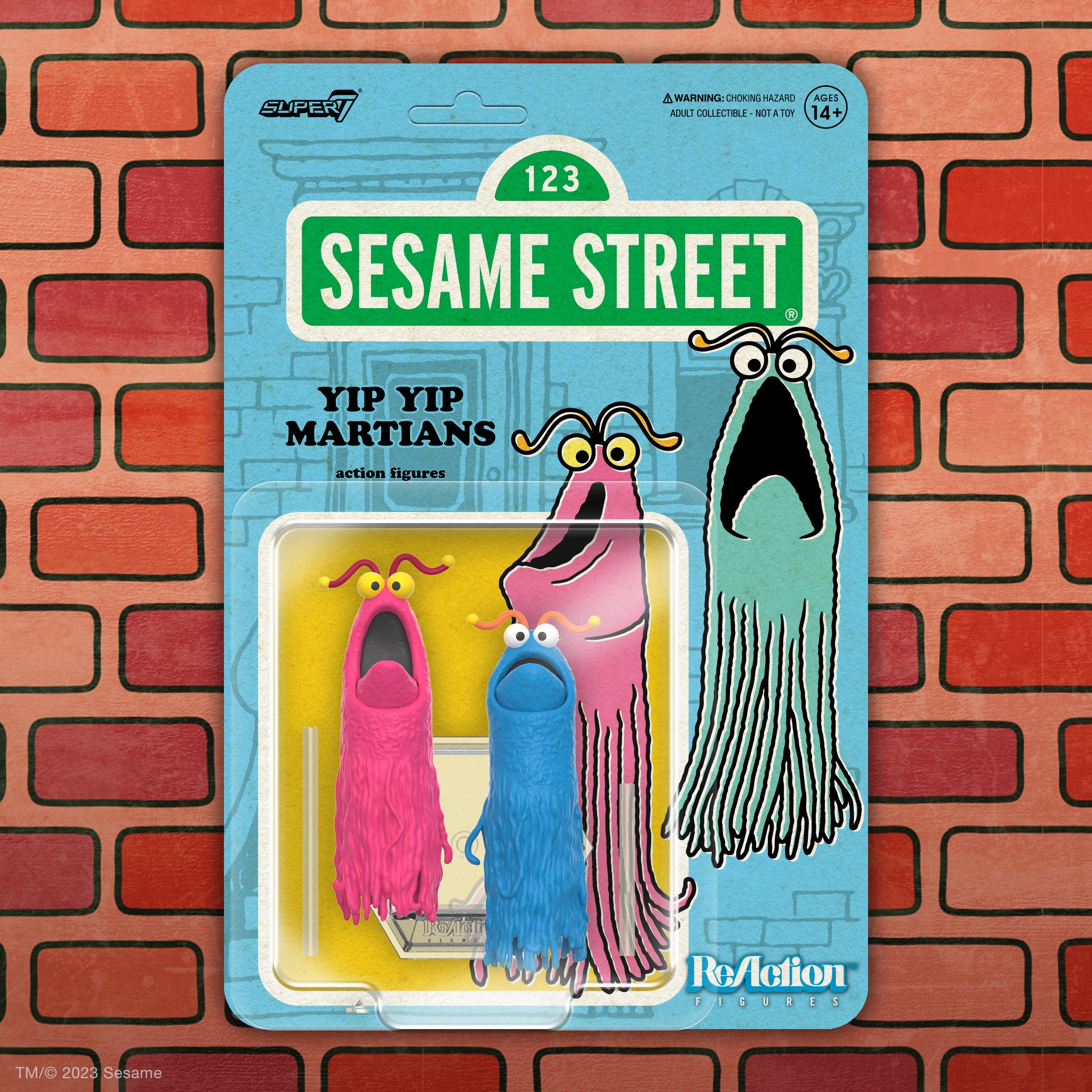
You know the sound. It’s a rhythmic, stuttering "yip-yip-yip-yip" followed by a sudden, frantic "uh-huh! uh-huh!" If you grew up anywhere near a television in the last fifty years, those sounds are probably hardwired into your brain. We’re talking about the Sesame Street Martians, those floating, fringe-covered puppets with the giant eyes and the even bigger sense of existential confusion. They aren't the main characters. They don't have a regular "street" presence like Big Bird or Elmo. Yet, they remain one of the most enduring pieces of Jim Henson’s legacy because they perfectly capture the pure, unadulterated terror of trying to understand a telephone.
They are officially known as the Yip-Yips.
When they first drifted onto the screen in 1972, they weren't exactly high-tech. In fact, they’re basically just long tubes of fabric. But that’s the magic of the Muppets, isn't it? The Sesame Street Martians represent a specific type of puppetry where the performer's skill is the only thing standing between a masterpiece and a pile of laundry.
The Weird Origins of the Yip-Yips
Most people assume every Muppet comes directly from the mind of Jim Henson. While Jim was the visionary, the Yip-Yips were actually a collaboration involving some of the heaviest hitters in puppet history. We have to talk about Jerry Nelson. He was the soul of these characters. Along with Jim Henson and later performers like Kevin Clash and Bill Barretta, Nelson turned a simple "yip" into a masterclass in comedic timing.
The design is deceptively simple. They are "rod puppets." Their mouths are operated from below, and their "arms" (if you can call them that) are moved with thin wires. But look at the eyes. Those big, ping-pong-ball-style eyes are fixed. They don't blink. They don't move. All the emotion—the curiosity, the fear, the eventual "uh-huh" of realization—comes from the tilt of the head and the frantic vibrating of their fringe.
It’s genius, honestly.
The Martians were designed to represent the ultimate "outsider" perspective. On a show dedicated to teaching kids about the world, the Martians were the only characters who knew even less than the toddlers watching at home. They were the blank slate. When they encounter an object—a clock, a radio, a computer—they approach it with the same misplaced confidence we all feel when we try to put together IKEA furniture without the manual.
Why the "Earth Book" Always Fails Them
The recurring gag is legendary. The Martians descend from space (usually just floating down from the top of the frame) and encounter a mundane Earth object. They consult their "Earth book," which is a tiny, useless yellow manual that supposedly explains our planet.
Spoiler alert: the book is never helpful.
Take the classic telephone sketch. This is arguably their most famous bit. They see a phone. They think it’s a cow. They "moo" at it. When the phone doesn't moo back, they think it’s a bird. They "tweet" at it. Finally, the phone rings. The absolute panic that ensues is a work of art. The way their jaws drop open—showing that dark, cavernous mouth—and they scurry backward while yelling "NOT-A-BIRD! NOT-A-COW!" is comedy gold.
The Evolution of the Sketch
- They arrive and identify the object incorrectly.
- They try to communicate with it using the wrong language.
- The object makes a noise (the "discovery" moment).
- They panic.
- They eventually "accept" the object by mimicking its sound.
It’s a repetitive structure, sure, but it works because of the nuance. If you watch closely, you'll see that the Martians are actually incredibly supportive of each other. When one gets scared, the other validates that fear. They are a team of two idiots doing their absolute best.
More Than Just "Yip": The Sound Design
Let's get technical for a second. The vocal performance of the Sesame Street Martians is what separates them from every other "alien" character in pop culture. It’s not just "yip." It’s the pitch.
Jerry Nelson used a high-pitched, almost operatic vibrato for the "yip-yip-yip" sequences. It sounds like a broken record or a glitching computer. This was 1972—long before digital glitches were a "vibe." They were unintentionally echoing the electronic music experiments of the era, like the work of Bruce Haack or Raymond Scott (who actually did early music for Sesame Street).
The "uh-huh" is the payoff. It’s the sound of a breakthrough. Even if they're wrong—and they usually are—that "uh-huh" represents the human (or Martian) desire to find common ground with the unknown. When they finally encounter a computer and realize it’s a "co-pooter," their joy is infectious. They don't just learn; they celebrate.
The Puppet Engineering Behind the Fringe
If you've ever wondered why they look so "shaggy," it’s not just an aesthetic choice. It’s functional. The Martians are made of a long-pile faux fur. Because they are rod puppets, the puppeteers need to hide the mechanics. The long fringe at the bottom masks the rods and the performers' arms as the characters "float" through the air.
- Materials: Slit-weave fabric and foam.
- Movement: Vertical bouncing to simulate low gravity.
- Eyes: Hard plastic, usually orange or green.
- Mouths: Black velvet interior to create a "void" effect.
There’s a specific "jiggle" the puppeteers do. It’s not a smooth movement. It’s a rhythmic shaking that makes the fringe dance. This creates the illusion of hovering. If they just sat still, they’d look like a bathmat. The constant motion gives them life.
Why We Still Care About Them in 2026
The world has changed. Kids today are "digital natives." They don't find a telephone mysterious; they've had iPads since they were in diapers. So, why do the Sesame Street Martians still resonate?
Because we are all still the Martians.
Think about the first time you tried to use a VR headset or an AI prompt generator. You probably felt a little bit like a Yip-Yip. You looked at the tech, you did something wrong, you got a result you didn't expect, and you went "uh-huh!" (or maybe "nope!"). The Martians represent the universal experience of being slightly behind the curve.
They also tap into a very specific kind of "safe" horror. For a three-year-old, the Martians can be a little scary. They have no noses. Their mouths are huge. They make weird noises. But because they are so clearly terrified of things like clocks, the child realizes they are more powerful than the aliens. It’s a brilliant bit of psychological writing. It empowers the kid by making the "monsters" the ones who are confused.
Impact on Pop Culture and Beyond
You see the Yip-Yips everywhere now. They’ve been parodied on Family Guy. They show up in memes whenever someone is confused on Twitter. There is a whole generation of adults who buy Yip-Yip beanies for Halloween because the silhouette is so iconic.
Interestingly, the Martians have stayed relatively "pure." Sesame Street hasn't tried to give them a complex backstory or a home planet name. They don't have names other than "The Martians." They don't have a family tree. They just are. In a world of "cinematic universes" and over-explained lore, there's something refreshing about two blue and pink blobs that just want to talk to a toaster.
How to Spot a "Fake" Yip-Yip
If you're looking at vintage toys or replicas, there are a few things that give away a high-quality Martian:
- The Fringe Length: Real Martians have fringe that is at least half the length of their body.
- The Eye Placement: They should be right at the top, almost touching, looking slightly outward.
- The Mouth Shape: It shouldn't be a perfect circle; it’s more of an elongated oval that can "scrunch."
The Sesame Street Martians remind us that curiosity is a good thing, even if it makes you look a bit ridiculous. They remind us that it’s okay to be afraid of new things, as long as you eventually try to "yip" at them.
Putting the "Yip" Into Practice
If you're a creator or just a fan of the Muppets, there are a few actionable takeaways from how these characters were built.
First, simplicity wins. You don't need a 4K render to create a character people love; you need a clear silhouette and a distinct voice. Second, embrace the mistake. The funniest part of any Martian sketch isn't when they get it right—it's the journey of getting it wrong.
Finally, if you’re looking to introduce a new generation to the Yip-Yips, start with the "Telephone" or "Radio" sketches. They are the purest examples of what makes these characters work. Don't over-explain it to the kids. Just let them watch these two weirdos try to figure out what a clock is. They’ll get it. They’ll start yipping along in no time.
The next time you’re frustrated by a piece of new technology that makes no sense, just take a breath. Look at the device. Tilt your head. Say "yip-yip-yip-yip." You’ll feel a lot better.
Actionable Next Steps:
- Watch the Classics: Search for the 1972 "Telephone" sketch on the official Sesame Street YouTube channel to see the original puppetry.
- Observe the Puppetry: Pay attention to the "vibration" of the puppets—that's the secret to their "alien" movement.
- Share the Logic: Use the Yip-Yip method next time you teach someone a new skill: Identify, Attempt, Fail, Panic, and finally, Accept.



