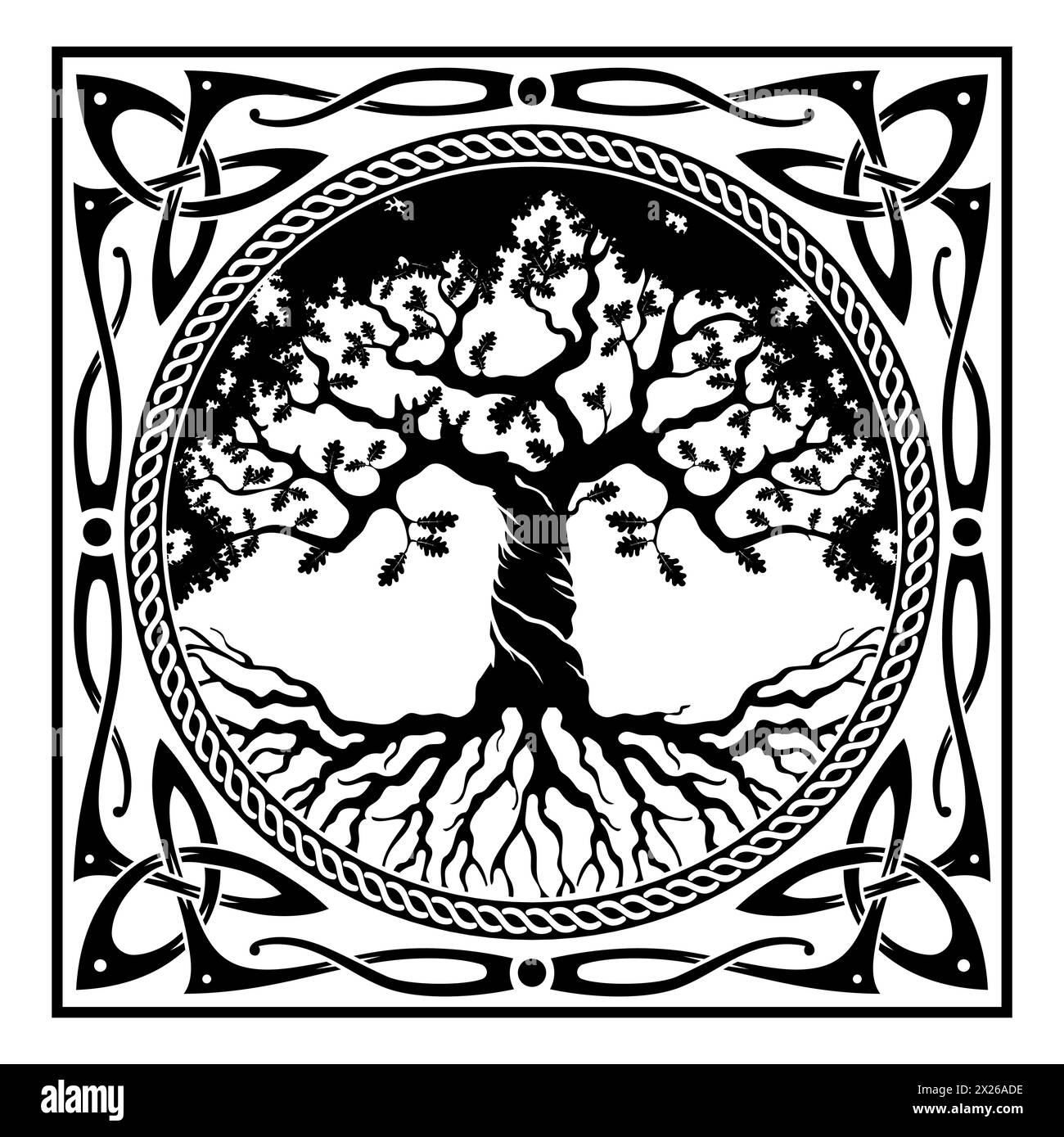
Think of the biggest tree you've ever seen. Now, imagine its roots don't just go into the dirt, but into the very fabric of existence. That’s Yggdrasil. It isn't just a big oak in a field somewhere in Scandinavia; it's the skeletal system of the cosmos. For the Vikings, the world wasn't a globe floating in a vacuum. It was a massive, evergreen ash tree.
Most people think of it as a static map. You know, like a fantasy novel diagram where Asgard is at the top and Hel is at the bottom. But the real Norse world tree was a living, breathing, and—honestly—pretty gross ecosystem. It was infested with stag-deer eating the leaves, a dragon gnawing at the roots, and a squirrel running up and down the trunk just to talk trash. It was a mess.
If you want to understand the Viking mindset, you have to understand Yggdrasil. It represents the idea that life is interconnected but also constantly under threat. The tree is always groaning. It’s always dying, yet it’s always being reborn.
The Three Roots and the Cosmic Plumbing
The structure of Yggdrasil is where things get complicated. The Poetic Edda and Snorri Sturluson’s Prose Edda—our main sources—don't always agree on where the roots go. One root reaches toward the Aesir (the gods) in Asgard. Another goes to the Jötnar (the giants) in Jötunheimr. The third plunges down into Niflheim, the realm of mist and cold.
Underneath these roots, you’ve got the wells. These aren't just puddles. They are the sources of cosmic power. The Well of Urd is probably the most important one because that’s where the Norns hang out. The Norns are the three ladies who weave the fate of every living being. They spend their days carving runes into the bark and pouring water from the well onto the roots to keep the tree from rotting. Basically, they’re the universe’s most high-stakes gardeners.
Then there’s Mímisbrunnr, the Well of Wisdom. This is where Odin famously traded his eye for a drink. It shows you the price of knowledge in the Norse world. It isn't free. You have to sacrifice something physical to gain something spiritual.
The last well is Hvergelmir. This one is dark. It’s located in the freezing depths and serves as the source of many rivers. It’s also where the dragon Níðhöggr lives. This dragon isn't just sitting there; he’s actively chewing on the root, trying to bring the whole system down. It’s a constant battle between the life-giving water of the Norns and the destructive hunger of the dragon.
It Isn't Just a Tree, It’s a Warzone
You’ve probably seen beautiful, peaceful art of the Norse world tree. It looks serene. In reality, the myths describe it as a place of constant animal-driven chaos.
Let's talk about the eagle and the squirrel. Up at the very top of Yggdrasil sits an unnamed eagle who knows "many things." Between the eagle’s eyes sits a hawk named Veðrfölnir. Why is there a hawk on an eagle’s face? Mythology is weird like that. Now, down at the bottom, you have the dragon Níðhöggr.
Then there’s Ratatoskr.
Ratatoskr is a squirrel. His entire job—his whole reason for existing—is to run between the eagle and the dragon and carry insults. He’s a cosmic gossip. He makes sure the eagle and the dragon stay mad at each other. Why? Because conflict is a fundamental part of the universe's energy.
Then you have the four harts (deer) named Dáinn, Dvalinn, Duneyrr, and Duraþrór. They spend their time craning their necks back and eating the buds and leaves of the tree. To us, it sounds like a nature documentary. To the ancient Norse, it was a metaphor for how time and nature slowly consume the world. The tree is supporting all of life, but life is simultaneously eating the tree.
The Nine Realms: Not Layers, but Branches
People love to list the nine realms like they’re levels in a video game. 1. Asgard. 2. Midgard. 3. Alfheim. It doesn’t really work like that. The realms are more like different dimensions or states of being that coexist.
Midgard is where we are. It’s "Middle Earth," literally. It’s situated right in the center, protected by a fence made from the eyelashes of the giant Ymir. Around us is the vast ocean where the Midgard Serpent, Jörmungandr, bites his own tail.
Above us is Asgard, the high-rent district of the gods. Then you have Vanaheim, home of the Vanir gods, and Alfheim, where the light elves live. Lower down, you find Svartalfheim (the home of the dwarves/dark elves) and Jötunheimr, the rocky, chaotic land of the giants.
Deepest of all are Niflheim (ice), Muspelheim (fire), and Hel (the underworld). Note that Hel isn't "Hell" in the Christian sense. It’s a damp, cold place where people go if they didn't die in battle. It’s more of a waiting room for the dead than a place of punishment.
Why Yggdrasil Matters in 2026
It’s easy to look at this and think it’s just cool campfire stories. But Yggdrasil represents a sophisticated ecological philosophy. The Norse people understood that the environment is fragile.
The tree is under attack from above (the deer), from within (the rot), and from below (the dragon). Yet, it stays standing because of the care of the Norns. This reflects the human condition. We live in a system that is constantly breaking down, and it’s our job to maintain it.
Even at Ragnarök—the end of the world—the tree doesn't just vanish. It shivers. It groans. But it’s the place where two humans, Líf and Lífþrasir, hide to survive the fire and the flood. When the world ends, the tree provides the seed for the next one. It’s the ultimate symbol of resilience.
Scholars like Rudolf Simek and Carolyne Larrington have pointed out that the "ash" tree might not even be an ash. In some descriptions, it’s evergreen and has needles. This has led some to believe it was actually a Yew tree. Yews live for thousands of years and are toxic, which fits the "deadly but eternal" vibe of the myths much better than a standard ash tree.
Actionable Steps for Exploring the World Tree
If you want to move beyond the surface level of Norse mythology, you should look at the primary sources. Reading a summary is one thing, but seeing the original descriptions changes your perspective.
- Read the Grímnismál: This is a poem in the Poetic Edda where Odin, in disguise and being tortured between two fires, starts rambling about the cosmology of the world. It’s the most detailed source we have for the animals living in the tree.
- Study the "Axis Mundi" Concept: Compare Yggdrasil to other "World Trees" like the Mesoamerican Ceiba or the Hungarian Égig érő fa. You’ll find that humans across the globe have almost always envisioned the universe as a giant plant.
- Visit an Ancient Yew: If you’re ever in the UK or Scandinavia, visit a churchyard with a 1,000-year-old yew tree. Standing under those heavy, dark branches gives you a physical sense of why the Norse felt the universe was a tree.
- Analyze the Symbolism of the Well: Instead of looking at the tree as an object, look at the water. The water flows from the wells, up the tree, and falls as dew. It’s a cycle of memory and fate. Think about what your "Well of Urd"—your personal history—is contributing to your current "tree."
The Norse world tree isn't a dead myth. It’s a map of how to live in a world that is always under pressure. It teaches us that even when the dragons are biting at our heels, we have to keep pouring the water. We have to keep the system alive.
To dig deeper, find a copy of Jackson Crawford’s translation of the Poetic Edda. He strips away the Victorian fluff and gives you the grit of the original Old Norse. You’ll see Yggdrasil for what it really is: a terrifying, beautiful, and precarious home for everything we know.



