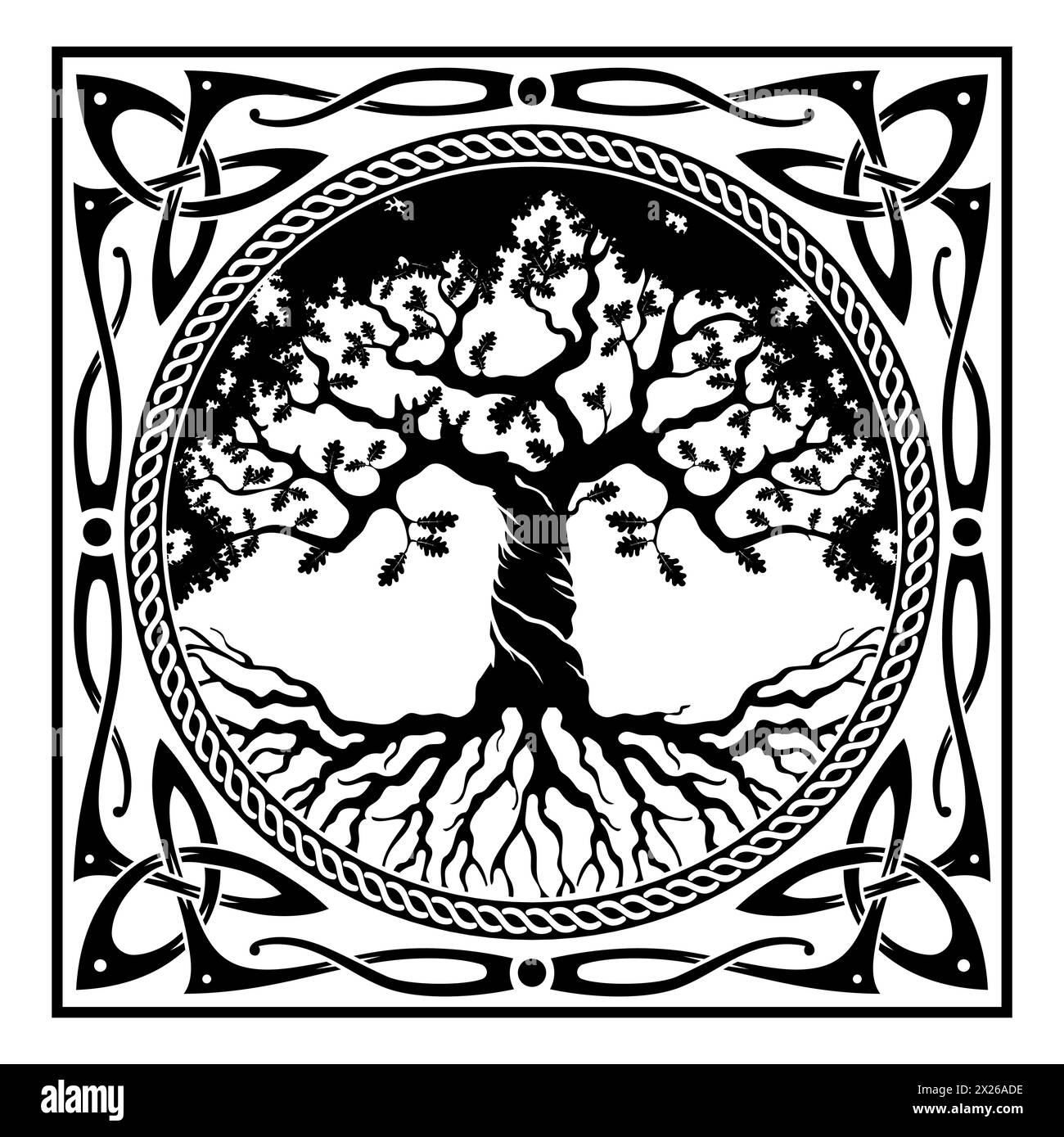
Imagine a tree. But not just any tree you'd see in a local park or on a hiking trail. This thing is massive. Its branches literally hold the weight of the stars, and its roots are dug into the very fabric of existence. That's Yggdrasil, the Norse world tree, and honestly, it’s the most metal concept in ancient mythology. It’s not just a decoration or a symbol of nature; it’s a living, breathing map of the universe.
People often get it wrong. They think of Yggdrasil as a simple ladder connecting "heaven" and "hell." It's way more chaotic than that. It’s a messy, ecological disaster of a tree where things are constantly biting it, rotting it, and trying to tear it down.
The Weird Anatomy of the Norse World Tree
You’ve probably seen the beautiful, symmetrical drawings on Pinterest. Forget those. In the Poetic Edda, the primary source of what we actually know about Norse myths, Yggdrasil is under constant siege. It’s an ash tree, specifically Fraxinus excelsior, though some scholars like Hilda Ellis Davidson have argued it might have been a yew tree because ash trees aren't evergreen, and the myths describe it as "always green."
The structure is basically a cosmic central nervous system.
The roots are where things get complicated. One root goes to Asgard, the home of the Aesir gods. Another stretches toward Jötunheimr, the land of the giants. A third reaches down into Niflheim, the realm of ice and mist. Beneath these roots aren't just dirt and worms. We’re talking about primordial wells of power. There’s the Well of Urd, where the Norns—the weavers of fate—spend their days watering the tree so it doesn't rot away. They use a special white clay to keep the bark healthy. It’s basically cosmic skincare for a giant ash tree.
The Animals That Hate This Tree
Life on the Norse world tree is a constant struggle. At the very top sits an unnamed eagle. Between its eyes perches a hawk named Vedrfolnir. Down at the bottom, in the dark pits of Hvergelmir, is a dragon named Nidhogg. He’s not just hanging out; he’s actively chewing on the roots, trying to kill the tree.
Connecting the eagle and the dragon is a squirrel named Ratatoskr.
He is the ultimate instigator. Ratatoskr spends his entire existence scurrying up and down the trunk, carrying insults back and forth between the eagle and the dragon. It’s petty. It’s hilarious. It’s also a perfect metaphor for how information—and drama—moves through a system. Then you have the four stags—Dainn, Dvalinn, Duneyrr, and Durathror—who spend their time eating the leaves. The tree is being eaten from the top, the middle, and the bottom. It exists in a state of perpetual "becoming" and "decaying."
Why the Nine Realms Actually Matter
When we talk about the Norse world tree, we have to talk about the Nine Realms. But here’s the kicker: the ancient texts never actually give us a list. We have to piece it together like a puzzle with missing parts. Snorri Sturluson, the 13th-century Icelandic historian who wrote the Prose Edda, is our main guy here, but even his accounts have gaps.
The realms aren't planets. They are "homes" or "worlds" (the word heimr means home).
- Midgard: That’s us. The "Middle Enclosure."
- Asgard: High up, the gated community of the gods.
- Vanaheimr: Home of the Vanir, the other group of gods who are more about fertility and nature.
- Jötunheimr: Rocks, ice, and giants.
- Alfheimr: The light elves. Think ethereal and shiny.
- Svartalfheimr: The "dark elves" or dwarves. They live underground and make the best gear.
- Niflheim: Cold, foggy, and miserable.
- Muspelheim: Fire and heat.
- Hel: Not "Hell" in the Christian sense, but a cold place for those who didn't die in battle.
What’s fascinating is that these realms aren't static. They are connected by the branches of the Norse world tree, meaning everything is linked. If Nidhogg finally chews through that root in Niflheim, the vibration is felt in Midgard. It’s an early form of systems thinking. Everything is interconnected. If one part of the ecosystem fails, the whole thing comes crashing down. That’s essentially what happens during Ragnarok.
Odin’s Sacrifice: The Tree as a Gallows
The name "Yggdrasil" actually reveals a dark secret. Yggr is one of the many names for Odin, meaning "The Terrible One." Drasill means "horse." So, the name translates to "Odin’s Horse."
But he wasn't riding it.
In the poem Hávamál, Odin describes how he "hanged on a windy tree" for nine nights. He pierced himself with his own spear, Gungnir. He had no food and no drink. He was sacrificing himself, to himself. Why? To gain the knowledge of the runes.
"I know that I hung on a windy tree nine long nights, wounded with a spear, dedicated to Odin, myself to myself."
This is why the Norse world tree is often called a gallows. In Old Norse culture, a gallows was sometimes poetically referred to as the "horse of the hanged." Odin "rode" the tree into a state of near-death to unlock the secrets of the universe. This tells us that the tree isn't just a physical structure; it’s a site of initiation. It’s where you go to suffer if you want to understand the truth.
The Practical Wisdom of the Ash
Why an ash tree? In the Viking Age, ash was the gold standard for tool-making. It’s incredibly strong but also flexible. If you were making a spear or an axe handle, you wanted ash. It’s resilient.
By making the center of the universe an ash tree, the Norse were saying that reality itself is tough but flexible. It can take a beating from four stags and a dragon, and it still stands. Mostly.
There’s also the concept of Mímameiðr, which many scholars believe is just another name for Yggdrasil. It’s the "Tree of Mim" (Mimir), the wise being whose head Odin keeps around for advice. Mimir’s Well sits under one of the roots. To drink from it, Odin had to pluck out his own eye. The price of wisdom at the base of the Norse world tree is always high. You don't get anything for free in this mythology.
How to Apply the World Tree Philosophy Today
You don't have to believe in a giant squirrel to find value here. The Norse world tree is a masterclass in understanding how systems work.
Consider the idea of the "Three Wells." You have the Well of Fate (Urdarbrunnr), the Well of Wisdom (Mímisbrunnr), and the Well of Life/Rivers (Hvergelmir). These represent the past, the present cost of knowledge, and the raw energy of nature.
If you want to live with a bit more "Viking" intentionality, look at how you balance these things.
- Acknowledge the rot. Just like the dragon Nidhogg, every project or relationship has something gnawing at the roots. If you ignore the "rot," the tree dies.
- Tend the roots daily. The Norns didn't just water the tree once a year. They did it every single day. Consistency is the only thing keeping chaos at bay.
- Expect the drama. If a literal cosmic squirrel is trying to start a fight between an eagle and a dragon, your office drama or family tiffs are basically just part of the natural order. Don't take it so personally.
- Sacrifice for growth. Odin didn't get the runes by sitting on his couch. He had to give something up. What are you willing to "hang" for to get to the next level of your own understanding?
The Norse world tree eventually falls during Ragnarok, but even then, it’s not the end. Two humans, Lif and Lifthrasir, hide within the wood of Hoddmímis holt (likely another name for the tree) to survive the fire and the flood. When the world is reborn, the tree is still there. It’s the ultimate survivor. It reminds us that while individual branches might break and the leaves will definitely be eaten, the core—the trunk—remains.
To dive deeper into this, your next move should be reading the Völuspá. It’s the most famous poem in the Poetic Edda and gives the most vivid description of how the tree trembles when the end of the world finally arrives. Look for the Jackson Crawford translation if you want something that sounds like actual human speech rather than a 19th-century textbook.



