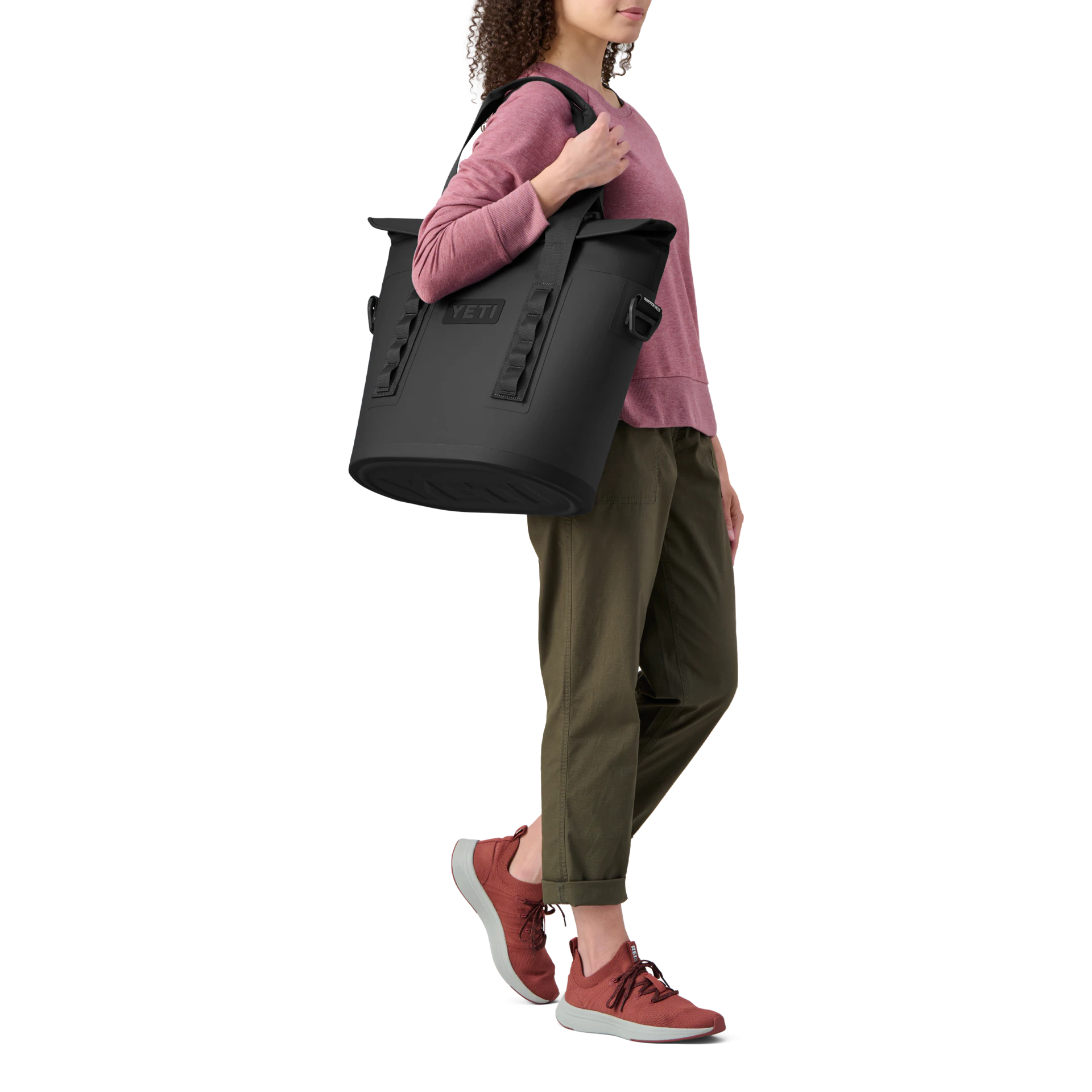
You’re standing on the beach. It's 95 degrees. You reach for a cold seltzer, but you’re fighting a zipper that feels like it was designed by a medieval blacksmith. We’ve all been there with old-school soft coolers. They leak. They stick. They scrape your knuckles. Honestly, that’s why the YETI M15 Tote Soft Cooler became such a massive deal when it hit the market. It wasn't just another bag; it was a fundamental shift in how we actually get into our food and drinks while we’re outside.
YETI basically killed the traditional zipper on their mid-sized totes. They swapped it for MagShield technology. This isn't just a marketing buzzword. It’s a row of ultra-powerful magnets that snap shut the moment you let go. It’s satisfying. It’s fast. But more importantly, it solved the "someone left the cooler open" problem that ruins every camping trip.
The M15 sits in that Goldilocks zone. Not too big. Not too small. It’s the successor to the older M20 and M30 models, refining the dimensions to make it feel less like a bulky suitcase and more like a rugged, over-engineered beach bag.
The Magnetic Reality Check
Let's talk about those magnets. If you remember the previous versions of YETI's magnetic coolers, there was a bit of a hiccup. There was actually a massive voluntary recall in early 2023 involving the M20 and M30 models because those magnets could, in rare cases, detach. YETI didn't just patch the problem. They went back to the drawing board to ensure the M15 Tote Soft Cooler was built differently.
The new MagShield is encased much more aggressively. It’s a strip of magnets that creates a literal gasket-like seal. You can tip this thing over in the back of your truck, and—provided you didn't overstuff it so the magnets can't touch—it isn't going to soak your carpet. It's not technically 100% waterproof in the same way a submersible hard-shell Panga bag is, but for 99% of people, it’s effectively leakproof.
Why does this matter? Because zippers are the fail point of almost every soft cooler. They break. They get sand in the teeth. They require "zipper lube" (which, let's be real, nobody actually uses). The M15 removes that friction. You just pull it open with the tabs, grab your sandwich, and let go. Snap. Done.
Cold Retention: Managing Expectations
People buy YETI because they want ice to stay ice. But we need to be honest here. A soft cooler will never, ever outperform a Tundra 45 hard cooler. It just won't. The M15 uses ColdCell Insulation, which is a closed-cell foam that’s about an inch thick.
If you throw a warm 12-pack in here with a handful of ice, you’re going to have lukewarm beer by sunset. That's just physics. To get the most out of the YETI M15 Tote Soft Cooler, you have to treat it like a professional. Pre-chill the cooler in a cool room. Use a 2:1 ice-to-can ratio. Use YETI ICE blocks if you have them, because they freeze at a lower temperature than water ice and act as a thermal foundation.
On a normal day? You’ll get solid ice retention for about 24 to 48 hours. If you're going on a three-day trek through the desert, this isn't your primary cooler. If you’re heading to a Saturday tailgate or a Sunday boat session? It’s perfect. It holds about 32 cans (if you aren't using much ice) or about 15 pounds of ice solo.
The "Tote" Factor
Design matters. The "tote" shape of the M15 is narrower than the old M30. This is a huge ergonomic win. Have you ever tried to carry a wide, heavy cooler long distances? It bangs against your hip. It throws off your center of gravity. You end up walking like a confused penguin.
The M15 is taller and slimmer. It hugs your side. The shoulder strap is heavily padded, which is necessary because 15 pounds of ice plus drinks gets heavy fast. There are also reinforced handles on the sides, so if you’re pulling it out of a crowded trunk, you have multiple grab points.
Ruggedness and the DryHide Shell
The exterior is made of what YETI calls DryHide. It’s essentially a high-density fabric that’s similar to what they use in white-water rafts. It’s puncture-resistant. It’s mildew-resistant. It’s UV-resistant.
I’ve seen these things dragged across gravel and tossed into the bottom of aluminum boats. They take a beating. One thing to watch out for, though, is the color. The lighter colors like "Canopy Green" or "Cosmic Lilac" look incredible in photos, but they do show dirt and fish scales more than the classic Navy or Charcoal. A quick spray with a hose usually fixes it, but the fabric has a slight texture that can hold onto stubborn grime.
HitchPoint Grid: The Secret Weapon
Most people ignore the webbing on the front. Don't. That’s the HitchPoint Grid. It’s designed for MOLLE accessories. You can clip on a Bottle Opener, a SideKick Dry gear bag (for your phone and keys), or even just a carabiner with your sandals. It turns the cooler into a modular base camp.
If you’re the type of person who loses their keys at the beach every single time, getting a SideKick Dry to attach to the front of your M15 is a life-changer. It keeps your electronics bone-dry while your drinks stay ice-cold inches away.
What Most People Get Wrong
There’s a misconception that "more expensive means better ice." In the world of soft coolers, more expensive usually means better durability and better usability.
You can buy a $50 soft cooler at a big-box store. It might keep ice for four hours. But the liner will tear within a season. The zipper will snag. The handle will rip off when you try to lift it. The M15 is an investment in frustration reduction. You're paying for the fact that the interior liner is RF-welded—meaning there are no sewn seams to leak. You’re paying for the fact that the magnets won't rust.
However, you should know that the M15 doesn't have an external pocket. This drives some people crazy. If you want a place to put a napkin or a koozie, you have to buy an accessory or just toss it inside the main compartment. It’s a minimalist design, for better or worse.
Comparing the M15 to the M12 Backpack
Choosing between the M15 Tote and the M12 Backpack usually comes down to how far you’re walking. The M12 is obviously better for hiking. But the M12 is surprisingly small inside. The "tote" opening of the M15 is much wider. It’s easier to see what’s at the bottom. It’s easier to clean. If you're just going from the car to the sand, the M15 is the superior choice because you aren't digging blindly for that last black cherry hard seltzer buried at the bottom of a deep backpack sleeve.
Real-World Maintenance
Don't just throw this in the garage when you get home. If you leave it closed while it’s damp inside, it will smell. Use a mild soap and water. Prop it open with a rolled-up towel so the magnets can't close, and let it air dry completely.
If the magnets do get some sand or salt on them, wipe them down. While they are incredibly durable, salt buildup can eventually affect the "glide" of the material covering the magnets.
Is It Worth the Price Tag?
Let's be real: YETI gear is expensive. The M15 isn't a "budget" pick.
It’s for the person who spends every weekend outside. It’s for the person who is tired of buying a new "disposable" cooler every two years. If you value a "buy it once" mentality, it’s arguably the best soft cooler on the market right now. The magnetic closure is simply faster and more reliable than any zipper ever made.
But if you only go on a picnic once a year? Honestly, you probably don't need this. You're paying for the over-engineering.
Actionable Steps for New Owners
- The Initial Freeze: Before your first big trip, put a sacrificial bag of ice in the M15 for two hours. Dump it, then pack your real ice and cold drinks. This "sacrificial" ice brings the internal foam temperature down so your "real" ice doesn't waste energy cooling the bag itself.
- The Accessory Play: Look into the Rambler Bottle Sling or the SideKick Dry. The M15 is great, but it’s even better when you customize the HitchPoint Grid to hold your specific gear.
- Storage Secret: Always store the M15 with the magnetic top slightly propped open. This prevents any residual moisture from turning into a science project.
- Pack Smart: Put the heaviest items (bottles/cans) at the bottom and your perishables (sandwiches/fruit) in a dry bin or at the very top. Since heat rises, the bottom stays coldest the longest.



