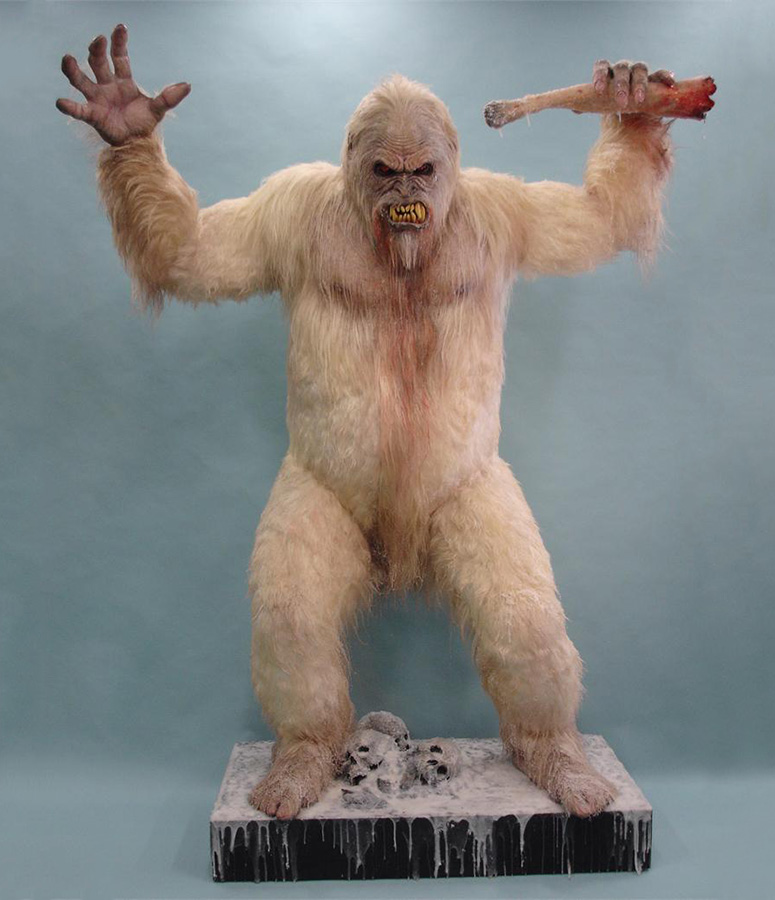
High in the Himalayan peaks, where the oxygen gets thin and the wind starts to sound like a human scream, people still talk about the Migoi. Most of us know it as the Abominable Snowman. But for the Sherpa and Tibetan communities who actually live there, the yeti in real life isn't a cartoon character or a mascot for a cooler brand. It is a biological reality that has haunted their culture for centuries. Honestly, the gap between what Western tourists think a yeti is and what locals describe is massive. We imagine a giant white ape; they describe something reddish-brown, smelling of sulfur, and incredibly dangerous.
It’s easy to laugh. People love to dismiss cryptids as campfire stories. But if you look at the sheer scale of the Himalayas—stretching across five countries with thousands of square miles of unexplored terrain—you start to realize how little we actually know about what's living up there.
The DNA Reality Check
Back in 2014, Bryan Sykes, a geneticist from the University of Oxford, decided to put the myths to the test. He didn't just go looking for footprints. He asked for hair samples from all over the world that were claimed to be from "anomalous primates." He got two specific samples from the Himalayas—one from Ladakh in India and another from Bhutan.
The results were weird.
The DNA didn't match a human or a known modern ape. Instead, it showed a 100% match to a prehistoric polar bear jawbone found in Svalbard, Norway. That bone was at least 40,000 years old. Sykes suggested that a subspecies of brown bear, perhaps a hybrid with ancient polar bears, might be roaming the high altitudes. This makes a lot of sense when you consider the yeti in real life descriptions: a creature that can walk on two legs but spends much of its time on four, possessing incredible strength and thick, insulation-heavy fur.
Then came the 2017 follow-up. Charlotte Lindqvist and her team analyzed nine "yeti" samples. Most turned out to be Himalayan brown bears or black bears. One was a dog. This sounds like a "case closed" moment, right? Not quite. Science doesn't work by proving things don't exist; it just fails to prove they do. While many artifacts in monasteries—like the famous "Yeti Scalp" at Khumjung—have been identified as goat skin (specifically the Himalayan serow), the sightings persist.
Why the High Altitude Matters
Evolution is a strange beast. Animals living at 20,000 feet develop traits that seem alien to us. The bar-headed goose flies over Everest. The snow leopard is basically a ghost made of muscle and fur. If there is a yeti in real life, it isn't a primate in the way we think of a chimpanzee. It would have to be something uniquely adapted to extreme cold and low caloric intake.
Daniel C. Taylor, who spent over sixty years searching for the truth behind the tracks, eventually focused on the Barun Valley in Nepal. This place is incredibly lush and isolated. He found footprints that were undeniably "yeti-like," with an opposable hallux (a thumb-like big toe). After years of boots-on-the-ground research, he concluded the tracks belonged to the Asiatic black bear, which uses its inner toe to climb trees in a way that leaves a human-looking print in the snow.
Yet, even Taylor admits that the "Yeti" is more than just a bear. It's a placeholder for the unknown.
The Cultural Weight of the Legend
To understand the yeti in real life, you have to stop looking at it through a microscope and start looking at it through history. In Tibetan Buddhism, the yeti is sometimes seen as a "glacier spirit" or a wild man of the woods. There are different types:
- The Meh-Teh: A man-sized ape-like creature.
- The Chuteh: A massive bear-like animal.
- The Thelma: A smaller, gibbon-like being.
Westerners usually lump these all together. But for a Sherpa hunter, knowing the difference could be the difference between life and death. They don't see it as a "monster." They see it as a neighbor you really want to avoid. It’s a part of the ecological system, just as real as the yak or the wolf.
What People Get Wrong About the Footprints
Most people point to the 1951 Eric Shipton photographs as the ultimate proof. Those prints look huge. They look like a giant man walked through the snow barefoot. But any mountain guide will tell you about "sublimation."
When a footprint is left in the snow, the sun hits it. The edges melt and then refreeze. The wind blows. A normal-sized bear or wolf print can expand to twice its size in a matter of hours. This doesn't mean the person who saw it was lying. It just means the environment is a master of illusion.
Does that explain everything? Maybe not. Some trackers have reported "gait patterns" that don't match known quadrupeds. They describe a bipedal movement that covers vertical distances no human could manage without ropes and ice axes.
Investigating the Modern Evidence
In 2011, a conference in Russia claimed they had "95% proof" of the yeti’s existence in the Kemerovo region. They found some twisted branches and grey hairs. Predictably, it turned out to be a bit of a PR stunt to boost tourism. This is the problem with finding a yeti in real life—there is money to be made in the mystery.
But there are also the stories from people who have nothing to gain. Take Reinhold Messner, arguably the greatest mountaineer in history. He was the first to climb all 14 "eight-thousanders" without bottled oxygen. He’s a man of facts and endurance. In 1986, he had a close encounter with a creature in Eastern Tibet. He didn't see a "monster." He saw a large, terrifying animal that moved with immense power. He spent years researching it and concluded it was the Ursus arctos pruinosus—the Tibetan blue bear.
Messner’s take is the most grounded one we have: The yeti is real, but it's a bear that has been elevated to the status of a legend.
Actionable Steps for the Curious
If you’re planning to go looking for the yeti in real life, or just want to understand the mystery better, don't just watch reality TV shows. The truth is much grittier.
- Study the Barun Valley: If you're a trekker, this is the most likely habitat for any undiscovered large mammal. It’s one of the few places with enough biodiversity to support a large predator.
- Read "Yeti: The Ecology of a Mystery" by Daniel C. Taylor: It’s the best book on the subject because it respects the science without killing the wonder of the mountain.
- Visit the Khumjung Monastery: You can see the purported "scalp" for yourself. Even if it's made of serow hide, the fact that it was preserved for generations tells you how important the creature is to the local culture.
- Check the Himalayan Database: Look for climber reports of "unidentified animals." These are often buried in technical climbing logs rather than sensationalist news articles.
- Focus on Environmental DNA (eDNA): The future of finding the yeti isn't in cameras; it's in the water. Modern researchers are beginning to test high-altitude meltwater for DNA sequences that don't match the current database.
The Himalayas are the youngest and tallest mountains on Earth. They are still growing. As long as there are valleys that humans haven't stepped in, the yeti in real life will remain a possibility. It might be a bear, it might be a relic hominid, or it might be a trick of the light and the thin air. But for the people who live in the shadow of the peaks, the mystery is very much alive.