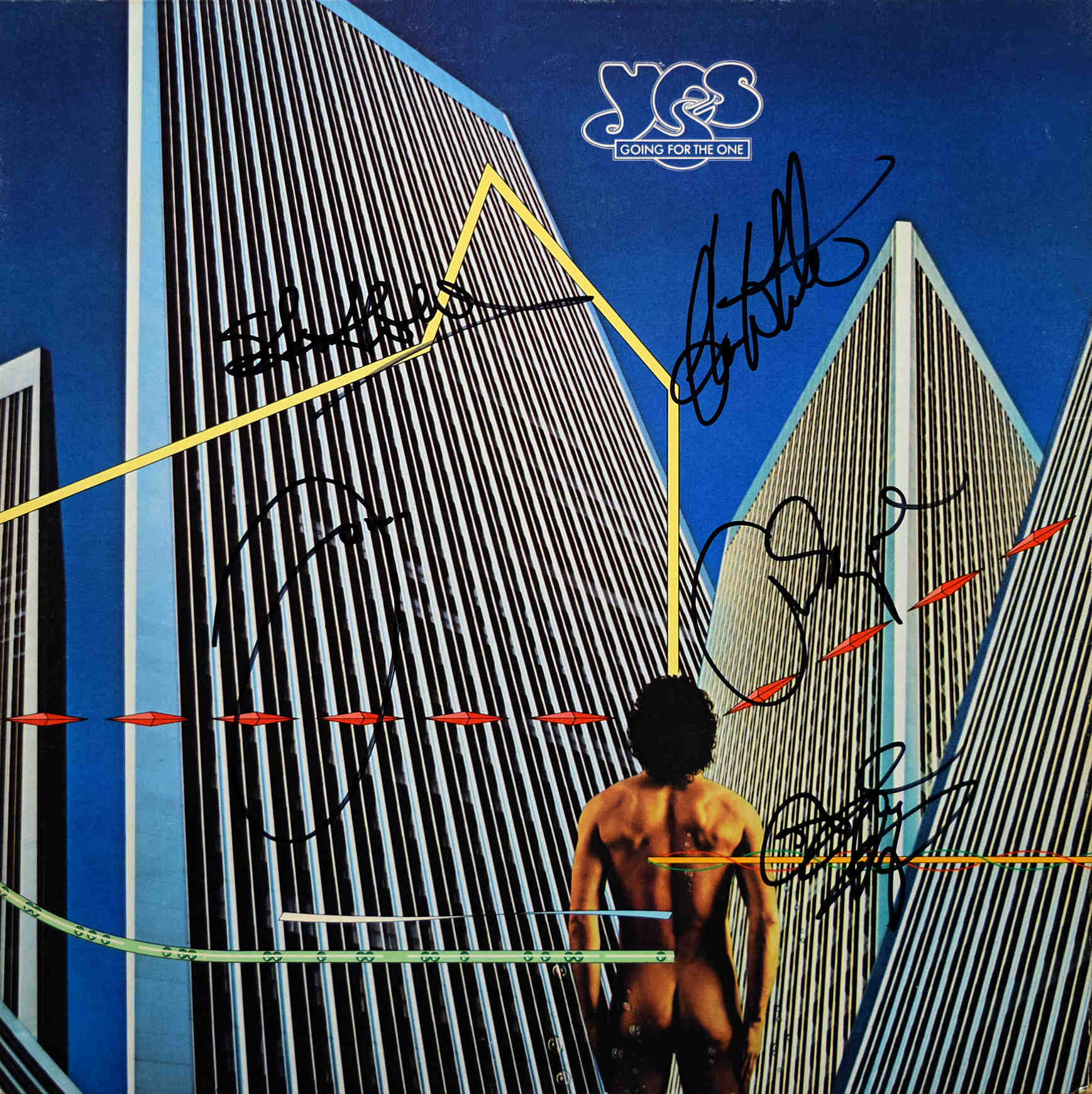
Prog rock was supposedly dead by 1977. At least, that's what the critics in London were screaming while they pinned safety pins to their leather jackets. Johnny Rotten famously wore a "I Hate Pink Floyd" shirt, and the sprawling, twenty-minute synthesizer epics of the early seventies felt like dinosaurs waiting for the comet. Then came Going for the One.
It’s a weird record. Honestly, it’s arguably the most "Daylight" album Yes ever made, recorded in the mountains of Montreux, Switzerland, rather than the dark, cramped studios of London. After years of solo projects and the dense, almost impenetrable textures of Relayer, the band decided to tune their guitars, shorten the songs (mostly), and try to be a rock band again. But it wasn't just a "back to basics" move. It was a high-wire act.
The Return of Rick Wakeman and the Church Organ
You can't talk about Going for the One without talking about the caped crusader himself, Rick Wakeman. He’d left the band previously because he wasn't a fan of the jazz-fusion direction they took on Tales from Topographic Oceans. He famously ate a curry on stage during that tour because he was so bored.
When he came back for this session, something shifted.
Instead of just layering Moog synthesizers in a booth, Wakeman went to St. Martin's Church in Vevey. He stayed there. The band used telephone lines to transmit his pipe organ performances back to the Mountain Studios. You can hear the physical space in the track "Parallels." It isn’t a digital preset; it’s the sound of massive wooden pipes pushing air in a cold Swiss church. That’s the kind of technical excess that makes this album feel grounded yet massive.
Why the Title Track Scared People
The opening notes of the song "Going for the One" are a shock. Steve Howe isn't playing a delicate lute or a jazz hollow-body; he’s ripping into a Fender Steel guitar with a slide, creating this frantic, almost country-rock on acid vibe. It’s loud. It’s messy. Chris Squire’s bass is so distorted it sounds like it’s about to blow the speakers.
Jon Anderson’s lyrics are, as usual, a bit of a cosmic Rorschach test. He’s singing about sport, competition, and "the game," but also about cosmic alignment. It’s a strange juxtaposition. Some fans hated it. They wanted the mystical forests of Close to the Edge. Instead, they got a song that sounded like it belonged in a stadium.
Yet, it worked. The album hit number one in the UK. In the middle of the punk explosion, these "dinosaurs" were outselling the kids. It’s a testament to the fact that musicianship still had a market, even if the fashion was changing.
Awaken: The Last Great Epic?
If the first side of the record was about being a "rock band," the second side—specifically the fifteen-minute masterpiece "Awaken"—was Yes proving they hadn't lost their soul. Anderson has often called this the most "complete" song the band ever wrote.
It starts with a frantic piano flourish from Wakeman. Then, it breathes.
There is a section in the middle of "Awaken" that is basically a meditation. It features Alan White on tuned percussion and Anderson on harp. It’s the antithesis of the punk movement happening simultaneously in the UK. While the Sex Pistols were shouting about "No Future," Yes were spending ten minutes building a cathedral of sound that suggested the future was infinite.
- The Scale: It’s 15:31 of pure dynamic range.
- The Gear: Squire used a triple-neck bass. Yes, three necks. It was heavy, ridiculous, and sounded incredible.
- The Lyrics: It’s about the cycle of life and the "master of images." Classic Anderson.
The Montreux Effect
Recording in Switzerland changed the DNA of the music. In earlier albums, you can hear the claustrophobia of London. Going for the One sounds like it has oxygen. The production, handled by the band themselves rather than Eddie Offord (who had been their go-to guy), is crisp.
The cover art also signaled a change. Gone were the Roger Dean landscapes of floating islands and blue dragons. In their place was a minimalist, Hipgnosis-designed cover featuring a naked man looking at the Century Plaza Towers in Los Angeles. It was sleek. It was "modern." It told the world that Yes weren't living in a fantasy novel anymore. They were living in the 20th century.
The Nuance of the Mix
Listening back to the 2003 Rhino remasters or the more recent Steven Wilson mixes, you notice things. You notice that Steve Howe’s guitar work on "Turn of the Century" is some of the most technically demanding acoustic playing of his career. It’s a heartbreaking song about a sculptor whose grief brings a statue to life. It’s sentimental, sure, but the interplay between the guitar and Anderson’s vocals is delicate in a way that’s hard to replicate.
Then you have "Wonderous Stories."
It’s a hit single. It’s basically a pop song disguised as prog. It’s gentle, melodic, and features some of the best vocal harmonies the band ever put to tape. It showed that they didn't need twenty minutes to make a point. They could do it in three.
Is it actually a "Prog" album?
Some purists argue that Going for the One is where the "classic" era ended and the "commercial" era began. I think that's a bit reductive. If "Awaken" isn't prog, then nothing is.
What the album actually represents is a band realizing they couldn't keep doing the same thing. They saw the landscape changing. They saw that the world was moving toward shorter attention spans and higher energy. Instead of folding, they adapted. They took the complexity of their early work and injected it with a raw, almost garage-band energy on the title track, while keeping the spiritual core intact for the deeper cuts.
Real-World Takeaways for the Listener
If you’re just getting into the 1970s discography of Yes, don't start here. Start with The Yes Album or Fragile. But once you understand their "language," Going for the One is the most rewarding listen. It shows a band at the height of their technical powers but also at their most vulnerable.
- Listen for the Church Organ: On "Parallels," try to hear the reverberation of the room. It’s a lesson in how physical space changes the "weight" of a recording.
- Analyze "Awaken": Treat it like a symphony. It’s not a rock song; it’s a multi-movement piece that requires your full attention. Turn off your phone.
- Appreciate the Bass: Chris Squire’s Rickenbacker tone on this album is "the" definitive prog bass sound. It’s clanky, melodic, and drives the songs more than the guitars do.
- Compare the Artwork: Look at the Hipgnosis cover vs. the Roger Dean covers. It helps you understand the psychological shift the band was going through in 1977.
The album proves that "going for the one"—the top spot, the perfect take, the ultimate truth—is a messy process. It isn't always polished. Sometimes it’s a bit out of tune, and sometimes it’s way too long. But in 1977, it was exactly what the genre needed to survive.
Actionable Next Steps
If you want to truly appreciate this era of music, seek out the live recordings from the 1977 tour. The band was playing with a ferocity that isn't always captured on the studio floor. Specifically, look for versions of "Awaken" from the Yesshows live album. You’ll hear a band fighting to prove they still matter in a world that was trying to forget them.
Beyond the music, look into the history of Mountain Studios in Montreux. It became a sanctuary for bands like Queen and David Bowie for a reason. The isolation of the Alps allowed for a level of experimentation that you just couldn't get in a city. Understanding the environment helps you understand the "breath" within the tracks of this record.



