Rock and roll is messy. It’s supposed to be. But by 1976, Yes—the undisputed kings of complex, cosmic progressive rock—had become something of a high-altitude laboratory. They were coming off Relayer, an album so jagged and aggressive it practically fought the listener. Then everything stopped. The band took a break for solo projects, and when they finally reconvened to record Yes Going For The One, the musical landscape was shifting beneath their feet. Punk was starting to snarl in London, and the fifteen-minute "keyboard gymnastics" of the early seventies were suddenly looking a bit dusty.
Honestly, people forget how much was at stake here. This wasn't just another album; it was a pivot point. Rick Wakeman was back on keyboards after his first departure, and the band decamped to Montreux, Switzerland. They traded the claustrophobic London studios for Mountain Studios, sitting right on the edge of Lake Geneva. You can actually hear the air in these recordings. It’s a bright, soaring, and weirdly disciplined record that managed to save the band from becoming a relic.
The Return of the Cape and the Church Organ
The biggest story surrounding Yes Going For The One is undoubtedly the return of Rick Wakeman. Patrick Moraz had done a stellar job on Relayer, bringing a jazz-fusion edge that was technically brilliant, but he never quite fit the "classic" Yes chemistry. When Wakeman came back, something clicked. But he didn't just bring his racks of Moogs and Mellotrons.
In a move that sounds like a total logistical nightmare, the band decided they needed a real pipe organ for the track "Parallels." They didn't use a synthesizer or a sample. Instead, they hooked up a high-fidelity telephone line from St. Martin's Church in Vevey to the recording studio. Wakeman sat in the church, miles away, playing this massive, thunderous instrument while the rest of the band played in the studio. It’s that kind of commitment to "the real thing" that gives the album its massive, resonant low end.
Steve Howe’s guitar work changed too. He famously moved away from his Gibson ES-175 and started leaning heavily on a Fender Steel guitar. You hear it immediately on the title track. It’s slide-heavy, country-tinged, and weirdly driving. It’s almost... boogie? Well, as close to boogie as Yes ever gets.
Stripping Down (By Yes Standards)
The title track, "Going for the One," is a shock to the system. It’s five minutes long. For a band that spent the previous five years writing side-long epics like "Close to the Edge," a five-minute opener felt like a sprint.
The lyrics are classic Jon Anderson—abstract, spiritual, slightly nonsensical if you look at them too hard—but the energy is different. It’s frantic. It’s Chris Squire’s Rickenbacker bass rattling your teeth while Alan White keeps a beat that’s surprisingly straightforward.
- "Turn of the Century" offers the emotional heartbeat of the record. It’s a tragic, beautiful story about a sculptor and his late wife.
- "Parallels" brings that church organ roar, turning a standard rock structure into something cathedral-like.
- "Wonderous Stories" became a legitimate hit. It’s a delicate, shimmering piece of pop-prog that proved the band could be accessible without losing their soul.
Then you have "Awaken."
Ask any die-hard fan about Yes Going For The One and they will eventually stop talking about the short songs and start vibrating when they mention "Awaken." It’s fifteen minutes of pure, unadulterated musical ambition. It has harp sections. It has choral arrangements. It has a mid-section that sounds like the universe is being birthed in a Swiss basement. Anderson has often called it the most "complete" thing the band ever did. It’s the bridge between the sprawling 1973 era and the more polished 1980s sound.
Why the Cover Art Actually Matters
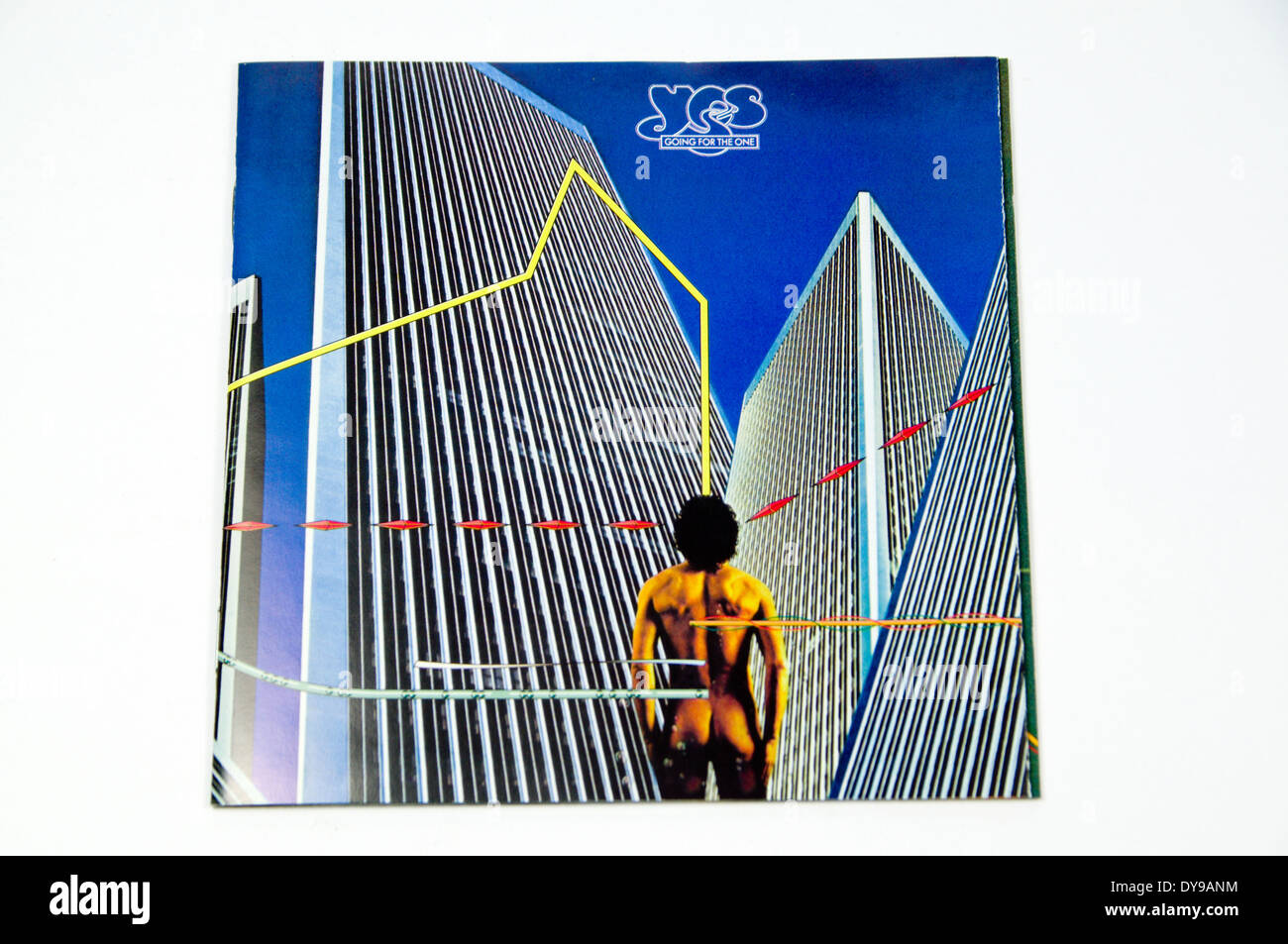
Look at the cover. If you’re used to the Roger Dean fantasy landscapes—the floating islands and psychedelic dragons—the cover of Yes Going For The One is a cold shower. It’s a photo of a naked man looking out at the Century Plaza towers in Los Angeles. Designed by Hipgnosis (the same folks who did Pink Floyd’s Dark Side of the Moon), it signaled a break from the past.
It was a "man in the modern world" aesthetic. It told the audience that Yes was living in the present day, not just in a Middle-earth dreamscape. This wasn't always popular with the fans. Some felt the "inner space" of Roger Dean was essential to the Yes brand. But looking back, the shift to a more "human" and "urban" visual style mirrored the tighter, punchier songwriting on the record.
Technical Brilliance vs. Raw Energy
Recording in Switzerland wasn't just about the tax breaks or the scenery. The acoustics of Mountain Studios gave the drums a snap that was missing on Tales from Topographic Oceans. Listen to Alan White’s snare on this record. It’s crisp. It cuts through the wall of keyboards.
Most people think of prog as being "overproduced." But Yes Going For The One has a strange, raw quality. The band was recording mostly live in the studio. They were reacting to each other in real-time. You can feel the tension in the tempo shifts. It’s not a metronome-perfect digital product; it’s five guys in a room trying to outplay each other while staying in the same key.
Critics at the time were surprisingly kind. Even Rolling Stone, which usually hated prog rock with a passion, gave it a decent shake. They recognized that the band had trimmed the fat. The "solos for the sake of solos" were mostly gone, replaced by parts that actually served the song.
The Legacy of Going For The One
Is it their best album? That’s a fight that will last as long as there are record stores. Close to the Edge usually wins the popular vote. But Yes Going For The One is the album that proved they could survive. It went to number one in the UK. It showed that even as the Sex Pistols were screaming about anarchy, there was still a massive audience for high-concept, expertly played music.
It’s also the last time this specific lineup—Anderson, Howe, Squire, Wakeman, and White—would feel this unified. The follow-up, Tormato, was a bit of a mess, and then the band fractured into the 1980s "owner of a lonely heart" era. This record is the peak of the mountain before the descent.
How to Listen to the Album Today
If you’re coming to this album for the first time, don’t treat it like background music. It’s too dense for that.
- Find the 2003 Rhino Remaster or the Steven Wilson Remix. The original 1977 vinyl is great, but the mid-range can get a bit muddy because there is so much happening. The modern remasters clean up the separation between the church organ and the bass.
- Start with "Wonderous Stories." It’s the easiest entry point.
- Read the lyrics to "Awaken" while you listen. It sounds pretentious, but it helps you track the movements of the song. It’s basically a symphony in three parts.
- Listen for the bass. Chris Squire’s tone on "Going for the One" is legendary among bassists. He’s playing it like a lead guitar, and it’s arguably his finest hour.
The reality is that Yes Going For The One represents a moment where a band at the height of their powers decided to look at the world around them instead of just the stars. They took the complexity of prog and injected it with the urgency of the late seventies. It’s bright, it’s loud, and it’s unapologetically grand.
To truly appreciate what Yes did here, you have to look at the track sequencing. They lure you in with a rocker, hit you with a ballad, blow your mind with a massive organ-driven anthem, and then give you a short folk-pop breather before the fifteen-minute finale. It’s a masterclass in pacing. Even if you aren't a "prog person," there is a craftsmanship here that is impossible to ignore. It’s the sound of a band realizing they don't have to choose between being smart and being catchy. They chose to be both.
Next Steps for the Listener:
- Analyze the Gear: Check out the specific equipment used by Steve Howe on this record, specifically his use of the Vachon pedal steel, which defines the title track's "sliding" sound.
- Compare the Eras: Listen to Relayer (1974) and then immediately play Going for the One. Pay attention to the "space" in the recording; notice how the Swiss studio allowed the instruments to breathe compared to the dense, compressed sound of the London sessions.
- Deep Dive into "Awaken": Research the "Circle of Fifth" section in the middle of "Awaken." It’s a technical marvel that uses a cycling harmonic structure to create the feeling of a rising, never-ending spiral of sound.



