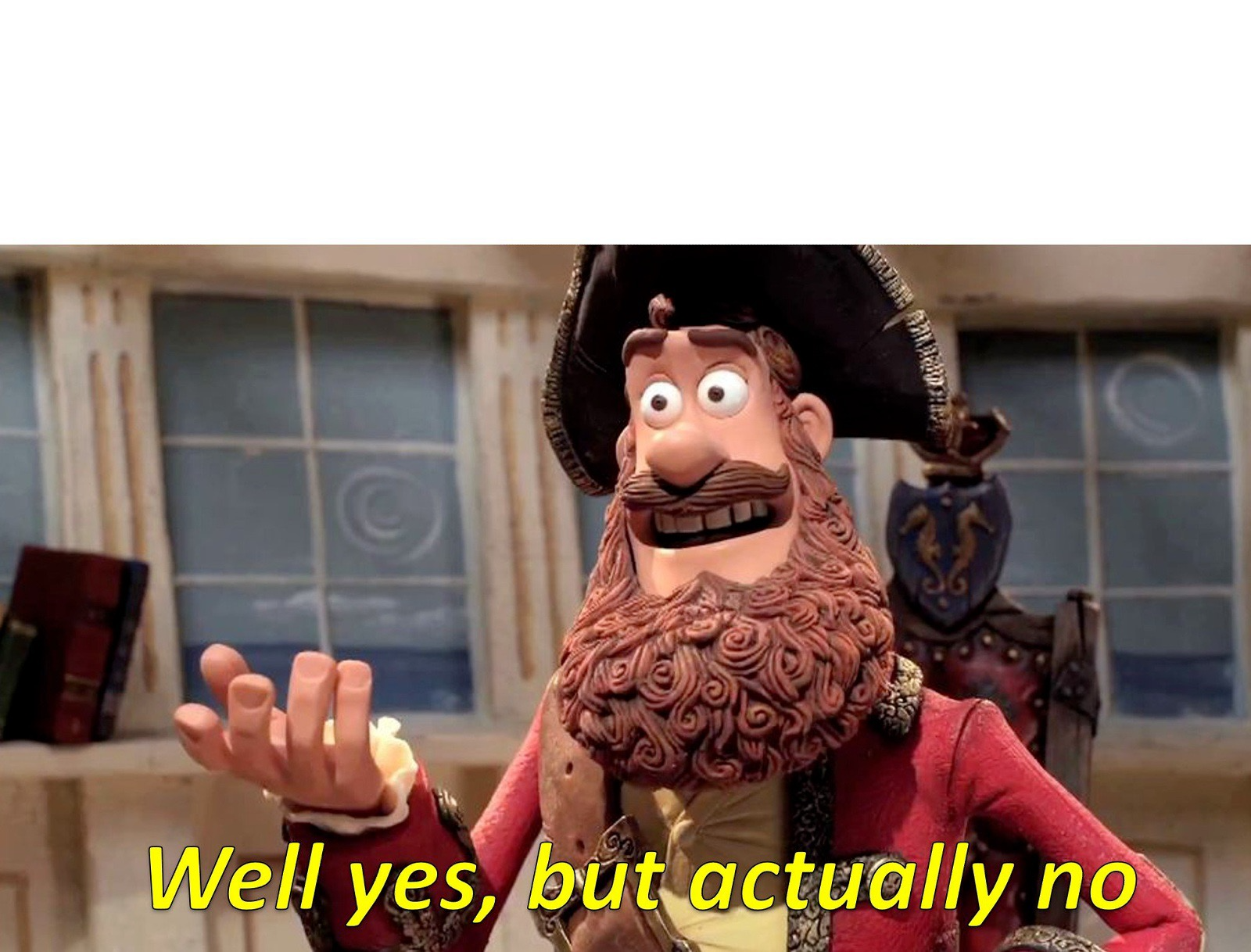
Memes usually die fast. They burn bright for a week, get posted by a corporate Twitter account, and then vanish into the digital graveyard of cringe. But the yes but actually no meme is different. It’s been around for over a decade, and somehow, it still feels like the only way to describe the absolute absurdity of modern life.
You’ve seen it. It’s that grainy image of a cartoon pirate—specifically the Pirate Captain from the 2012 Aardman Animations film The Pirates! In an Adventure with Scientists! (released as Band of Misfits in the US). He’s leaning in, looking slightly concerned but mostly polite, delivering a line that perfectly captures the feeling of a technicality ruining a perfectly good answer.
It is the ultimate "well, technically" response. It’s what happens when the truth is complicated and annoying.
The Weird History of the Pirate Captain
Here is the thing about the yes but actually no meme: he never actually says those words in the movie.
Seriously. Go watch the film. It’s a great movie, honestly. Hugh Grant voices the Captain, and the animation is that classic, chunky stop-motion style that Aardman perfected with Wallace & Gromit. In the actual scene, the Pirate Captain is talking to Charles Darwin. Yes, that Charles Darwin. The Captain asks if a "silent 'sh' count" as a word during a bit of dialogue. The actual line in the movie is, "Well, yes, but no."
The internet, in its infinite wisdom, decided to spice it up. Somewhere around 2018—six years after the movie came out—the "Actually" was added to the bottom text. It just sounded better. It added that layer of smugness that makes a meme truly elite. It’s that specific brand of "I’m trying to be helpful but I’m about to give you some really bad news" energy.
Why We Can't Stop Using It
Why does this specific image carry so much weight?
Context matters. We live in an era of fine print. Everything is a "yes" followed by a giant "but."
- "Is the Wi-Fi free?" Yes but actually no (it's free for ten minutes if you give them your soul and your email address).
- "Did I get a raise?" Yes but actually no (inflation just ate it for breakfast).
- "Is this game finished?" Yes but actually no (it’s in early access for the next nine years).
The meme bridges the gap between a simple answer and the messy reality of the situation. It’s the visual representation of a caveat. Psychologically, it works because the Pirate Captain looks so earnest. He’s wearing a coat that’s seen better days, and he’s trying his best to be a good captain, even though he’s kind of a failure. We relate to that. We are all just trying to navigate a world of "yes but actually no" scenarios while wearing a metaphorical pirate hat.
The Technicality That Changed Everything
In the world of SEO and digital communication, the yes but actually no phenomenon is a lesson in how humans process information. People don't want a "maybe." They want a binary answer that they can immediately debunk.
Think about the way Google’s Featured Snippets work. Often, they give you a direct answer that is technically correct but practically useless. You search for "Can I eat this mushroom?" and the snippet says "Many people do," but the second paragraph explains you’ll spend the next 48 hours in a hospital. That is the meme in action. It’s the conflict between the headline and the reality.
The Evolution of the Template
The meme didn't just stay a static image. It evolved.
First, it was just the image. Then, people started redrawing it. You’ll see versions of the Captain dressed as video game characters, politicians, or software developers. In the coding community, yes but actually no is basically the unofficial slogan for "Does the code run?"
It runs. But it also breaks the entire database if you click "Submit" twice.
How to Spot a "Yes But Actually No" Situation in Real Life
You encounter this more often than you think. It’s the hallmark of modern bureaucracy and "corporate speak."
When a company says, "We value your feedback," that is a yes but actually no moment. They value the data point, but they aren't going to change the product because you complained on Reddit. When a streaming service says they have "thousands of movies," it’s the same thing. They do! But 90% of them are low-budget horror sequels you’ve never heard of.
It’s also prevalent in the world of health and fitness. "Is chocolate good for you?" Yes but actually no. Dark chocolate has antioxidants, sure, but if you eat three bars a day, the sugar content is going to win that fight every single time.
The Cultural Impact of Aardman’s Mistake
Aardman Animations probably never expected a box-office "okay" film to become a cornerstone of internet culture. But they have a knack for it. Their character designs are incredibly expressive. The clay-like texture gives a warmth that CGI often lacks.
When you use the yes but actually no meme, you aren't just sharing a joke. You're participating in a specific type of visual shorthand that signals you understand the nuance. You're telling the other person, "I know the world is complicated, and I’m acknowledging the loophole."
It’s the opposite of "fake news." It’s "technically true but functionally false news."
Actionable Takeaways for Using Nuance
Stop giving people flat "no" answers. It’s boring. It shuts down the conversation.
If you want to communicate better, embrace the yes but actually no mindset in your professional life—though maybe leave the pirate image out of your formal emails to the CEO.
- Acknowledge the partial truth. If a client asks if a project can be done by Friday, don't just say "no." Say, "Yes, we can have the draft done, but actually, the final polish will take until Tuesday." It manages expectations.
- Identify the "Actually." In any complex situation, the "Actually" is where the real work happens. Focus your energy there.
- Use the meme for levity. When things go wrong in a project, a well-timed Pirate Captain in the Slack channel can break the tension. It’s a way of saying, "We all know this is a mess, let's just deal with it."
- Beware of the trap. Don't be the person who uses technicalities to deceive. If your "Yes" is too far removed from the "Actually No," you’re just lying with extra steps.
The yes but actually no meme is more than just a funny picture of a pirate. It’s a philosophical stance on the complexity of the 21st century. It’s the recognition that very few things are black and white. Most things are just various shades of "well, technically."
Next time you find yourself in a situation where the answer is both right and wrong at the same time, remember the Captain. He’s been there. He’s still there. He’ll probably be there for another ten years, politely explaining why your favorite TV show isn't actually cancelled, it's just "on an indefinite hiatus."
Embrace the nuance. It's the only way to survive the internet.



