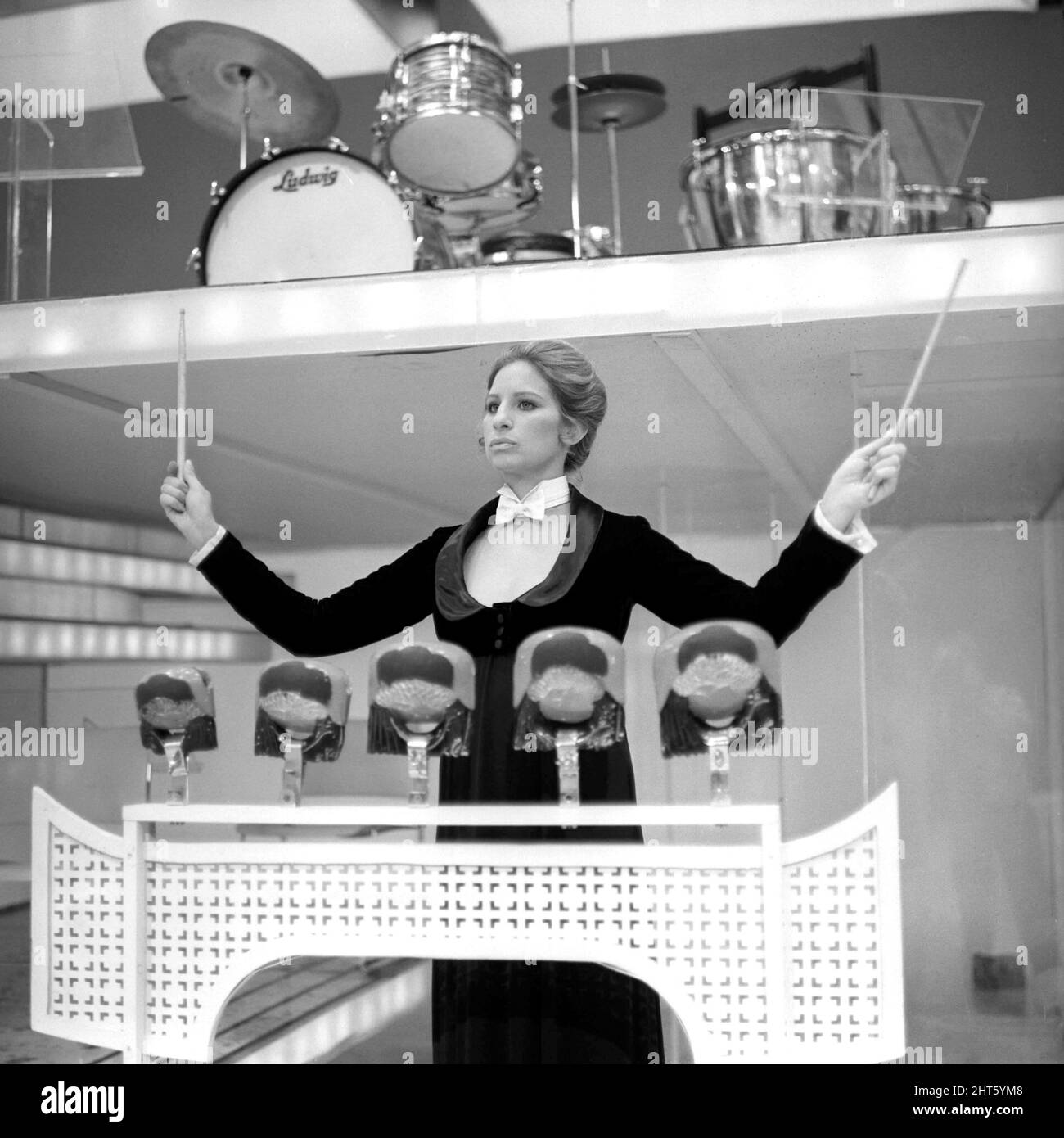
Hollywood didn't want this movie to exist. Honestly, that is the only way to start talking about the 1983 Barbra Streisand musical Yentl. For fifteen years, every major studio executive in town told Barbra Streisand that a story about a Jewish girl in Eastern Europe who disguises herself as a man to study the Torah was "too ethnic" or "too niche." They were wrong.
Streisand didn't just star in it. She co-wrote the screenplay, produced it, and became the first woman to win a Golden Globe for Best Director for her work on the film. It was a massive gamble. Think about the landscape of 1983 for a second. We’re talking about the year of Return of the Jedi and Flashdance. Into that neon-soaked, high-energy cinema culture, Streisand dropped a period piece set in 1904 Poland where the protagonist spends half the movie in a prayer shawl and a flat cap. It shouldn't have worked. But it did.
The film follows Yentl Mendel, the daughter of a village rebbe. In a world where women were expected to master the kitchen and nothing else, Yentl had a hunger for the Talmud that defied social law. When her father dies, she cuts her hair, puts on his clothes, and renames herself Anshel. She finds her way to a yeshiva, falls in love with her study partner Avigdor (played by a young, brooding Mandy Patinkin), and ends up in a bizarre, heartbreaking love triangle involving a woman named Hadass (Amy Irving).
The Musical Language of an Internal Monologue
If you go back and watch the 1983 Barbra Streisand musical today, the first thing that hits you is the structure of the songs. Unlike Grease or The Sound of Music, people don't just burst into song in the middle of the street. Nobody is dancing on tables. In fact, Streisand is the only person who sings.
Michel Legrand, the legendary composer, and the lyricists Alan and Marilyn Bergman created a score that acts entirely as Yentl's "interior monologue." When she sings "Papa, Can You Hear Me?" or "The Way He Makes Me Feel," no one else in the scene hears her. It's a bold stylistic choice. It emphasizes her isolation. She is the only person in her world who knows her true self, so she is the only person allowed to share her voice with the audience.
It was a risky move. Some critics at the time, like the famously prickly Pauline Kael, felt the solo-heavy soundtrack was a vanity project. But look at it from a narrative perspective: how else do you represent a character who is literally forbidden from speaking her truth? The music is her sanctuary.
Why 1983 Was a Turning Point for Women in Film
We often talk about "female-led" cinema today as if it’s a new invention. It's not. Streisand’s journey to get Yentl made is a masterclass in persistence. She originally bought the rights to Isaac Bashevis Singer's short story, "Yentl the Yeshiva Boy," way back in 1968.
The industry basically patted her on the head. They told her she was too old to play a teenager (she was 40 when it finally filmed). They told her the themes were too intellectual.
Streisand’s response? She went to Czechoslovakia to film on a shoestring budget relative to what a "Barbra Streisand movie" usually cost. She obsessed over every frame. She handled the lighting, the costumes, and the historical accuracy of the religious rituals with a level of detail that made the studio heads nervous. When the film was released in November 1983, it grossed over $40 million—a huge sum for a musical at that time.
Yet, the Academy Awards snubbed her for Best Director. It’s one of the most famous snubs in Oscar history. While the film won for Best Original Score, the fact that the person who willed the entire project into existence wasn't even nominated for her direction remains a point of contention for film historians. Steven Spielberg reportedly called it the most impressive directorial debut since Citizen Kane. That’s not a quote you throw around lightly.
The Complexity of Identity and Gender
The 1983 Barbra Streisand musical feels remarkably modern because of how it handles gender. Yentl isn't just "playing dress-up." She discovers a version of herself that only exists when she is Anshel. There is a deep, simmering tension in the scenes where she studies with Avigdor.
You’ve got Mandy Patinkin—who, by the way, is incredible in this—looking at his best friend and feeling an attraction he can’t explain. It’s messy. It’s confusing. It’s deeply human.
The ending of the film often catches new viewers off guard. In the original short story by Singer, the ending is much darker and more ambiguous. In Streisand's version, Yentl chooses independence. She boards a ship for America. She realizes that she can't go back to being a village wife, but she also can't live a lie as a man forever. She chooses a third path: a future where she might actually be allowed to be both a woman and a scholar.
Technical Mastery Behind the Scenes
Let's get into the weeds for a second. The cinematography by David Watkin is breathtaking. He used a lot of natural light and "Dutch master" aesthetics to make the scenes look like living paintings.
- The Kitchen Scenes: Notice the warm, amber hues. These represent the traditional, domestic world Yentl is trying to escape.
- The Yeshiva: The lighting becomes cooler, sharper, more focused. This is the world of the mind.
- The Forest: Most of the pivotal emotional beats happen in nature, where the strict walls of the town and the school don't exist.
The transition from a 10-page short story to a two-hour musical required a lot of padding, but Streisand filled that space with character development rather than fluff. She spent months researching the specific way students in the early 20th century would have argued over the Torah. She wanted the "pilpul" (the analytical hair-splitting of the text) to feel authentic.
Isaac Bashevis Singer’s Critique
It’s worth noting that the original author wasn't exactly a fan. Isaac Bashevis Singer famously wrote an essay in the New York Times expressing his disappointment. He felt Streisand gave the story a "Hollywood ending."
He argued that the real Yentl wouldn't have gone to America to find herself; she was a creature of the old world, trapped by her own obsession with the divine. Singer felt the musical numbers softened the blow of the tragedy.
Was he right? Maybe from a literary standpoint. But from a cinematic standpoint, Streisand knew her audience. She wasn't just making a movie about 1904; she was making a movie for the women of 1983 who were finally starting to break into law schools and boardrooms in record numbers. She wanted to give them an anthem.
Actionable Takeaways for Modern Fans
If you’re revisiting the 1983 Barbra Streisand musical or watching it for the first time, here is how to get the most out of the experience:
Watch for the Editing Beats Notice how the songs often start with a hum or a quiet thought. Streisand’s editing (done by Terry Rawlings) is precise. The music doesn't just "start"—it evolves out of her breath. This is a great lesson for anyone interested in film rhythm.
Compare the Soundtrack to the Film The soundtrack album is iconic, but it’s a different experience than the movie. In the film, you get the "live" feel of her vocals, which were often recorded on set rather than dubbed in a studio later. It adds a raw, vulnerable quality that you don't always get on the LP.
Look at the Supporting Cast While it's a "one-woman show" in terms of singing, pay close attention to Amy Irving as Hadass. Her performance is incredibly subtle. She represents the "traditional" woman, but she isn't a caricature. She has her own desires and her own quiet intelligence, which makes Yentl’s guilt over deceiving her even more palpable.
Contextualize the "Snub" Research the 56th Academy Awards. Looking at the films that were nominated that year helps you understand why Yentl was such a disruptor. It didn't fit the mold of what a "serious" film was supposed to look like in the early 80s.
Find the Legacy You can see the DNA of Yentl in almost every modern musical that deals with internal struggle. Whether it’s Hamilton or Wicked, the idea of a protagonist singing their private ambitions to a world that won't listen owes a massive debt to what Streisand accomplished in 1983.
The 1983 Barbra Streisand musical remains a landmark. It’s a film about the cost of education, the fluid nature of identity, and the sheer force of will required to change one's destiny. Even if you aren't a fan of musicals, the sheer craftsmanship on display is undeniable. Barbra Streisand didn't just make a movie; she proved that a woman could hold every single string in a production and create something that would be talked about decades later.
Go watch the "A Piece of Sky" finale again. Watch how the camera pulls back as she stands on the prow of that ship. It’s not just Yentl leaving Poland. It’s a filmmaker proving she belonged at the helm all along.
To really appreciate the depth of the production, seek out the 40th-anniversary retrospective materials or Streisand's own memoirs, which detail the grueling daily schedule she kept while balancing her roles as director and lead. Understanding the logistical hurdles of filming in the Eastern Bloc during the Cold War adds an entirely new layer of respect for the final product.



