Yellowstone is weird. I don't mean just the "smells like rotten eggs and might explode at any minute" kind of weird, though that’s definitely part of the charm. I’m talking about the fact that the first national park in us history shouldn't really exist. If you look at the timeline of the 1870s, the United States was busy. We were recovering from a brutal Civil War, pushing the railroad across the continent, and basically trying to extract every ounce of gold and timber we could find.
Conservation wasn't really a "thing" yet.
But then, in 1872, President Ulysses S. Grant signed the Yellowstone National Park Protection Act. Just like that, two million acres of land were set aside for "the benefit and enjoyment of the people." It sounds poetic now, but at the time, it was a desperate, chaotic experiment. People honestly thought the explorers who first described the place were hallucinating or just flat-out lying. I mean, would you believe someone telling you the ground was boiling and water was shooting 100 feet into the air every hour? Probably not.
The Myth of the "Untouched" Wilderness
There is this massive misconception that when Yellowstone became the first national park in us borders, it was a pristine, empty wilderness. That is objectively false. We need to be real about the history here: people had been living there for over 11,000 years. The Tukudika (Sheep Eaters), the Crow, the Blackfeet, and the Nez Perce didn't just pass through; they called this place home.
When the park was created, the government basically had to ignore the fact that people lived there to make the "wilderness" narrative work. They wanted a pleasuring-ground, not a community. This created a lot of friction. For years after 1872, Indigenous groups continued to hunt and gather in the park, which led to some pretty tense—and sometimes violent—encounters with early park "superintendents."
The early management was a mess.
There was no budget. No rangers. No rules that anyone actually followed. Poachers were killing elk and bison by the thousands because, honestly, who was going to stop them? The first superintendent, Nathaniel P. Langford, didn't even have a salary. He visited the park maybe twice in five years. It was basically the Wild West with a fancy "National Park" sticker slapped on the front gate.
Why Yellowstone Almost Didn't Happen
If it weren't for the Northern Pacific Railroad, you probably wouldn't be booking a flight to Bozeman this summer.
Jay Cooke, a massive banking mogul, saw Yellowstone as a way to sell train tickets. He figured if he could get the government to protect the land, his railroad would have a monopoly on bringing tourists to see the "wonders." It was a business move. Pure and simple. He even funded the 1871 Hayden Expedition, bringing along painter Thomas Moran and photographer William Henry Jackson.
The Art that Saved the Geysers
They say a picture is worth a thousand words, but in this case, it was worth two million acres. When Ferdinand Hayden returned to Washington D.C., he didn't just bring back rocks and dirt samples. He brought Moran’s stunning watercolors and Jackson’s massive photographs.
Congressmen were floored.
They had never seen anything like the Grand Canyon of the Yellowstone. The deep yellows, the vibrant oranges—it looked like another planet. Before those photos, most politicians thought the stories of "Colter’s Hell" (named after mountain man John Colter) were just tall tales told by drunk trappers. Seeing the visual proof changed everything. It made the abstract idea of a "national park" something tangible and worth voting for.
The Chaos of Early Tourism
Imagine visiting the first national park in us history back in 1880. No paved roads. No gift shops. No "Keep 100 Yards from Bears" signs.
People were insane.
They used to throw their laundry into the geysers. Seriously. They thought the boiling water and soap would act like a natural washing machine. It worked, until the geyser would erupt and shred their shirts to pieces or, worse, get "choked" by the debris and stop erupting entirely. Tourists would also chip off pieces of the delicate silica formations around Old Faithful to take home as souvenirs. It was total vandalism, but back then, it was just called "sightseeing."
By 1886, the situation got so bad that the U.S. Army had to step in. For 30 years, soldiers actually managed Yellowstone. They built the forts, chased off the poachers, and tried to keep people from falling into the hot springs (which, by the way, will literally dissolve you).
The Wolf Debacle: A Lesson in Humility
We can’t talk about the first national park in us history without talking about the wolves. In the early 1900s, the "experts" thought they knew best. They decided that "good" animals were elk and deer, and "bad" animals were predators like wolves and mountain lions.
So, they killed them. All of them.
By 1926, the last wolf pack in Yellowstone was gone. The result was an ecological nightmare. Without wolves to keep them in check, the elk population exploded. They stayed in one place and ate every willow and aspen sapling in sight. The songbirds left because there were no trees. The beavers left because there was no wood for dams. The rivers started eroding because the vegetation was gone.
It took until 1995 for the park to finally admit the mistake and reintroduce gray wolves. The "trophic cascade" that followed is now one of the most famous stories in biology. The wolves changed the behavior of the elk, the plants came back, the beavers returned, and the entire ecosystem stabilized. It’s a huge reminder that even "protected" land can be ruined by humans trying to play God.
Is Yellowstone Still "The Best" Park?
That depends on what you’re looking for. If you want solitude, Yellowstone in July is a nightmare. It’s a parking lot. You’ll see "bison jams" where hundreds of cars are backed up because one buffalo decided to take a nap in the middle of the road.
But if you get off the main loop? It’s magic.
Most people never walk more than half a mile from their car. If you hike three miles into the backcountry, you are suddenly in the same wild landscape that Jim Bridger described in the 1800s. You have the Lamar Valley—often called the "American Serengeti"—where grizzlies, wolves, and thousands of elk roam in a scale you just can't find anywhere else in the lower 48.
Geothermal Weirdness
Yellowstone sits on top of a "supervolcano." The magma chamber is only a few miles beneath your feet. That’s why there are over 10,000 thermal features. It’s the highest concentration of geysers on Earth.
- Old Faithful: Not the biggest, not the tallest, but the most predictable.
- Steamboat Geyser: The world's tallest active geyser. It can shoot water 300 feet in the air, but it’s totally unpredictable. It might go off twice in a week or wait fifty years.
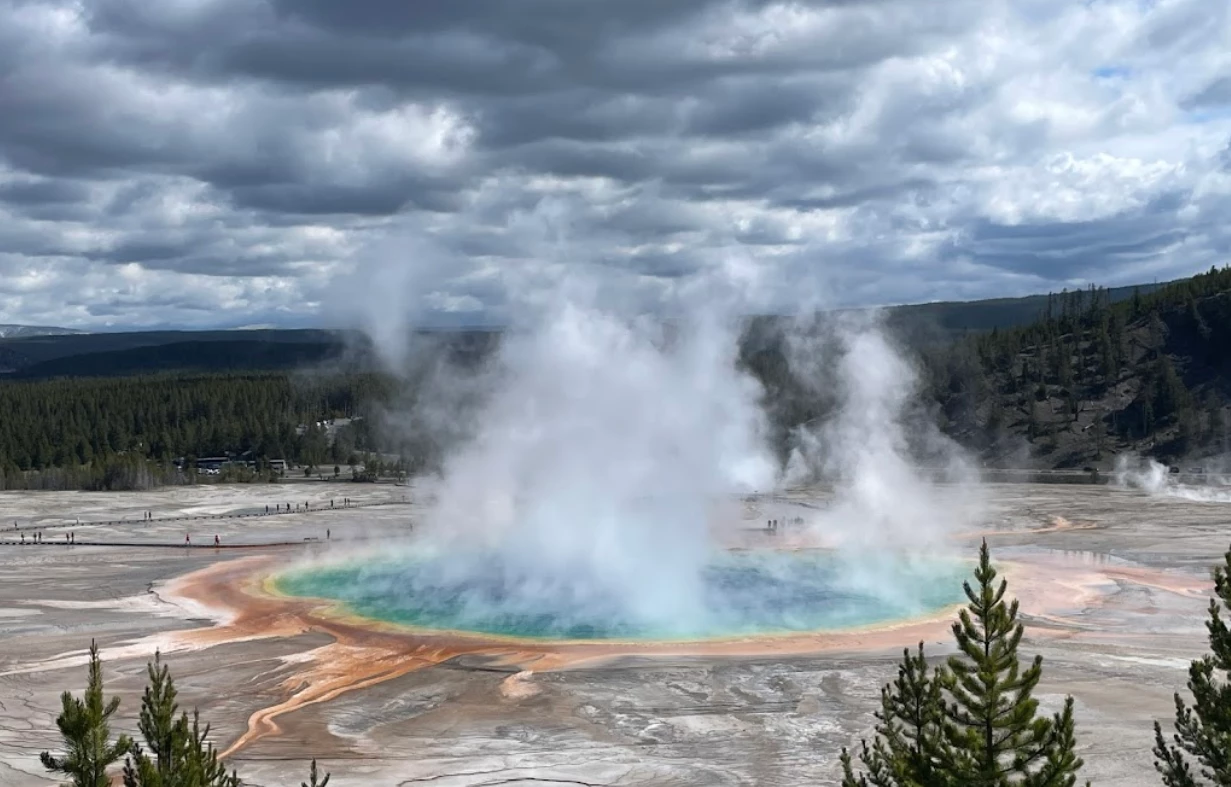
- Grand Prismatic Spring: The one you see in all the drone shots. The rainbow colors come from "extremophiles"—bacteria that live in water so hot it would kill almost anything else.
What Most People Get Wrong About Safety
Every year, someone tries to pet a bison. Don't be that person.
Bison look like big, fluffy cows. They aren't. They can run 35 miles per hour and they are incredibly moody. More people are injured by bison in Yellowstone than by bears. And the water? It’s not just hot; it’s often acidic. In 2016, a man fell into a hot spring in the Norris Geyser Basin, and by the next day, his body had completely dissolved. No remains. Nothing.
The first national park in us history is a wild place that happens to have roads, not a theme park that happens to have animals.
How to Actually Experience Yellowstone
If you're planning a trip, don't just do the "Grand Loop" and leave. You’ll be bored and frustrated by the traffic.
First, get up early. Like, 5:00 AM early. The wildlife is most active at dawn, and you’ll beat the tour buses to the geyser basins. Second, go in the shoulder seasons. September is arguably the best month. The bugs are gone, the elk are bugling (it’s a terrifyingly cool sound), and the crowds have thinned out.
Honestly, the best way to see the park is to pick one region and stay there for two days rather than trying to see the whole thing in a weekend. The park is bigger than Rhode Island and Delaware combined. You can't "do" Yellowstone in a day.
Actionable Insights for Your Visit
- Download Offline Maps: Cell service is basically non-existent once you leave the main villages. Use the NPS app and download the Yellowstone map for offline use.
- Bring Binoculars: You’ll see a brown speck on a hillside. With binoculars, that speck becomes a grizzly bear mother with two cubs. It changes the entire experience.
- The "Lamar Valley" Rule: If you want to see wolves, head to the northeast corner of the park at sunrise. Look for the "wolf watchers"—people with massive spotting scopes. They are usually happy to let you take a peek if you're polite.
- Check the Geyser Times: The ranger station at Old Faithful posts predicted times for about six major geysers. Use those to plan your walks.
- Stay in the Park (If You Can): Booking a room at the Old Faithful Inn or Canyon Lodge is expensive and hard to get, but it saves you two hours of driving every day.
Yellowstone isn't just a park; it's an idea. It was the first time a nation decided that a landscape was more valuable as a public treasure than as a private resource. It was a messy, flawed, and often accidental process, but standing on the rim of the Grand Canyon of the Yellowstone today, it’s hard to argue with the result. Just watch where you step, and for the love of everything, stay away from the bison.