You’ve seen the headlines. Every few months, a grainy video of a bison running down a paved road or a slightly warmer-than-usual puddle in Wyoming goes viral, and suddenly everyone is convinced the Yellowstone volcano is about to erase the United States from the map. It sells clicks. It’s scary.
It’s also, honestly, mostly nonsense. If you liked this post, you might want to check out: this related article.
Yellowstone isn't a ticking time bomb in the way a Hollywood director wants you to believe. It’s a complex, living breathing geological system that experts like Dr. Michael Poland, the Scientist-in-Charge at the Yellowstone Volcano Observatory (YVO), spend every waking hour monitoring. If you’re standing in the middle of the Hayden Valley, you aren't standing on a fuse. You’re standing on one of the most monitored pieces of real estate on the planet.
What Most People Get Wrong About the Yellowstone Volcano
The term "supervolcano" is actually kind of a problem. It was popularized by a BBC documentary in 2000, but it isn’t a technical term geologists used much before that. Nowadays, we use it to describe a volcano that has had at least one "super-eruption" of Magnitude 8 on the Volcanic Explosivity Index. For the Yellowstone volcano, that means ejecting more than 1,000 cubic kilometers (240 cubic miles) of material. For another perspective on this event, check out the recent coverage from National Geographic Travel.
People think "supervolcano" means it only has super-eruptions. That’s just not true.
Since the last giant caldera-forming blast 631,000 years ago, the park has seen about 80 non-explosive lava flows. If the volcano "goes off" again in our lifetime, it’s almost certainly going to be a thick, sluggish crawl of rhyolite lava that moves about as fast as a turtle. It would be a mess for park infrastructure, sure, but it’s not an existential threat to Nebraska.
The Magma Problem
Let’s talk about what’s actually under your feet.
A lot of folks imagine a giant cavern of liquid fire just waiting for a crack to open. In reality, the "magma chamber" is more like a sponge. It’s mostly solid rock with bits of melt tucked into the pores. Current seismic imaging shows that the upper reservoir is only about 5% to 15% molten.
You need a lot more liquid than that to trigger a massive eruption. Think about it like trying to drink a milkshake that’s 90% frozen solid—you aren't getting anything through the straw.
The Real Danger (And It Isn’t Lava)
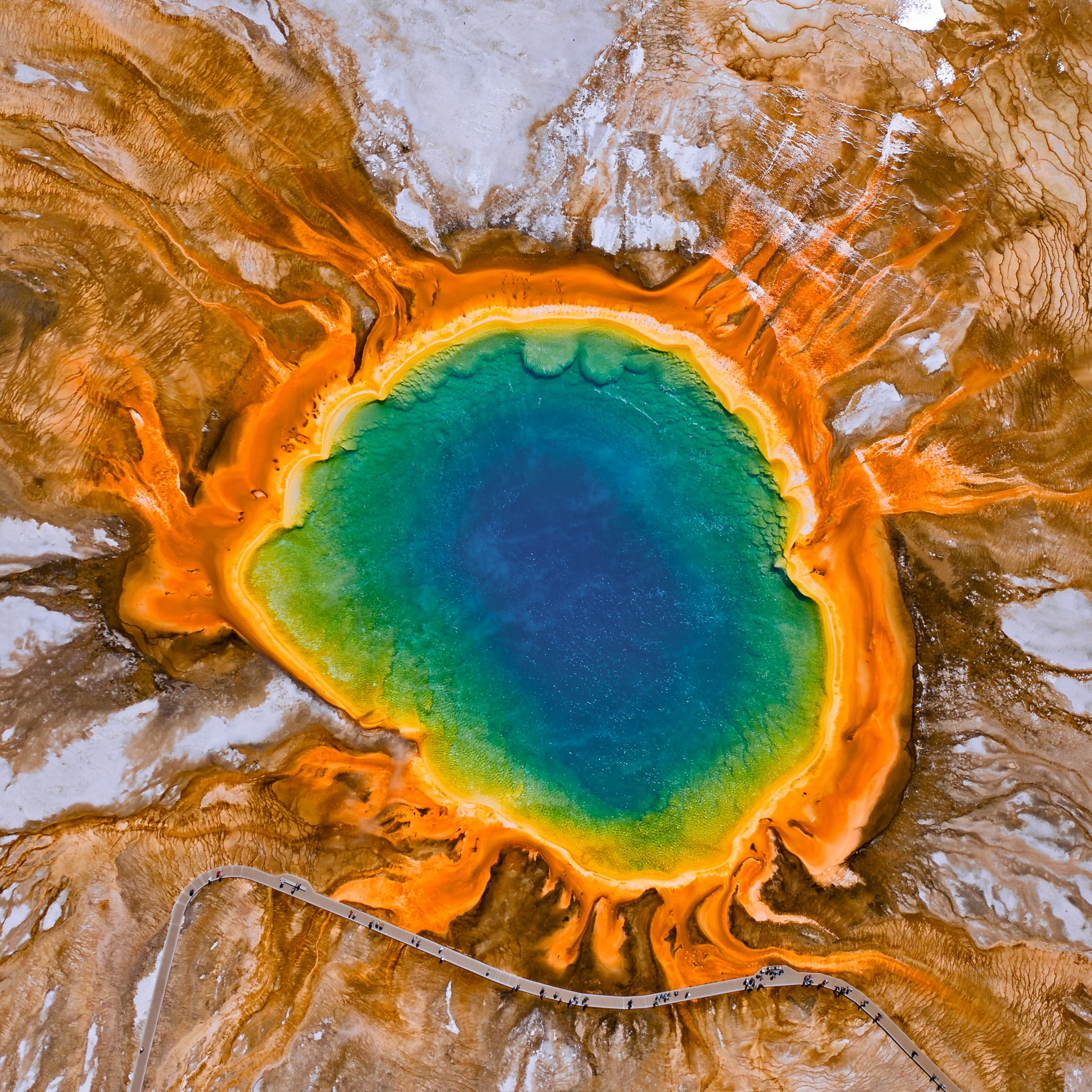
If you’re visiting the park, the Yellowstone volcano actually does pose a threat, but it's not the one you're thinking of. Hydrothermal explosions are the real deal.
These happen when superheated water trapped beneath the ground suddenly flashes to steam. No magma involved. Just a massive, localized blast of boiling water, mud, and rocks. In July 2024, a significant hydrothermal explosion occurred at Biscuit Basin. Tourists were standing right there on the boardwalk. Rocks the size of basketballs were flying through the air.
Nobody died, luckily. But it serves as a reminder: the plumbing is the problem, not the furnace.
- Biscuit Basin (2024): A dramatic reminder that the geyser basins are volatile.
- Porkchop Geyser (1989): This geyser literally blew itself up, sending rocks 220 feet away.
- Norris Geyser Basin: This is the hottest, oldest, and most dynamic of Yellowstone's thermal areas. It changes almost daily.
Is the Ground Actually Rising?
Yes. And falling.
It’s called ground deformation. The Yellowstone caldera breathes. Between 2004 and 2009, the ground rose nearly 10 inches. Then it started sinking. Then it rose again. This isn't a sign of an impending "big one." It’s usually just pressurized water and gas moving around in the hydrothermal system.
The U.S. Geological Survey (USGS) uses high-precision GPS and InSAR (Interferometric Synthetic Aperture Radar) to track these movements down to the millimeter. If the Yellowstone volcano were actually preparing for a massive magmatic event, we wouldn't just see a few inches of uplift. We would see massive, sustained deformation, thousands of small earthquakes, and significant changes in gas emissions ($SO_2$ and $CO_2$).
The 1959 Hebgen Lake Earthquake
Earthquakes are a daily occurrence in the park. Most are so small you'd never feel them. But in 1959, a magnitude 7.3 quake struck just outside the park boundary. It caused a massive landslide that buried a campground and created "Quake Lake."
While that quake was tectonic—meaning it was caused by faults, not moving magma—it shows the scale of power in the region. When people worry about the volcano, they often forget that the shifting crust is a much more immediate risk than a volcanic blast.
What Happens if it Actually Erupts?
Okay, let's play along with the "end of the world" scenario for a second, just to ground it in some science. If the Yellowstone volcano had another Category 8 eruption, it wouldn't be like a movie.
The primary issue is ash.
Not the fluffy stuff from a campfire. Volcanic ash is actually tiny shards of glass and pulverized rock. It’s heavy. It’s abrasive. It destroys car engines and collapses roofs. A massive eruption would dump inches—maybe feet—of this stuff across the Great Plains. It would wreak havoc on the U.S. electrical grid and water supplies.
But again, the math is on our side. The probability of this happening in any given year is roughly 1 in 730,000. You are significantly more likely to be struck by lightning while winning the Powerball.
Monitoring the Beast
The Yellowstone Volcano Observatory isn't just one office. It's a collaboration between the USGS, the National Park Service, and several universities (like Utah and Wyoming).
They have sensors everywhere.
- Seismometers for quakes.
- GPS for ground movement.
- Borehole strainmeters.
- Stream gauges to check the chemistry of the water leaving the park.
If something weird starts happening, they know. They’re not going to hide it. In the world of modern volcanology, it’s basically impossible to hide the signals of a large-scale magma movement. The "government cover-up" theory falls apart the moment you realize how many independent university students are looking at the same raw seismic data in real-time.
Practical Steps for Your Visit
If you're planning a trip to see the Yellowstone volcano features, don't waste your energy looking at the sky for ash clouds. Focus on the ground.
Stay on the boardwalks. Seriously. The crust in thermal areas is "eggshell thin" in places. Beneath that thin layer of silica is acidic, boiling water. Every few years, someone wanders off the path and falls through. It is a horrific way to go.
Check the YVO website before you go. They post a monthly update. It’s usually pretty dry—"Seismicity remained at background levels"—but it’s the best way to get the facts straight from the people whose job it is to know.
Bring binoculars to the Grand Canyon of the Yellowstone. You can see the distinct yellow layers of rhyolite ash and lava flows from past eruptions. It's the best way to visualize the sheer volume of material this system has moved over millions of years.
Stop worrying about the apocalypse and enjoy the steam. The fact that we have a living, breathing volcanic system accessible by a paved road is a geological miracle. Yellowstone isn't a threat to be feared as much as it is a world-class laboratory to be respected.
If you want to stay truly informed, follow the Yellowstone Volcano Observatory's "Caldera Chronicles." It's a weekly column where scientists explain everything from why Old Faithful is slowing down to how they track magma using cosmic rays. It’s the single best resource for cutting through the tabloid hype and understanding the actual science of the park.
Respect the thermal features, keep your distance from the wildlife, and remember that the ground moving an inch is just the park taking a breath.