You’ve seen the headlines. Maybe you saw that 2009 disaster movie where the ground literally turns into a tidal wave of lava. The idea of Yellowstone Park blowing up is one of those internet fixations that just won't die. It’s the ultimate "what if" scenario. People love to imagine the entire North American continent buried under three feet of ash while the sky turns black for a decade. It's cinematic. It's terrifying.
But honestly? Most of it is total nonsense. Meanwhile, you can read similar stories here: The Right to Touch the Sea.
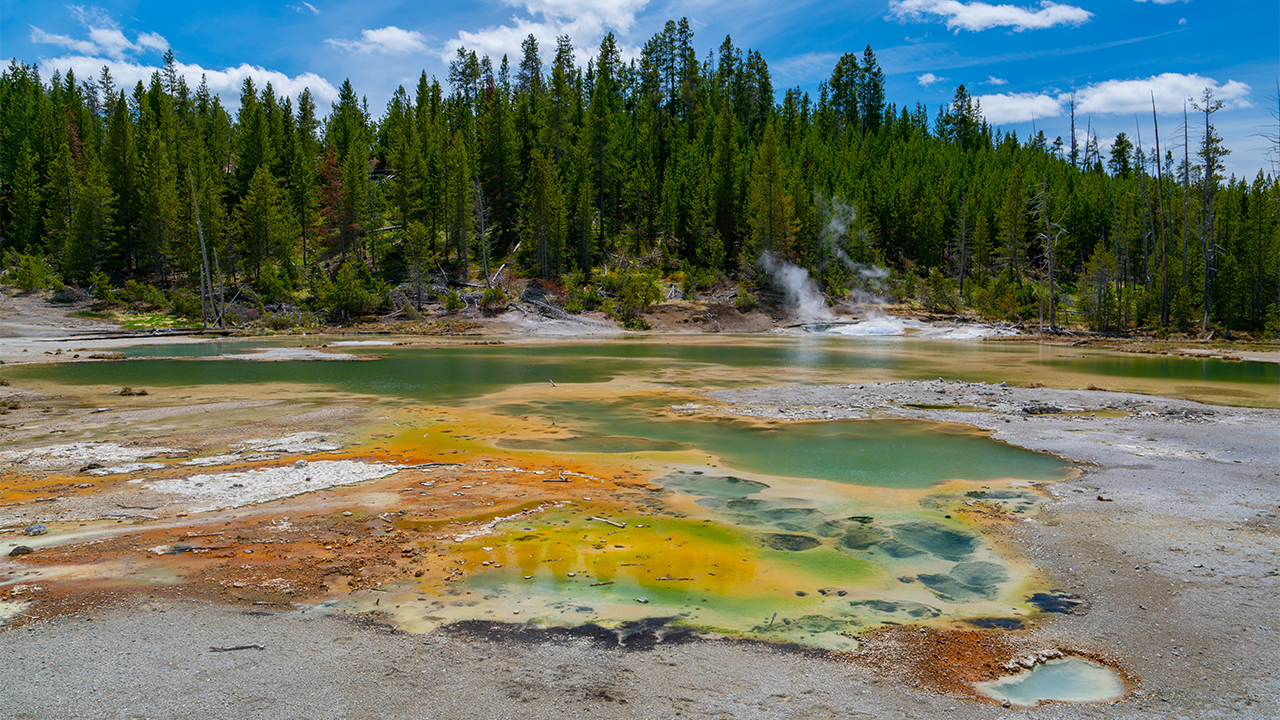
If you talk to the actual geologists at the Yellowstone Volcano Observatory (YVO), they aren't losing sleep over a cataclysmic "super-eruption." They’re much more worried about things like localized hydrothermal explosions or, frankly, tourists getting too close to a bison. The gap between the clickbait YouTube thumbnails and the actual seismic data is massive. To understand what’s actually happening beneath the Lodgepole pines and the colorful thermal pools, we have to look at the plumbing. Yellowstone isn't a ticking time bomb with a digital readout hitting zero; it’s a living, breathing geologic system that behaves nothing like a movie script.
The "Overdue" Myth is Geologic Fiction
One of the biggest arguments for Yellowstone Park blowing up any day now is the idea that it’s "overdue." You've heard the math. It erupts every 600,000 to 700,000 years, and the last one was 631,000 years ago, so we’re basically in the danger zone, right? To understand the bigger picture, we recommend the detailed report by Lonely Planet.
That’s not how volcanoes work.
Volcanoes don't follow a schedule. They don't have an alarm clock. Mike Poland, the scientist-in-charge at YVO, has spent years debunking this specific point. If you look at the three major caldera-forming eruptions—the Huckleberry Ridge eruption (2.1 million years ago), the Mesa Falls eruption (1.3 million years ago), and the Lava Creek eruption (631,000 years ago)—the math doesn't even support a regular interval. Plus, three data points is a terrible sample size for a statistical "average." It’s like saying because you ate a sandwich at noon yesterday and 1:00 PM today, you are "overdue" to eat a sandwich at 2:00 PM tomorrow. The magma chamber beneath Yellowstone is currently estimated to be only about 5% to 15% molten. For a super-eruption to occur, you generally need a much higher percentage of melt to be mobilized.
Right now, the system is mostly "mush"—a crystalline matrix that’s more like a slushy than a pressurized tank of gas.
What an actual eruption would look like
If Yellowstone were to act up, it wouldn't necessarily be a world-ending event. Most people don't realize that since the last "big one," there have been about 80 different eruptions. These weren't "blowing up" the park; they were relatively quiet lava flows.
Imagine thick, viscous rhyolite oozing out of the ground like cold peanut butter.
These flows filled in the caldera over thousands of years. They didn't send ash to New York. They didn't cause a nuclear winter. They just changed the local landscape. If the park "blows up" in our lifetime, this is the most likely scenario. It would be a disaster for the park's infrastructure, sure. Roads would melt. Old Faithful might get buried. But it wouldn't be the end of the United States.
The real danger—the stuff that actually happens frequently—are hydrothermal explosions. This is when superheated water trapped underground flashes to steam. It happens without warning. In July 2024, a significant hydrothermal explosion occurred at Biscuit Basin. It sent rocks and boiling water hundreds of feet into the air, destroying a boardwalk. Nobody was hurt, luckily. But that’s the real "Yellowstone blowing up" threat. It’s small, localized, and happens with zero seismic lead-up. It’s basically a giant pressure cooker lid popping off because a pipe got clogged with mineral deposits.
The plumbing underneath the park
The magmatic system is deeper and more complex than we thought ten years ago. Seismic tomography—basically a CAT scan for the Earth—shows two distinct magma chambers. There’s a shallow one, which we’ve known about for a while, and a much larger, deeper one in the lower crust.
- The shallow reservoir sits about 3 to 9 miles down.
- The deeper reservoir is about 12 to 30 miles down.
- The deep one is about 4.5 times larger than the shallow one.
Even with all that heat, the ground is constantly rising and falling. This is called "breathing." Scientists use GPS and InSAR (satellite radar) to measure the ground moving by centimeters every year. When people see headlines like "Yellowstone Ground Rising," they panic. In reality, the ground has been rising and falling for as long as we’ve been measuring it. It’s caused by hydrothermal fluids and gases moving around, not necessarily magma pushing its way to the surface.
Why you'd see it coming months in advance
The USGS isn't going to be surprised by Yellowstone Park blowing up. It is the most heavily monitored volcanic system on the planet. We are talking about hundreds of seismometers, tiltmeters, and GPS stations.
To get a massive eruption, you need a massive amount of precursor activity.
You wouldn't just wake up to an explosion. You’d have thousands of intense earthquakes, not just the little "swarms" that happen every year. You’d see massive, rapid ground deformation that would buckle highways. You’d see changes in gas emissions—specifically a huge spike in sulfur dioxide and carbon dioxide. This would go on for weeks, months, or even years. The idea that it could just "pop" tomorrow without warning is scientifically impossible.
We also have to consider the "hotspot" theory. The North American tectonic plate is sliding southwest over a stationary plume of heat in the mantle. This is why the older calderas are located in Idaho and Nevada. As the plate moves, the "active" zone shifts. Some geologists argue that the Yellowstone hotspot might actually be waning as it encounters the thicker crust of the Rocky Mountains. It might be running out of juice.
Misconceptions about the "Ash Cloud"
The internet loves to show maps of the "Ash Zone" covering the entire US. While a super-eruption would produce a lot of ash, the distribution depends entirely on wind patterns at the time. A study by Mastin et al. (2014) used computer modeling to show that while the Midwest would get hit hard, the impact on the coasts might be less than people fear.
The biggest issue wouldn't be getting buried; it would be the impact on the power grid and agriculture. Ash is heavy. It’s basically crushed glass. It shorts out transformers. It kills jet engines. It turns into heavy cement when it gets wet, collapsing roofs. It’s a logistical nightmare, not a literal "fire and brimstone" scenario for most of the country.
Real experts you should follow
If you want the truth, stop watching "End of the World" documentaries on cable TV. Look at the people who actually do the work.
- Dr. Michael Poland: His monthly video updates on the USGS YouTube channel are the gold standard. He’s calm, data-driven, and very good at explaining why the latest "earthquake swarm" is actually just normal tectonic settling.
- Jake Lowenstern: A former head of the YVO who has spent decades studying the geochemistry of the park.
- The University of Utah Seismograph Stations (UUSS): They track every single tremor in the park. You can literally go to their website and see the live helicorders. If the lines start going crazy and stay crazy, then you can worry.
What you should actually worry about in Yellowstone
If you’re planning a trip, don't worry about the volcano. Seriously. You are infinitely more likely to be injured by your own choices than by Yellowstone Park blowing up.
Every year, people are burned by thermal features. The water in those pools is often near boiling and can be as acidic as battery acid. Stay on the boardwalks. People also get gored by bison because they want a selfie. Bison look like big, fluffy cows, but they can outrun you and they have a very short temper. Then there are the roads. Yellowstone’s roads are narrow, winding, and filled with distracted drivers looking at bears. Car accidents are the leading cause of death in the park.
The "supervolcano" is a fascinating geologic wonder, but as a threat to your summer vacation, it’s at the bottom of the list.
Actionable insights for the curious
If you want to stay informed without the hype, here is how you should actually track the situation:
- Check the YVO Monthly Update: Every month, the USGS releases a summary of seismicity and ground deformation. If the alert level is "Green/Normal," you're fine.
- Learn to read a Seismogram: Go to the UUSS website and look at the "Webicorders." Most of the "spikes" you see are actually wind, trucks driving by, or small quakes that are perfectly normal.
- Understand "Swarms": Yellowstone has 1,000 to 3,000 earthquakes a year. Most are so small you can't feel them. They happen in clusters called swarms. This is just the earth adjusting to the heat; it’s not a sign of impending doom.
- Respect the Thermal Areas: If you see steam coming out of the ground where it wasn't before, tell a ranger. That’s a hydrothermal risk, and that’s the kind of "blowing up" that actually happens.
The park is a dynamic, changing landscape. It's supposed to be active. That’s why we have the geysers and the mud pots. Appreciate the power of the magmatic system for what it is—a spectacular display of planetary heat—rather than a looming apocalypse. The earth is very good at doing its own thing, and usually, that thing doesn't involve ending civilization on a Tuesday afternoon.