You’re driving through the Lamar Valley, eyes peeled for a grizzly or maybe one of the Junction Butte wolves, and you glance at your dashboard clock. Then you look at your phone. They don’t match. It’s a classic Yellowstone move. Most people heading into the world’s first national park worry about bear spray or snagging a campsite at Slough Creek, but the Yellowstone National Park timezone is the one thing that actually trips up your dinner reservations at the Old Faithful Inn.
It's Mountain Time.
But saying "it's Mountain Time" is kinda like saying Yellowstone is "just a park." It’s technically true, yet it misses the chaotic reality of how time actually functions when you’re standing on top of a supervolcano that spans three different states.
Yellowstone is massive. 2.2 million acres massive. Because it sits primarily in Wyoming but spills over into Montana and Idaho, you’d think there’d be a messy patchwork of time changes. Actually, the National Park Service keeps it simple by anchoring the entire park to Mountain Standard Time (MST) or Mountain Daylight Time (MDT), depending on the season.
Why the Wyoming Border Dictates Your Watch
Ninety-six percent of the park is in Wyoming. That’s the "why" behind the logic. Since the bulk of the landmass, the headquarters at Mammoth Hot Springs, and the iconic geyser basins are firmly in Wyoming territory, the park operates on Wyoming time.
Montana and Idaho are also in the Mountain Time Zone. So, if you’re driving in from Bozeman or West Yellowstone, your watch stays the same. If you’re coming from Idaho Falls, no change there either. It seems straightforward until you realize how close the Pacific Time Zone border is to the park’s western edge.
Head just a few hours west into central Idaho, and suddenly you’re losing or gaining an hour.
Travelers coming from Washington or Oregon often forget this. They hit the road at 8:00 AM, drive all day, and arrive at the West Entrance thinking they have plenty of time for a sunset boardwalk stroll, only to realize they "lost" an hour somewhere near Missoula or Salmon. It’s a frustrating way to start a vacation. Honestly, I’ve seen people miss the last seating at the Mammoth Hotel dining room because they didn't account for that invisible line.
The Daylight Saving Mess
We still do the "spring forward, fall back" dance here.
From the second Sunday in March to the first Sunday in November, Yellowstone is on Mountain Daylight Time. The rest of the year? Standard.
This matters because Yellowstone is a place dictated by light. In June, the sun stays up until nearly 10:00 PM. You can be out at Hayden Valley watching bison under a purple sky well into the evening. But in late September, the light fades fast. If you’re trying to time a geyser eruption based on a prediction from the Geyser Times app or the ranger desk, you have to be precise.
A 10-minute error doesn't just mean you missed Old Faithful; it means you’re waiting another 90 minutes in the cold.
Does Your Phone Actually Know Where It Is?
Here is the real kicker: cell service in Yellowstone is spotty at best and non-existent at worst. Your smartphone relies on pinging towers to update its internal clock. When you’re deep in the Grand Canyon of the Yellowstone or trekking toward Shoshone Lake, your phone might get "stuck" on the last time it registered.
I’ve had my phone jump back and forth between Mountain and Pacific time while hiking near the Idaho border. The phone gets confused. It searches for a signal, grabs a tower from a different region, and suddenly your alarm goes off an hour late.
Basically, don't trust your phone’s "automatic" setting.
If you have a digital watch or a dashboard clock, set it manually to Mountain Time the moment you enter the park. Lock your phone’s timezone settings to "Denver" or "Boise" instead of "Set Automatically." It sounds like a small thing, but when you're trying to catch the 6:00 AM wildlife activity in the northern range, that hour is everything.
Managing Logistics Across the Three-State Spread
People forget that Montana and Idaho aren't just tiny slivers of the park. Montana claims about 3% and Idaho about 1%. While the Yellowstone National Park timezone remains consistent across these lines, the local laws and amenities outside the gates might not feel so uniform.
- West Yellowstone, MT: The busiest gate. It’s Mountain Time.
- Gardiner, MT: The North Entrance. Mountain Time.
- Cooke City, MT: The Northeast Entrance. Mountain Time.
- Island Park, ID: Near the West Entrance. Mountain Time.
Even though you aren't changing timezones, you are changing jurisdictions. This affects things like when you can buy alcohol or when certain local businesses close. Montana and Wyoming have different vibes, different tax structures, and different ways of handling the "shoulder season."
The "Yellowstone Time" Mindset
There is a psychological element to time in the park. Experienced backpackers and photographers talk about "Yellowstone Time" as a way of life, not a setting on a Rolex.
The park doesn't care about your schedule.
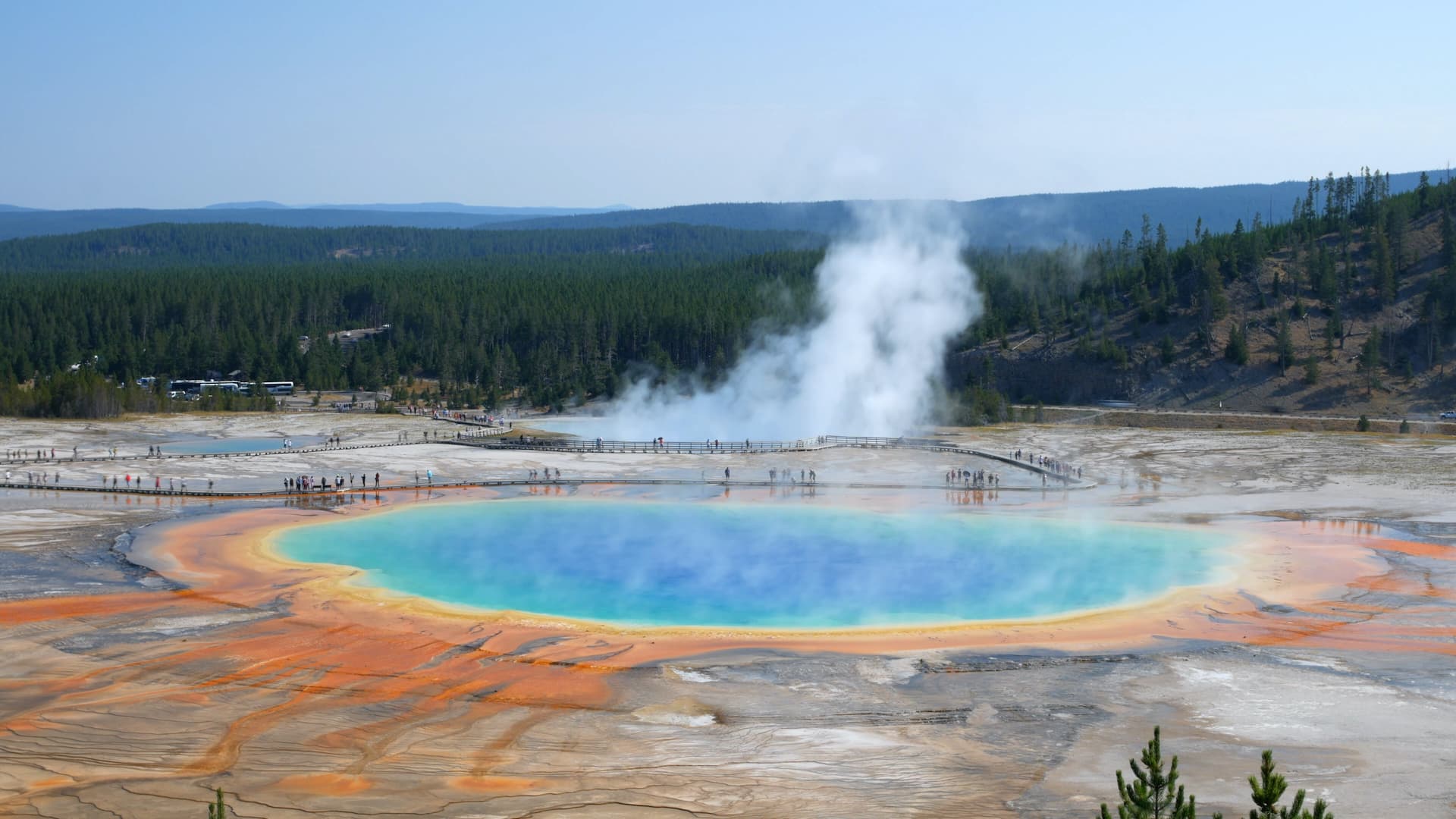
A "bison jam" in the Lamar Valley can turn a 20-minute drive into a two-hour ordeal. You might plan to see Grand Prismatic at noon when the colors are brightest, but a sudden thunderstorm moves in, and suddenly you're waiting for the steam to clear.
The timezone tells you when the visitor centers open (usually 8:00 AM or 9:00 AM), but the park tells you when you're actually going to get where you're going.
Expert Tips for Keeping Your Schedule Straight
If you’re planning a trip, there are a few hard rules to follow to ensure the Yellowstone National Park timezone doesn't ruin your plans.
First, if you are flying into Salt Lake City (SLC), you are in the Mountain Time Zone. You’re safe. If you fly into Spokane, Washington (GEG), you are in Pacific Time. You will lose an hour as you drive east toward the park.
Second, pay attention to the tour operators. If you book a guided wolf-watching trek or a snowcoach tour in the winter, those start times are sharp. They won't wait for you because your phone didn't update. They operate on "Park Time," which is Mountain Time.
Third, consider the sun. Because Yellowstone is so far north, the difference in daylight between summer and winter is radical. In the winter, the sun can set by 4:30 PM. If you’re coming from the south, this can be a shock to your system. You have to pack more into a shorter window of "usable" time.
The Idaho Anomaly
Technically, if you wander into the very southwest corner of the park—the Bechler region—you are in Idaho. This area is known as the "Cascade Corner" because of the insane number of waterfalls. It’s one of the most remote parts of Yellowstone.
Even here, in the Idaho "slice," the rangers and the maps stick to Mountain Time.
However, if you exit the park through that corner and head toward certain parts of Northern Idaho, you will eventually cross the line into Pacific Time. It’s a rare route for most tourists, usually reserved for serious backpackers, but it’s the one spot where the timezone issue becomes a physical reality you have to hike through.
Actionable Steps for Your Visit
To avoid any timezone-related headaches, do these three things the day you arrive:
- Manual Override: Go into your phone settings (Settings > General > Date & Time on iPhone) and toggle off "Set Automatically." Select "Denver" as your time zone. This prevents your phone from jumping to Pacific Time if it catches a stray signal from the west.
- The "Buffer Hour": Always add 60 minutes to any GPS estimate. A GPS might say it takes two hours to get from Canyon Village to Old Faithful. It's lying. Between traffic, animals, and slow-moving RVs, "Mountain Time" moves slower than "Real World Time."
- Sync the Group: If you’re traveling with multiple cars or a large family, make sure everyone’s watch is synced to the same source. Communication is terrible in the park, and "meet at the car at 4:00" only works if everyone agrees on what 4:00 actually is.
Yellowstone is a place where you should be looking at the geysers, not your watch. By locking in the Mountain Time Zone and ignoring the "auto" features of your tech, you can actually focus on why you’re there. The bears don’t care what time it is, and honestly, after a few days in the backcountry, you probably won't either. Just make sure you’re back at the lodge before the kitchen closes.