It happens every single summer. You're scrolling through your feed and there it is—another video of a guy in cargo shorts trying to pet a thousand-pound bison. Or maybe it’s a group of people walking off the boardwalks at Grand Prismatic Spring, their footprints scarring a delicate bacterial mat that took centuries to form. Yellowstone national park rule breaking tourists have basically become a viral subgenre of their own. People call them "tourons," a portmanteau of tourists and morons, and while the name is catchy, it highlights a massive, growing problem for the National Park Service (NPS).
It's weird, right? We have more information than ever. There are signs everywhere. Bright yellow ones with pictograms of people getting tossed into the air by horns. Yet, the rangers are busier than ever writing tickets and, unfortunately, calling for ambulances.
The Psychology of the "Perfect Photo"
Why do people do it? Honestly, a lot of it comes down to the "Disney-fication" of nature. When you grow up watching nature documentaries filmed with 800mm lenses, you expect that level of intimacy when you finally pay your entrance fee at the North Entrance. People forget that Yellowstone isn't a zoo. There are no fences between you and the grizzly bears.
Social media has poured gasoline on this fire. A decade ago, if you did something stupid in a park, maybe five people saw it. Now? If you get close enough to a bull elk to take a selfie, you might get a million views. That hits the dopamine receptors hard. The risk of a $5,000 fine or a night in a Wyoming jail seems secondary to the clout.
But it’s not just about ego. There's a genuine "herd mentality" at play. If one person steps off the boardwalk to get a better angle of an erupting geyser, three more people think it's safe. Then ten more. Suddenly, you have a crowd standing on top of a thin crust of silica that could collapse into 200°F water at any moment.
Close Encounters of the Dangerous Kind
The bison is the unofficial mascot of Yellowstone national park rule breaking tourists. They look slow. They look like big, fluffy cows. They aren't. A bison can sprint three times faster than you. They are incredibly agile and, frankly, quite grumpy during the rut.
Back in 2022, a 34-year-old man from Colorado was gored after he and his family got within 10 feet of a bison near Giant Geyser. Just a few weeks later, a 71-year-old woman was gored in the same general area. These aren't isolated incidents. The NPS mandate is clear: stay at least 100 yards away from bears and wolves, and 25 yards away from everything else.
If you're close enough to take a selfie where the animal's head is bigger than yours, you're too close. Period.
It’s not just the animals, though. The hydrothermal features are arguably more dangerous because they don't look like a threat. They look like pretty blue swimming pools. In 2016, a young man from Oregon died after walking off the boardwalk at Norris Geyser Basin. He was looking for a place to "hot pot" (soak in the thermal water). He slipped and fell into a highly acidic boiling spring. By the time rangers reached the area, the water had literally dissolved his body. It’s a grisly, horrific reality that many visitors just don't grasp when they see the steam rising from the ground.
The Impact on the Ecosystem
We talk a lot about the danger to humans, but the damage to the park is permanent.
Take the Morning Glory Pool. It used to be a brilliant, deep blue. Now it’s sort of a murky green and orange. Why? Because decades of Yellowstone national park rule breaking tourists threw "lucky" pennies, rocks, and trash into the vent. This plugged the plumbing, lowered the temperature, and allowed different types of bacteria to grow. We are literally changing the biology of the park with our garbage.
- Micro-trash (cigarette butts, gum wrappers) chokes small mammals.
- Footprints on thermal crusts destroy delicate "extremophile" bacteria.
- Feeding coyotes or ravens turns them into "beggars" that eventually have to be euthanized when they get aggressive.
Rangers often use the phrase "a fed bear is a dead bear." It's true. Once an animal associates humans with food, it stops hunting. It starts hanging out in parking lots. It starts biting. Then, the park staff has no choice but to put the animal down to protect the public. The tourist goes home with a story; the animal loses its life.
The Legal Hammer: What Happens When You Get Caught
Don't think the NPS isn't watching. They've stepped up enforcement significantly. They have undercover rangers, and they absolutely use social media to track people down after they leave the park.
If you get caught violating park regulations, you aren't just getting a "slap on the wrist." You’re likely headed to a mandatory appearance in front of a federal magistrate in Mammoth Hot Springs.
- Fines: These can easily reach $5,000 depending on the severity.
- Jail Time: People have served weeks or months for significant damage or reckless endangerment.
- Bans: You can be banned from all National Parks for life.
- Legal Fees: You'll need a lawyer, and federal court isn't cheap.
In 2021, a woman was sentenced to four days in jail and ordered to pay $2,000 because she didn't move away when a grizzly bear charged her family. She stayed to take photos. The judge made it clear: her actions weren't just a risk to herself, but to the rangers who would have had to rescue her or kill the bear.
Why the Rules Are Actually There
Rules in a place like Yellowstone aren't meant to be "fun killers." They are engineered for survival—both yours and the park's.
The boardwalks exist because the ground in thermal areas is often just a thin "pie crust" of minerals over boiling mud. You can't tell by looking at it if it's three feet thick or three millimeters thick.
The distance rules exist because animals have a "flight or fight" zone. Once you enter that zone, the animal feels threatened. A stressed animal is an unpredictable animal.
How to Actually Enjoy Yellowstone (Without Being "That Person")
You want the best experience? You’ve gotta change your mindset. Yellowstone is a place to observe, not to participate.
Buy a pair of binoculars. Seriously. A decent pair of 8x42 binoculars will give you a better view of a grizzly than you could ever get by walking toward it. If you’re into photography, invest in a 400mm or 600mm lens.
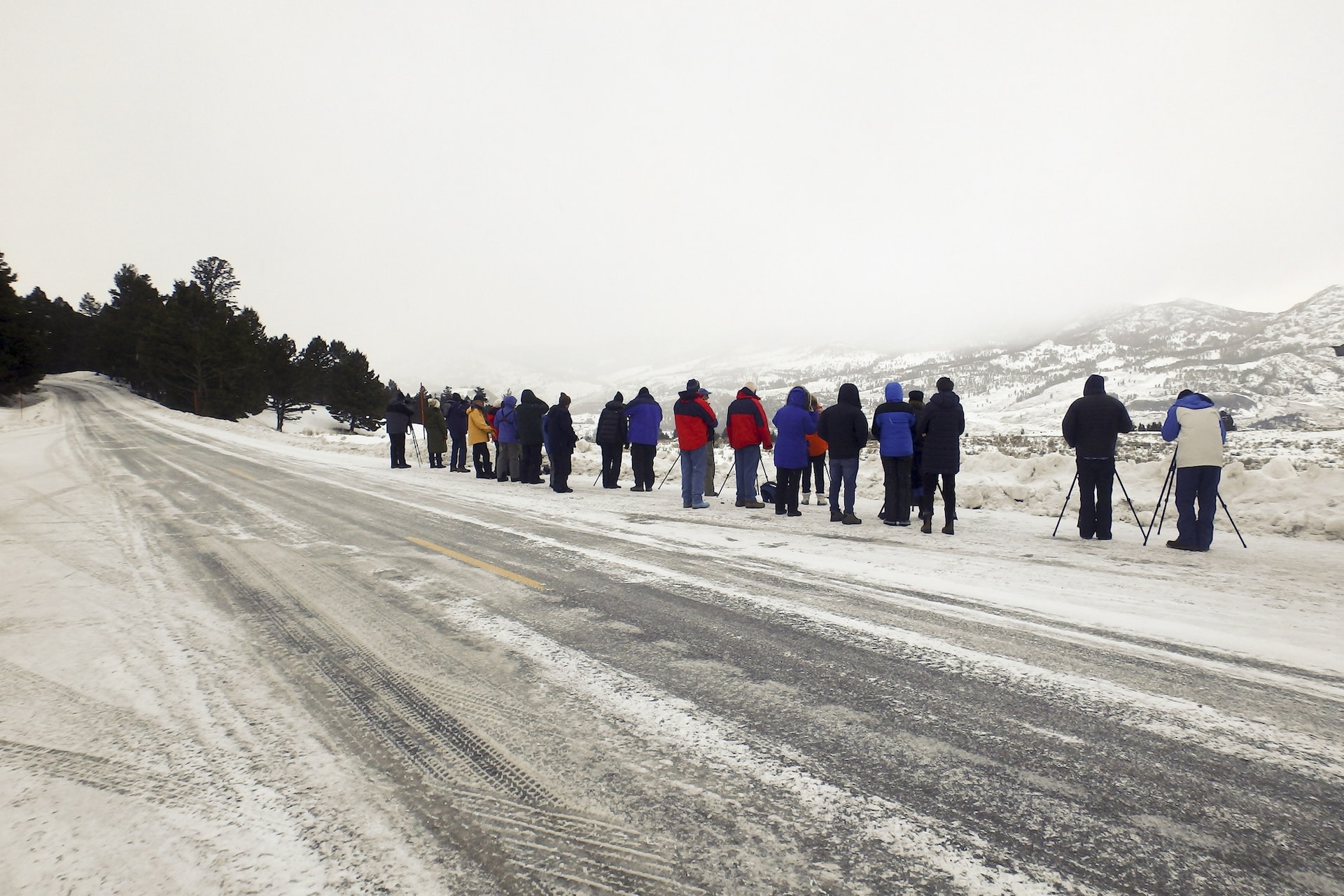
Also, timing is everything. If you want to see wildlife without the "zoo" atmosphere, get up at 4:30 AM. Be in the Lamar Valley or Hayden Valley by sunrise. You’ll see the wolves and bears doing their thing from a safe distance, often with a professional "wolf watcher" nearby who will happily let you look through their $3,000 spotting scope.
Actionable Steps for Your Next Visit
If you're planning a trip, here is how to avoid becoming the next viral video of Yellowstone national park rule breaking tourists:
Practice the "Rule of Thumb" This is the easiest way to check your distance. Stretch your arm out all the way. Close one eye and put your thumb up in front of the animal (like a bison). If your thumb completely covers the animal, you're likely at a safe distance. If you can see the animal around the edges of your thumb, you're way too close. Back up.
Download the NPS App for Offline Use Cell service is non-existent in most of the park. Download the official National Park Service app and toggle the "Save for Offline Use" button for Yellowstone. It has real-time alerts about road closures and, more importantly, clear safety guidelines for every specific area of the park.
Report Violations Discreetly If you see someone doing something dangerous or illegal, don't confront them—people can be aggressive. Take a photo or video of the incident (and their license plate if possible) and report it to the nearest ranger station or call the park's 24-hour dispatch line. Your evidence can help the NPS issue citations after the fact.
Stay on the Wood It sounds simple, but make it a personal law. If your feet aren't on asphalt or wooden planks in a thermal area, you are in the wrong. Even if you see "cool" footprints leading somewhere, don't follow them. Those footprints might be from a ranger or a researcher with specialized gear—or just another tourist who got lucky.
Pack Out Everything Even "biodegradable" stuff like orange peels or apple cores shouldn't be left behind. In Yellowstone's high-altitude climate, things decompose slowly. More importantly, it attracts wildlife to the roadsides, which leads to "animal jams" and vehicle strikes. Keep a small trash bag in your car door and empty it at the bear-proof bins at every major pullout.
Check the "Yellowstone Calendar" Wildlife behavior changes by the month. May is for bison calves (red dogs); September is for the elk rut (lots of bugling and aggression). Knowing what the animals are doing helps you predict their behavior. If it's September, give those bull elk even more than 25 yards. They are literally looking for a fight.
By following these steps, you ensure that the park remains wild and that you don't end up with a federal court date or a very expensive hospital bill. Yellowstone is one of the last truly wild places in the lower 48 states—keep it that way by respecting the boundaries.