On July 23, 2024, at approximately 9:58 a.m., a massive wall of black mud, boiling water, and jagged rock launched hundreds of feet into the air. It wasn't a volcanic eruption in the way most people fear. No lava. No global catastrophe. But for the tourists standing on the boardwalk at Biscuit Basin, the Yellowstone National Park explosion was terrifyingly real.
Black Diamond Pool basically just... blew up.
People were screaming. A father grabbed his kid. You can see it in the viral videos—the frantic dash for safety as the sky turned dark with debris. It’s the kind of thing that makes you realize just how thin the crust really is under your feet in Wyoming. Most people visit Yellowstone to see Old Faithful or some bison, but this event was a violent reminder that the park is essentially a plumbing system under extreme pressure.
Why it happened (and why it wasn’t the "Big One")
Social media went into a total meltdown after the footage hit. You probably saw the comments. "The supervolcano is waking up!" Honestly, it wasn’t. This was a hydrothermal explosion. There’s a massive difference between magma reaching the surface and what happened at Biscuit Basin.
Think of it like a pressure cooker.
In a hydrothermal system, water gets trapped in underground channels. It’s heated way past the boiling point by the magma deep below, but it stays liquid because of the weight of the water and rock above it. If that pressure suddenly drops—maybe because a silica seal breaks or an earthquake shifts something—that superheated water flashes into steam instantly. Steam takes up way more space than water.
Boom.
According to Mike Poland, the Scientist-in-Charge of the Yellowstone Volcano Observatory (YVO), these events are actually "relatively common." We just don't always catch them on camera because they usually happen in the backcountry. This one just happened to occur right next to a crowded boardwalk.
The debris field was massive
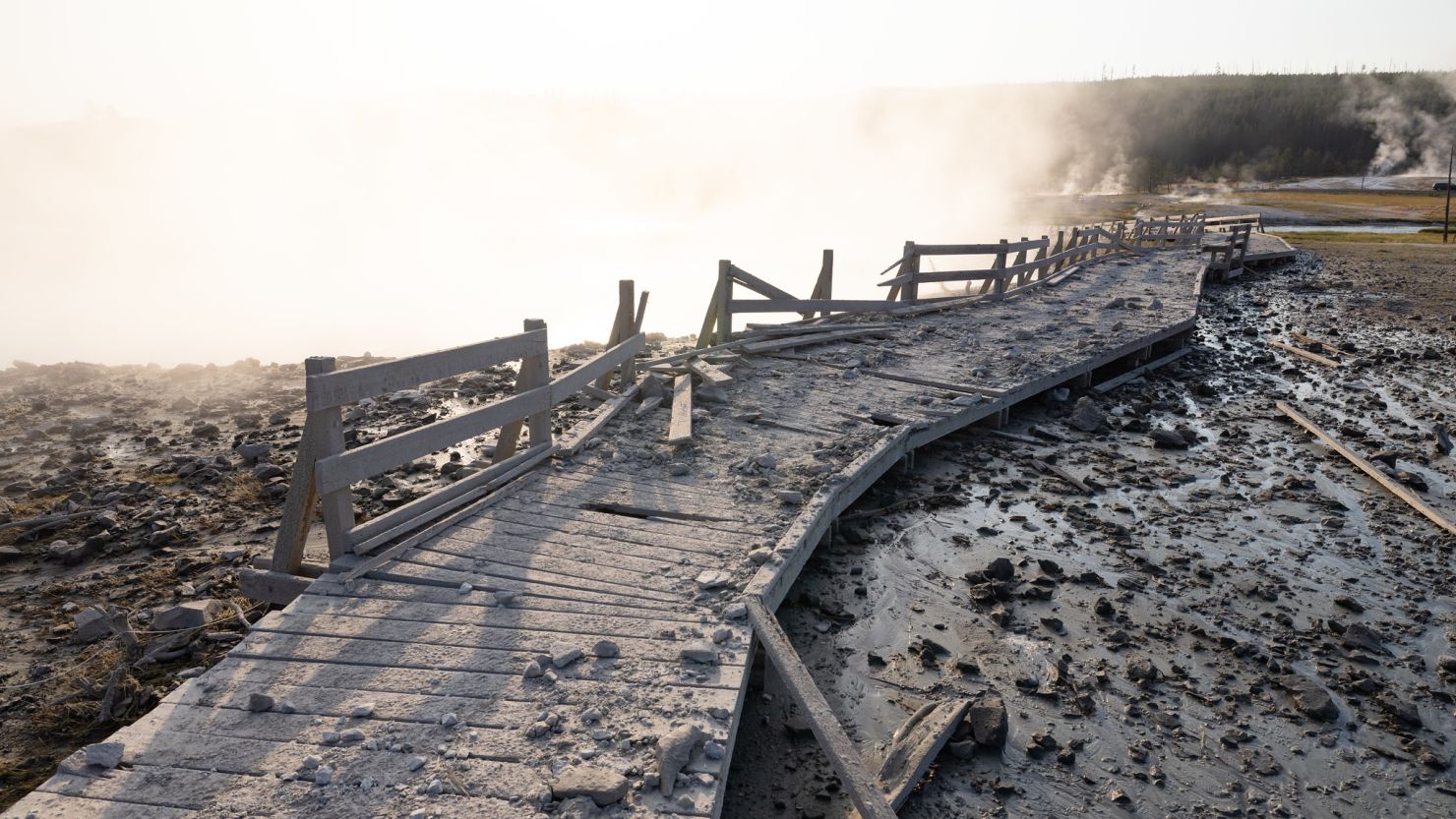
When the dust settled, the boardwalk was shredded. Geologists from the U.S. Geological Survey (USGS) and the National Park Service (NPS) arrived to find blocks of rock the size of small cars tossed around like toys. Some of these rocks weighed hundreds of pounds. If anyone had been standing ten feet closer, the outcome would have been tragic. Miraculously, nobody was hurt.
The water in Black Diamond Pool and nearby Sapphire Pool changed color. It’s kinda fascinating how the plumbing is all connected. When one vent blows, the pressure change ripples through the whole basin.
Historic context: This has happened before
We have to look back to 1989 to find the last time something this significant happened at Biscuit Basin. It was a similar event at the same spot. But if you want to talk about "big" explosions, you’ve got to look at Mary Bay or Turk Lake.
Thousands of years ago, Yellowstone saw hydrothermal explosions that left craters miles wide.
Those were gargantuan.
The 2024 Yellowstone National Park explosion was tiny by comparison, but it’s part of a much larger pattern. The park has at least 25 large craters created by these steam blasts over the last 14,000 years. It’s actually a much more immediate threat to visitors than the actual volcano erupting. You’re way more likely to get caught in a localized steam blast or burned by a hot spring than you are to see a lava flow.
The aftermath and the "new" landscape
Biscuit Basin was closed for the rest of the 2024 season. It had to be. The boardwalk was gone, and the ground was unstable. Geologists needed time to see if more explosions were coming.
When you look at the photos from the USGS flyovers, the landscape looks totally different now. Black Diamond Pool is larger. The edges are jagged. There’s a thick layer of grey silt everywhere. Nature is messy. It doesn’t care about our tourist infrastructure.
Actually, the park is constantly changing. One day a geyser is dormant, the next it’s a roaring fountain. Steamboat Geyser in the Norris Geyser Basin is a great example of this—it went decades without a major eruption and then suddenly started going off every few days. Yellowstone is a living, breathing thing.
Monitoring the "Supervolcano"
People love to freak out about the Yellowstone Supervolcano. It sells clicks. But the USGS monitors this place with a ridiculous amount of gear.
- Seismometers track the tiny tremors.
- GPS stations measure if the ground is rising or falling (uplift).
- InSAR uses satellites to map ground deformation.
- Stream gauges check the chemistry of the water.
If the volcano were actually preparing for a magmatic eruption, we wouldn't see just one pool blow up. We would see thousands of earthquakes, massive ground deformation across the entire park, and significant changes in gas emissions. None of that happened before or after the Biscuit Basin event. It was a localized "burp" in the plumbing.
What you need to know if you're visiting soon
If you're planning a trip, don't let the Yellowstone National Park explosion scare you off. It’s safe. Well, as safe as a giant geothermal field can be. But you’ve got to follow the rules. They aren't just suggestions.
Stay on the boardwalks. Seriously.
The ground in these thermal areas can be paper-thin. Underneath that "solid" looking dirt is boiling acidic water. People have died because they walked off the path and the ground collapsed under them. In 2016, a man at Norris Geyser Basin fell into a hot spring and his body was literally dissolved by the acidity before rescuers could get to him. It’s a harsh place.
Practical safety steps
- Check the NPS website: Before you head to a specific basin, check for closures. Things change fast.
- Watch the water: If a pool starts boiling violently or receding rapidly, move away.
- Listen to the rangers: They know the "mood" of the park.
- Carry bear spray: Honestly, you’re more likely to run into a grizzly than a hydrothermal blast.
The Biscuit Basin explosion was a freak event in terms of timing, but it was a completely natural part of how Yellowstone works. It’s what makes the park so special. You aren't visiting a museum; you’re visiting an active geological engine.
The weird science of "Sealing"
Why did it blow then? Scientists think it might be due to mineral deposits.
As hot water flows through the rocks, it carries dissolved silica. Over time, that silica precipitates out and forms a hard "husk" or seal. It’s like a clogged pipe. The pressure builds and builds behind that seal until it can’t hold anymore.
When that seal finally snaps, the "flash boiling" occurs. It’s a runaway reaction. The first bit of water turns to steam, which removes the weight on the water below it, which then also turns to steam. Within seconds, you have an explosion.
Interestingly, these events often happen in the summer. Some researchers wonder if the change in groundwater levels from snowmelt plays a role. It’s a complex puzzle. We’re still learning how these specific basins "breathe."
Final thoughts on the explosion
We often think we’ve "tamed" National Parks. We put up signs, build nice wooden walkways, and have gift shops. But the Yellowstone National Park explosion at Biscuit Basin proved that we are just guests. The earth does what it wants.
The event didn't signal the end of the world. It didn't mean the supervolcano is about to bury the Midwest in ash. It just meant that a very old, very hot pipe finally gave way.
Actionable Insights for Your Visit
- Download the NPS App: It has real-time alerts for road closures and thermal area updates.
- Visit early: To avoid the crowds at spots like Biscuit Basin (when it’s open), get there by 7 a.m.
- Respect the thermal features: Never throw anything into a pool. It clogs the vents and can cause pressure build-ups that lead to—you guessed it—explosions.
- Report weird activity: If you see a pool behaving strangely or a new vent opening near a trail, tell a ranger. You might be seeing the start of the next big change.
The beauty of Yellowstone is its volatility. The same forces that create the stunning blue of Sapphire Pool are the forces that blew it apart in 2024. Keep your distance, stay on the path, and enjoy the show. Just maybe keep one eye on the exit if the water starts to jump.